

In This Article
If you’ve ever finished a long Sunday ride with a dead toe, a slipping heel, or a hot spot on the outside of your foot that no amount of sock-adjusting could fix, you already know why women’s road cycling shoes exist as their own category rather than a marketing footnote. A women’s road cycling shoe isn’t simply a men’s shoe in a smaller size and a nicer colourway — it’s built on a different last, usually with a narrower heel pocket, a higher instep allowance, and a shorter overall shape to match how the average female foot is proportioned. That distinction matters more than most riders realise until they try a proper pair.

This guide pulls together seven real, currently available women’s road cycling shoes sold on Amazon UK and specialist retailers, spanning budget carbon options through to genuine race-day kit. Rather than just parroting spec sheets, every entry comes with honest analysis of who each shoe actually suits, how it compares against its closest rivals, and where the aggregated review sentiment lines up (or doesn’t) with the marketing copy. We’ll also dig into the wider questions that come up constantly in bike shop fitting rooms and cycling forums alike — the differences between women’s and unisex sizing, what a “women’s specific shoe last” genuinely changes, and how to shop smart if you’ve got a narrow heel fit that’s made every previous shoe feel like it was designed for somebody else’s foot entirely.
Whether you’re upgrading from your first pair of budget shoes, chasing marginal gains for club rides, or just tired of feet that go numb by mile twenty, there’s a shoe below built with your foot shape in mind — and a fair bit of context to help you pick the right one before you spend a single penny. If you’re newer to the sport altogether, Cycling UK’s women’s cycling resources are a genuinely useful starting point covering everything from confidence-building to kit basics.
Quick Comparison Table
| Shoe | Closure | Price Range | Best For |
|---|---|---|---|
| Shimano RC7 Women’s | Dual BOA L6Z | around £150-£190 | Serious power transfer on a mid-range budget |
| Giro Regime Women’s | Dual BOA L6 | around £120-£180 | All-round club and sportive riding |
| Specialized Women’s Torch 3.0 | BOA dial + ratchet | around £130-£160 | Narrow heel, roomy toe box |
| Bontrager Velocis Women’s | Single BOA IP1 | around £90-£140 | Long days in the saddle |
| Fizik Tempo R5 Powerstrap Women’s | Velcro Powerstrap | around £80-£110 | Narrow feet on a tighter budget |
| Van Rysel RCR | Twin rotary dials | around £160-£180 | Slim feet wanting a race-ready feel |
| dhb Aeron Carbon Road Dial | Single ATOP dial | around £70-£100 | Entry-level carbon on a budget |
Looking at the spread here, there’s a clear split between shoes built on a genuine women’s last (the Shimano RC7 Women’s, Giro Regime Women’s, Specialized Women’s Torch 3.0, and Bontrager Velocis Women’s) and unisex options that happen to run narrow enough to suit many women’s feet, such as the Van Rysel RCR. Budget doesn’t automatically mean compromise either — the dhb Aeron Carbon Road Dial proves a full carbon sole is achievable well under £100. What the table can’t show you is fit, which is exactly what the rest of this guide is for.
💬 Found the shoe that’s caught your eye already? Scroll down for the full breakdown before you commit — fit matters more than price here.
Top 7 Women’s Road Cycling Shoes: Expert Analysis
We’ve deliberately mixed genuine women’s-specific lasts with a couple of unisex shoes known for running narrow, because plenty of women end up happily riding in both. Each entry below covers real specifications, what those specifications mean on the road, and where aggregated review sentiment agrees or disagrees with the marketing.
1. Shimano RC7 Women’s — best all-round power transfer for the money
The Shimano RC7 Women’s (model SH-RC703W) borrows construction directly from Shimano’s flagship S-PHYRE range, and it shows the moment you tighten the dials. Two independent BOA L6Z dials sit over a seamless synthetic leather upper, letting you fine-tune forefoot and midfoot tension separately rather than fighting a single strap that never quite gets both zones right at once. The hollow carbon midsole is genuinely stiff — this isn’t a nylon-carbon composite dressed up in marketing language — and Shimano’s Dynalast shaping is designed to keep your ankle moving through a more efficient arc on the upstroke, which matters more on longer club runs than most riders expect.
Based on the spec sheet, this sits closer to a performance shoe than a leisure one, and the women’s-specific last (sized from a genuinely small 35 up to 44) backs that up: it’s built for riders who already know their foot shape and want serious stiffness without stepping up to a £300 flagship model. Aggregated owner feedback across retailer review sections consistently flags the fit as true to size with a snug, low-volume heel cup, though a handful of reviewers with wider forefeet have needed to size up half a size to avoid pressure across the little toe.
Pros:
- ✅ Dual BOA dials allow independent forefoot and heel tension
- ✅ Genuine carbon midsole rated for serious power transfer
- ✅ True women’s-specific sizing down to EU 35
Cons:
- ❌ Snug heel cup can feel tight for wider feet
- ❌ Limited colourways compared with rival brands
At around £150-£190 depending on retailer and colourway, the RC7 Women’s sits mid-pack for price but punches above it for stiffness, making it a strong value pick for anyone serious about their cadence.

2. Giro Regime Women’s — best women’s-specific all-rounder
Giro built the Regime Women’s as a genuinely cheaper alternative to its flagship Imperial, and the compromise is smaller than the price gap suggests. The one-piece Synchwire upper is a stitch-less, thermo-bonded construction that trades a little of the Imperial’s ultimate breathability for real durability against grit and road spray — a sensible swap for a country where “seasonal riding” usually means four seasons in one afternoon. Dual BOA L6 dials with steel laces handle the closure, distributing pressure evenly rather than cinching hardest at one point, and the carbon composite sole allows 5mm of fore-aft cleat adjustment, useful if you’re still dialling in your position.
What most buyers overlook about this model is the fit range: Giro extends the women’s last from a 36 up to a 43, wider than several rivals, which makes it a sensible first stop if you’re not sure whether you need a narrow or standard fit yet. Reviewers on independent retailer sites consistently praise the comfort-to-stiffness ratio for £120-£180 money, with several noting the shoe disappears on the foot within the first few rides — cycling shorthand for “does its job without you thinking about it.”
Pros:
- ✅ Wide women’s-specific size range from EU 36 to 43
- ✅ Reflective heel detailing genuinely helps low-light visibility
- ✅ Carbon composite sole with useful cleat adjustment range
Cons:
- ❌ Slightly heavier than the priciest carbon-only rivals
- ❌ Less breathable upper than fully perforated race shoes
Prices sit in the £120-£180 range depending on discount cycles, and given the spec-to-price ratio, this is one of the strongest all-round value picks on this list.
3. Specialized Women’s Torch 3.0 — best for a narrow heel, roomy toe box
Specialized’s Torch 3.0 is where the “women’s specific shoe last” conversation gets genuinely interesting, because the brand has been vocal about designing around narrower heels and lower-volume forefeet rather than simply shrinking a men’s mould. The construction mixes TPU and mesh across the front of the shoe with synthetic leather around the heel, which on paper reads like a compromise but in practice creates a stiffer rear cup exactly where you want lockdown, while leaving room to wiggle your toes at the front.
The FACT carbon fibre sole keeps power transfer efficient without the shoe feeling harsh underfoot, and the BOA dial paired with a Velcro strap gives you two points of adjustment rather than relying on the dial to do everything. Here’s what the spec sheet won’t tell you, but user reports do: reviewers with genuinely narrow heels consistently report this shoe locks the heel down beautifully, while a smaller number with wider feet describe more room in the toe box than they expected — useful information either way depending on which end of the spectrum your foot falls.
Pros:
- ✅ Narrower heel cup with roomier forefoot for comfort
- ✅ FACT carbon sole balances stiffness with everyday comfort
- ✅ Dual BOA dial plus Velcro strap for adjustable lockdown
Cons:
- ❌ Toe box may feel loose for genuinely narrow forefeet
- ❌ Not the lightest shoe in this price bracket
Expect to pay in the region of £130-£160, positioning it as a genuine mid-range narrow-heel specialist rather than a budget compromise.
4. Bontrager Velocis Women’s — best ergonomic last for long days
Trek’s component brand built the Velocis Women’s around what it calls the inForm Pro last, engineered specifically for an ergonomically optimised female fit rather than a resized men’s pattern. The Silver Series carbon and fibreglass composite sole rates at 10 out of 14 on Bontrager’s own stiffness index — genuinely stiff, but with a touch more give than a full carbon race sole, which several long-distance riders in aggregated reviews describe as the sweet spot for century rides and multi-day tours rather than crit racing.
A single BOA IP1 dial handles the bulk of the retention, delivering two-way micro-adjustment so you can loosen slightly mid-ride without stopping to unwind laces, and Cycling Weekly’s editorial testing awarded the standard Velocis an Editor’s Choice award, specifically praising the balance between long-distance comfort and stiffness without discomfort. The perforated synthetic upper breathes well in summer conditions but, as several reviewers note, runs a little cold once the British fog rolls in during autumn and winter months.
Pros:
- ✅ inForm Pro last engineered specifically for women’s feet
- ✅ Genuinely comfortable stiffness rating for all-day rides
- ✅ Single BOA IP1 dial simplifies on-the-move adjustment
Cons:
- ❌ Perforated upper runs cold in cooler UK conditions
- ❌ Sizing starts at EU 36, less room for very small feet
Retail prices sit around £90-£140 depending on colourway and season, making the Velocis Women’s a strong pick if your riding leans towards distance over outright speed.
5. Fizik Tempo R5 Powerstrap Women’s — best narrow fit on a budget
Fizik’s Tempo R5 Powerstrap takes a different approach to closure entirely, wrapping the foot with a Velcro strap that runs like a ribbon around the midfoot rather than pulling two flaps together in the usual way. It sounds like a small distinction, but it changes how the pressure distributes: instead of a single pinch point, the strap compresses evenly, which is precisely why aggregated reviews repeatedly flag this shoe as a strong option for narrow feet that previously slipped inside dial-closure shoes during hard efforts and out-of-the-saddle sprints.
The nylon composite outsole reinforced with carbon won’t match a full carbon race sole for outright stiffness, but for club riding and sportives it holds up well, and the trade-off buys genuine comfort over a long day. Specifications list the fit as narrow to medium, and independent retailer review sections back that up directly, with one detailed review specifically praising how securely it holds narrow feet during hard unclipping efforts where other shoes let the foot slide.
Pros:
- ✅ Powerstrap Velcro closure distributes pressure evenly
- ✅ Specifically suited to narrow to medium foot widths
- ✅ Carbon-reinforced outsole balances comfort and stiffness
Cons:
- ❌ Less outright stiffness than full carbon rivals
- ❌ Velcro closure can pick up road grit over time
Priced around £80-£110, this is arguably the best-value entry point on this list for anyone whose narrow feet have never quite settled into a dial-closure shoe.

6. Van Rysel RCR — best narrow unisex pick for slim feet
Technically unisex, Decathlon’s Van Rysel RCR earns its place here because its narrow, low-volume forefoot fit has been repeatedly called out by reviewers as running smaller and slimmer than most rivals — precisely the shape many women with narrow feet have struggled to find elsewhere. The 100% carbon sole earns a full 12 out of 12 on Van Rysel’s stiffness scale, an unusually high rating at this price point, and the twin Habu rotary dials (built in partnership with Boa’s manufacturing know-how) deliver a genuinely race-grade fit.
On paper this means near flagship-level stiffness for roughly half the price of comparable branded race shoes, and independent testing backs that up: reviewers awarded it a “best value” verdict against rivals costing considerably more. The caveat, repeated across nearly every review, is the narrow forefoot and low-volume toe box — brilliant news if that matches your foot, frustrating if it doesn’t. Sizing runs from EU 36 upward, so smaller-footed riders aren’t excluded, but this is very much a shoe to try before committing given Decathlon’s comparatively strict returns policy on worn footwear.
Pros:
- ✅ Full carbon sole rated 12/12 for stiffness at this price
- ✅ Twin rotary dials deliver a genuinely race-ready fit
- ✅ Narrow, low-volume shape suits slim feet unusually well
Cons:
- ❌ Unisex sizing rather than a true women’s-specific last
- ❌ Narrow fit unsuitable for wider or higher-volume feet
Priced around £160-£180, it undercuts most branded rivals with comparable stiffness ratings, provided the narrow shape works for your foot.
7. dhb Aeron Carbon Road Dial — best budget carbon sole
British brand dhb built its reputation on delivering performance kit without premium pricing, and the Aeron Carbon Road Dial is the footwear equivalent. A full carbon fibre sole with a 3K weave top layer is a genuine surprise at this price bracket, paired with a single ATOP dial (functionally similar to Boa) plus two supporting Velcro straps for extra security across the midfoot. Independent reviewers have specifically noted the sole quality matches shoes costing considerably more, even if it’s not the outright stiffest carbon layup on the market.
This is a unisex shoe rather than a dedicated women’s last, and reviewers note it runs generously — dhb redeveloped its fit using a different last aiming for broader compatibility across foot shapes, described as sitting closer to Giro or Fizik’s volume than a snug race last. That roominess is exactly why it suits riders with an average to slightly wider foot rather than a genuinely narrow one, and it’s worth factoring into sizing decisions if you’re used to narrower women’s-specific shoes elsewhere on this list.
Pros:
- ✅ Full carbon sole rarely seen below £100
- ✅ ATOP dial plus straps offer secure, adjustable fit
- ✅ British brand with strong reputation for value
Cons:
- ❌ Unisex last runs roomy rather than narrow
- ❌ Upper ventilation is limited compared with pricier rivals
At around £70-£100, this remains one of the most complete budget carbon shoes available, provided your foot doesn’t need a narrow, low-volume fit.
What Is a Women’s Specific Shoe Last?
A women’s specific shoe last is the three-dimensional mould a shoe is built around, shaped to reflect how the average female foot differs from the average male foot — typically a narrower heel, a higher instep, and a proportionally shorter length relative to width…
That short definition hides a fair bit of genuine biomechanics. Brands that design around dedicated women’s lasts consistently point to three recurring differences: a narrower heel and ankle relative to forefoot width, a higher instep that needs more volume across the top of the foot without adding bulk at the sides, and a wider ball of the foot proportionally compared with heel width. None of this is universal — foot shape varies enormously between individuals regardless of gender — but as a population-level pattern, it’s consistent enough that manufacturers like Giro, Specialized, Bontrager and Shimano have all invested in separate women’s lasts rather than simply offering smaller sizes of a unisex shoe.
Practically, this shows up on the road as a narrower heel fit that locks down properly instead of lifting slightly with every pedal stroke — a subtle but real source of wasted energy and hot spots over a long ride. It’s also why trying a genuine women’s-specific shoe after years in unisex sizing often feels like a revelation rather than a marginal upgrade: the heel simply stops moving.
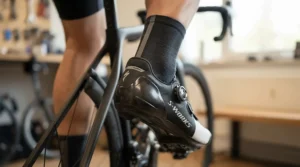
How to Choose Women’s Road Cycling Shoes
Picking the right pair comes down to matching foot shape, riding style, and budget rather than chasing the priciest option on the shelf. Here’s the process worth following:
- Measure your actual foot shape, not just length. Trace both feet on paper, noting heel width and ball width separately — most shoe-fit frustration comes from ignoring width entirely.
- Decide whether you need a genuine women’s last or a narrow unisex shoe. If your heel is narrow but your forefoot is average or wide, a shoe like the Specialized Women’s Torch 3.0 may suit better than an all-round narrow unisex option.
- Match stiffness to your riding, not your ambition. A stiffness rating in the 8-10 range, like the Bontrager Velocis Women’s, suits long sportives better than a race-day 12/12 sole that transmits every bit of road buzz.
- Consider closure type based on hand strength and dexterity. Dial systems like BOA or Habu offer finer adjustment; Velcro options such as the Fizik Tempo R5 Powerstrap Women’s are simpler and often gentler on narrow feet.
- Set a realistic budget band before you start browsing. Genuine carbon soles now start under £100 with shoes like the dhb Aeron Carbon Road Dial, so there’s rarely a need to overspend for basic stiffness.
- Check the retailer’s sizing chart against your own measurements, not just your usual size. Sizing varies noticeably between the shoes on this list, from Giro’s generous range down to Van Rysel’s narrower cut.
- Read aggregated review sentiment specifically about fit, not just star ratings. A 4.5-star average tells you little if most complaints centre on width issues that apply to your foot shape. For a wider view across the whole market, road.cc’s independently tested buyer’s guide is worth cross-referencing before you commit.
Women’s Road Shoes vs Unisex Road Shoes
This is one of the most common points of confusion for anyone buying their first serious pair of road shoes, and the honest answer is that neither option is objectively better — they’re built around different assumptions about foot shape.
| Factor | Women’s-Specific Shoes | Unisex Shoes |
|---|---|---|
| Heel fit | Narrower, designed to reduce lift | Wider, can feel loose for narrow heels |
| Sizing range | Often starts smaller (EU 35-36) | Rarely goes below EU 36 |
| Instep volume | Higher volume built into the last | Standard volume, may feel tight |
| Colour options | Frequently more varied | Often limited to unisex neutrals |
| Best For | Giro Regime Women’s, Specialized Women’s Torch 3.0 | Van Rysel RCR, dhb Aeron Carbon Road Dial |
Reading the table above, a genuine women’s last like the one used in the Giro Regime Women’s typically wins for riders whose heel is noticeably narrower than their forefoot, since the shape is built around that exact proportion rather than approximating it. Unisex shoes such as the Van Rysel RCR, however, can still work brilliantly if their overall last happens to run narrow — as the road cycling press has repeatedly noted about that particular model — so the right choice genuinely depends on trying shoes against your own foot rather than defaulting to the label on the box.
Best Women’s Road Shoes for Narrow Feet
If your heel disappears inside every shoe you’ve tried, and you’ve spent more time cinching straps than actually riding, this section is specifically for you. Women’s road shoes for narrow feet generally fall into two camps: dedicated narrow women’s lasts, and unisex shoes that happen to run slim.
In the first camp, the Specialized Women’s Torch 3.0 stands out precisely because Specialized designed the heel cup around narrower proportions while keeping the forefoot roomier, avoiding the common trap of a shoe that’s narrow everywhere and therefore uncomfortable across the toes. The Shimano RC7 Women’s offers a similarly snug heel pocket, backed by dual BOA dials that let you tighten the heel independently of the forefoot — useful if your narrow heel pairs with an average-width toe box, a combination that trips up a lot of “one-size-fits-narrow” shoes.
In the second camp, both the Van Rysel RCR and the Fizik Tempo R5 Powerstrap Women’s consistently earn praise from narrow-footed reviewers despite different approaches — one through an inherently slim unisex last, the other through a wraparound Velcro closure that compresses evenly rather than pinching at a single point. Reviewers with narrow feet specifically flagged the Fizik as solving problems with slipping during hard unclipping efforts, which is exactly the kind of practical, ride-specific detail that a spec sheet alone won’t tell you.
Common Mistakes When Buying Women’s Road Cycling Shoes
Even experienced cyclists trip up on a handful of recurring errors when shopping for new road shoes, and most of them are entirely avoidable with a bit of forethought.
The most frequent mistake is buying by length alone and ignoring width entirely, which leads directly to the narrow-heel, loose-forefoot problem described throughout this guide. A close second is assuming last season’s size will match this year’s model — brands regularly revise lasts between generations, and the Giro Regime Women’s sizing, for instance, doesn’t map identically onto Giro’s older Factor Techlace range. Buyers also frequently underestimate how much a stiffer sole changes comfort on longer rides; a race-focused 12/12 stiffness shoe like the Van Rysel RCR rewards short, hard efforts but can feel unforgiving on an all-day sportive compared with something like the Bontrager Velocis Women’s.
Another common pitfall is ignoring closure type preferences until after purchase — riders with limited hand dexterity or arthritis-related grip issues often find dial systems easier to manage mid-ride than double-strap Velcro setups, or vice versa depending on strap placement. Finally, plenty of buyers skip checking cleat compatibility entirely, assuming all road shoes work with all pedal systems; while the vast majority use a standard 3-bolt pattern compatible with Shimano SPD-SL, Look, and Time systems, it’s still worth a thirty-second check before checkout.
Real-World Scenarios: Which Women’s Road Cycling Shoes Suit Your Riding Life?
The weekend sportive rider. If you’re clocking 40-60 miles most Saturdays with a club group, comfort over five hours matters more than absolute stiffness. The Bontrager Velocis Women’s, with its 10/14 stiffness rating and genuinely ergonomic last, suits this pattern well — stiff enough to feel efficient, forgiving enough that your feet aren’t screaming by the coffee stop.
The narrow-footed commuter upgrading to road riding. If you’ve struggled with slipping heels in budget shoes and you’re riding three or four times a week on a tighter budget, the Fizik Tempo R5 Powerstrap Women’s offers a genuinely narrow fit without needing to spend £150-plus, and the Velcro closure is faster to get in and out of than fumbling with dials in cold weather before a commute.
The improving club racer chasing marginal gains. If you’re starting to enter time trials or fast club chain-gangs and want every watt transferred efficiently, either the Shimano RC7 Women’s or the Van Rysel RCR make sense depending on your heel shape — the Shimano for a true women’s last with adjustable dual-zone tension, the Van Rysel if your forefoot is narrow enough to suit its race-ready, low-volume shape at a lower price point.

Common Fit Problems and How to Solve Them
Problem: Heel lift with every pedal stroke. This is the classic sign of a shoe that’s too wide through the heel for your foot. Solution: move towards a genuine women’s-specific last like the Specialized Women’s Torch 3.0, or add a heel-lock lacing technique if your current shoe has adjustable straps positioned to allow it.
Problem: Numbness across the toes after 20-30 minutes. Usually caused by either an overly narrow toe box or cleats positioned too far forward, concentrating pressure on the metatarsals. Solution: check cleat position first — moving cleats slightly rearward often solves this without buying new shoes — and if it persists, look at shoes with a wider forefoot allowance such as the Giro Regime Women’s.
Problem: Hot spots on the outside of the foot during hard efforts. This typically points to a shoe that’s narrow overall rather than shaped to your specific proportions. Solution: a Powerstrap-style closure like the Fizik Tempo R5 Powerstrap Women’s distributes pressure more evenly than a single pinch-point dial.
Problem: Cold feet in winter despite thick socks. Highly perforated summer uppers, while excellent for ventilation, offer little insulation. Solution: pair a breathable shoe like the Bontrager Velocis Women’s with dedicated waterproof overshoes rather than assuming thicker socks alone will fix it.
Problem: Sole flex reducing power transfer on climbs. A nylon or composite sole flexing under load wastes energy that should be going into the pedals. Solution: step up to a full carbon sole such as the dhb Aeron Carbon Road Dial, which delivers genuine stiffness without the price tag of flagship carbon options.
Long-Term Cost & Maintenance
Road cycling shoes aren’t a one-off purchase in the way a jersey might be — with regular use, most riders replace them every two to four years, depending on mileage and how well they’re looked after in the meantime. Thinking in terms of cost-per-ride rather than upfront price tells a more useful story: a £180 pair of Shimano RC7 Women’s ridden three times a week for three years works out to roughly 12 pence per ride, which puts the initial outlay into proportion once you’re clocking serious miles. If your employer offers it, the UK’s Cycle to Work tax exemption scheme can also be used towards cycling safety equipment, which is worth checking before your next purchase.
Maintenance costs are modest but easy to overlook. BOA dials, as used on the Bontrager Velocis Women’s and Giro Regime Women’s, rarely need anything beyond occasional dust removal, but replacement dial units (should one fail outside warranty) typically run £15-£25 through official spares programmes. Velcro closures like those on the Fizik Tempo R5 Powerstrap Women’s need more regular cleaning since grit works into the hook-and-loop fastening over time, gradually reducing grip if ignored. Carbon soles are essentially maintenance-free structurally, but replaceable heel pads — available on several of these models — are worth swapping every year or so of regular walking-in-cleats use, at a cost of a few pounds, rather than let wear progress to the sole itself.
The genuine long-term value calculation, though, comes down to fit rather than price. A cheaper shoe that causes recurring numbness or hot spots often gets replaced within a season out of frustration, while a well-fitted pricier option, like a true women’s-specific last from Specialized Women’s Torch 3.0, tends to get ridden into the ground happily for years, which is the real definition of value here.
Features That Actually Matter (And Those That Don’t)
Actually matters: sole stiffness matched to your riding, not maximum stiffness. A 12/12 rated sole sounds impressive, but unless you’re racing regularly, something in the 8-10 range like the Bontrager Velocis Women’s often delivers a better real-world experience.
Actually matters: closure system suited to your dexterity and riding conditions. Dial systems generally offer finer adjustment; Velcro options are simpler in cold weather when fingers are stiff.
Actually matters: genuine women’s-specific lasts for narrow-heeled riders. As covered throughout this guide, this is the single biggest factor separating a shoe that disappears on your foot from one you’re constantly readjusting.
Doesn’t matter much: headline weight figures measured in single grams. The difference between a 245g and a 265g shoe is roughly the weight of a AA battery — noticeable on a spec sheet, irrelevant on the road.
Doesn’t matter much: maximum number of closure points. Two well-placed BOA dials, as on the Giro Regime Women’s, usually outperform three poorly positioned ones in terms of even pressure distribution.
Doesn’t matter much: flashy colourways and limited-edition finishes. Nice to have, but they add nothing to fit or performance, and often carry a price premium purely for exclusivity.
Road Cycling Apparel for Women: Completing the Kit
Shoes are only one part of a comfortable setup, and road cycling apparel for women has come a long way from the unisex-cut jerseys and bibs that dominated the market a decade ago. A well-fitted pair of women’s-specific bib shorts, cut with a wider hip allowance and a chamois pad shaped for female anatomy, makes as much difference to a long ride as shoe fit does — arguably more, given how much time is spent seated rather than standing on the pedals.
Look for jerseys with a shorter torso length and a more tapered waist than unisex cuts, which prevents the bunching and gaping around the midriff that plagues badly-fitted unisex kit. Base layers matter more in the UK than in drier climates, given how often a ride starts in fog and finishes in drizzle; a lightweight, moisture-wicking layer under a jersey manages temperature far better than simply adding another layer on top. Gloves deserve the same fit attention as shoes — narrower palms benefit from women’s-specific padding placement rather than a scaled-down men’s glove, which often leaves padding sitting in the wrong place entirely.
None of this needs to be bought all at once. Prioritising shoes and bib shorts first, given how directly they affect comfort and power transfer, then building out jerseys, gloves, and outerwear as budget allows, tends to deliver the biggest comfort gains per pound spent. British Cycling’s women’s pages also carry useful, ongoing guidance on kit and getting more women riding regularly.
Frequently Asked Questions
❓ Are women's road cycling shoes really different from men's?
❓ Can I wear unisex road cycling shoes if I have narrow feet?
❓ How do I know if I need a wide or narrow women's road shoe?
❓ What's the average lifespan of women's road cycling shoes?
❓ Do more expensive women's road cycling shoes always fit better?
Conclusion
Choosing between these seven women’s road cycling shoes ultimately comes down to matching your specific foot shape and riding style rather than chasing the most expensive option on the shelf. If a narrow heel has plagued every previous pair you’ve owned, the Specialized Women’s Torch 3.0 or Shimano RC7 Women’s are worth prioritising, both built around genuine women’s-specific lasts designed with that exact issue in mind. Riders logging longer, steadier miles will likely get more consistent comfort from the Bontrager Velocis Women’s, while anyone watching their budget shouldn’t overlook the surprisingly capable dhb Aeron Carbon Road Dial or the narrow-fitting Fizik Tempo R5 Powerstrap Women’s.
What matters more than any single spec on this page is trying shoes against your actual foot shape wherever possible, checking retailer sizing charts carefully, and reading aggregated review sentiment specifically about fit rather than star ratings alone. Get that right, and the shoe genuinely does disappear beneath you, leaving you free to focus on the ride rather than your feet.
✨ Ready to find your perfect fit?
Check current prices and availability on the models above before your next ride — the right pair might be closer than you think! 🚴♀️
Recommended for You
- Road Cycling Shoes Under £60: 7 Best Budget Picks (2026)
- Budget Road Cycling Shoes: 7 Best Affordable Picks (2026)
- Stiff Carbon Sole Road Shoes for Racing: 7 Best Picks (2026)
Disclaimer: This article contains affiliate links. As an Amazon Associate, I earn from qualifying purchases. If you purchase products through these links, we may earn a small commission at no additional cost to you.
✨ Found this helpful? Share it with a fellow cyclist who’s still fighting with the wrong-sized shoes!
