In This Article
Your legs might be the engine, but your feet are the gearbox — and a soggy, flexy gearbox wastes watts you’ve already paid for in pain. That’s the whole argument for stiff carbon sole road shoes for racing: a rigid platform stops your foot rolling and flexing mid-stroke, so more of what your quads produce actually reaches the pedal instead of disappearing into a squishy midsole. In plain terms, stiff carbon sole road shoes for racing are performance cycling shoes built with a rigid, full-carbon (or high-carbon-content) outsole rather than nylon or fibreglass, designed specifically to minimise energy loss during hard efforts like sprints, climbs and time trials.
We’ve spent time digging through spec sheets, manufacturer stiffness scales, and the aggregated review sentiment from UK retailers and cycling publications to bring you seven genuinely good options — from a sub-£200 giant-killer to a four-figure-adjacent Italian flagship. This isn’t a rehash of an Amazon listing page; every product below comes with commentary on who it actually suits, how it stacks up against rivals, and where your money is genuinely well spent versus where you’re paying for marginal gains that may not exist (more on that later — the stiffness debate is more interesting than the marketing suggests).
Whether you’re chasing a new personal best in a local time trial, lining up for your first crit, or simply fed up with your current shoes flexing visibly under a hard sprint, this guide covers budget, mid-range and premium options, explains what stiffness ratings actually mean, and flags the common buying mistakes that cost riders money and comfort. Let’s get into it.
Quick Comparison Table
Before the deep dive, here’s a snapshot of how our seven picks stack up on the numbers that matter most for racing: stiffness, weight, price and who each shoe is really built for.
| Shoe | Stiffness Rating | Weight (per shoe, approx.) | Price Range | Best For |
|---|---|---|---|---|
| Van Rysel RCR | 12/12 (brand scale) | ~290-315g | under £200 | Best value racer |
| Boardman Carbon Cycle Shoes | Moderate-high | ~300g | under £90 | Budget entry into carbon |
| Fizik Vento Infinito Carbon 2 | High | ~250g | £180-£230 range | All-round race/endurance |
| Sidi Shot 2 | 9.6/10 (brand scale) | ~250g | £300-£330 range | Long-term durability |
| Shimano S-Phyre RC9 | 12/12 (brand scale) | ~225g | £330-£350 range | Lightweight climbers |
| Bont Vaypor S | Very high (flat-plate) | ~230g | £300-£330 range | Wide or flat feet |
| Specialized S-Works Ares 2 | Very high | ~220g (claimed) | £450-£480 range | Sprinters and crits |
Looking across the table, there’s a genuinely useful pattern: the jump from budget to mid-range buys you meaningfully lower weight and a snugger closure system, but the jump from mid-range to flagship mostly buys marginal weight savings and closure refinement rather than dramatically more stiffness — most of these shoes are already sitting near the top of their brand’s own stiffness scale. That matters because it means a rider on a budget genuinely isn’t sacrificing race-day power transfer by choosing the Van Rysel RCR over the Specialized S-Works Ares 2; they’re sacrificing weight, closure precision and long-term durability instead.
💬 Found a shoe that looks right for you already? Scroll down to the full breakdown — or jump straight to checking today’s price.
Top 7 Stiff Carbon Sole Road Shoes for Racing: Expert Analysis
1. Van Rysel RCR — best value under £200
The Van Rysel RCR is the shoe that made a lot of established brands nervous, and for good reason — Decathlon’s in-house cycling label built a genuine 12-out-of-12 stiffness sole and sold it for a fraction of what rivals charge. The 100% carbon sole is paired with twin habu Li2 rotary dials (functionally identical to Boa’s premium Li2 system) and a reinforced mesh upper with two ventilation ports at the toe and midfoot.
On paper, that stiffness rating puts the Van Rysel RCR shoulder-to-shoulder with shoes costing twice as much, and in practice the sole genuinely doesn’t flex under hard efforts — this isn’t a marketing number that falls apart the moment you sprint. Based on the spec comparison, the compromise is fit rather than performance: the toe box runs narrow, even after Decathlon widened it by 3mm in this generation, so riders with broader forefeet should try before buying rather than ordering blind online.
Reviewers consistently report that the sole delivers genuinely excellent stiffness and that the shoe punches well above its price bracket, while flagging the narrower fit and a slightly less plush upper material as the main trade-offs. There isn’t a large enough independent long-term durability sample yet to make firm claims about how the dials hold up after several racing seasons, so we’d rather say that honestly than invent a verdict.
Pros:
- ✅ Full 12/12 stiffness rating at a fraction of flagship prices
- ✅ Precise twin rotary dial closure with micro-adjustment
- ✅ Genuinely competitive weight for the price point
Cons:
- ❌ Narrow forefoot won’t suit wider feet
- ❌ Upper material feels less premium than pricier rivals
At under £200, the Van Rysel RCR is hard to argue with on value — check current price and stock before racing season heats up.
2. Boardman Carbon Cycle Shoes — cheapest genuine carbon sole
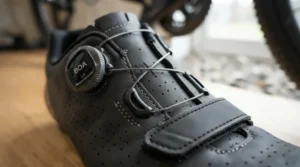
If the Van Rysel RCR is the value flagship, the Boardman Carbon Cycle Shoes are the entry ticket — a genuine carbon-soled race shoe at a price point where most competitors are still using nylon or fibreglass composites. Halfords-owned Boardman fits Atop ratchet dials rather than Boa, which keeps costs down without sacrificing much in the way of adjustability.
Here’s what the spec sheet doesn’t spell out: at this price, “carbon sole” doesn’t always mean maximum-stiffness carbon, and that’s true here too — the sole is stiff enough to feel a clear step up from entry-level synthetic soles, but the most powerful sprinters may notice some give that they wouldn’t get from a flagship shoe. That’s a reasonable trade for the price, not a flaw to be embarrassed about. Aggregated retailer and reviewer sentiment describes the construction and price as excellent value, the ventilation as generous, and the upper as noticeably supple for a budget shoe, while noting the sole stiffness sits a rung below true flagship territory.
This is the shoe we’d point a club racer or a rider doing their first few time trials towards — someone who wants the genuine efficiency benefit of a carbon platform without committing three figures before they know if racing is really their thing.
Pros:
- ✅ Genuine carbon sole at a genuinely low price
- ✅ Well-ventilated for summer racing conditions
- ✅ Comfortable, supple upper material for the price
Cons:
- ❌ Not the outright stiffest sole in a hard sprint
- ❌ Ratchet dials offer less fine-tuning than premium Boa systems
For newer racers or anyone testing the water, the Boardman Carbon Cycle Shoes remain one of the smartest under-£90 buys around — worth checking current availability given how often this model sells out.
3. Fizik Vento Infinito Carbon 2 — best all-round race and endurance shoe
The Fizik Vento Infinito Carbon 2 sits in the sweet spot between race-day stiffness and long-ride comfort, which is exactly why you’ll spot it on the feet of riders doing everything from crits to full-day sportives. Italian brand Fizik built it around a full carbon sole and a dual-Boa closure, with a slightly more generous last than some of its Italian rivals.
What most buyers overlook about this model is that Fizik designed the sole’s carbon layup specifically to balance stiffness against comfort over distance, rather than chasing the highest possible number on a stiffness scale — a sensible engineering choice for anyone who races criteriums one weekend and rides a 100-mile sportive the next. That versatility is the shoe’s whole pitch: it won’t top a pure stiffness leaderboard, but you won’t notice the difference unless you’re specifically comparing it back-to-back with a flagship sprinter’s shoe.
Reviewers commonly describe the fit as accommodating for a wider range of foot shapes than narrower Italian competitors, with the dual-dial closure praised for even pressure distribution and comfort across long stints in the saddle.
Pros:
- ✅ Comfortable enough for all-day rides, stiff enough to race in
- ✅ Dual Boa dials for precise, even tensioning
- ✅ More accommodating fit than many narrow Italian rivals
Cons:
- ❌ Not the single stiffest option if pure sprint power is your only priority
- ❌ Sits at a higher price than true budget alternatives
The Fizik Vento Infinito Carbon 2 is the shoe we’d recommend to riders who want one pair that genuinely does both racing and long training rides well — check the current price range before committing.
4. Sidi Shot 2 — Italian craftsmanship built to last seasons
Sidi has built its reputation on rebuildable, serviceable shoes rather than disposable ones, and the Sidi Shot 2 continues that tradition with a Carbon C-Boost SRS sole rated highly on the brand’s own rigidity scale, alongside Sidi’s TECNO-3 Push closure system and a Bioveg recycled microfibre upper.
Here’s the honest framing: independent, large-sample UK owner reviews specifically for this generation are still relatively thin at the time of research, so rather than inventing a rating, it’s worth noting what is verifiable — Sidi’s long track record of replaceable heel cups, soles and buckles across generations means owners have historically been able to keep a single pair race-ready for several seasons, which changes the total cost of ownership calculation considerably compared with shoes that get binned the moment a strap fails. Based on the spec comparison, the sole’s rigidity sits just below the very top of the field, but the closure precision and build quality are where this shoe earns its keep.
For a rider who hates the idea of replacing race shoes every eighteen months, that serviceability is a genuine, verifiable advantage that spec sheets alone don’t communicate.
Pros:
- ✅ Highly rated sole rigidity for genuine racing stiffness
- ✅ Replaceable components extend the shoe’s usable lifespan
- ✅ Bioveg upper is a more sustainable material choice
Cons:
- ❌ Premium price with fewer verified long-term UK owner reviews so far
- ❌ Narrower Italian last won’t suit every foot shape
If long-term value through serviceability matters to you as much as day-one stiffness, the Sidi Shot 2 is worth checking at current pricing.
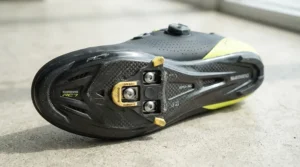
5. Shimano S-Phyre RC9 (RC903) — lightest true flagship option
Shimano’s flagship racing shoe, the Shimano S-Phyre RC9, uses a 360-degree wraparound one-piece upper construction that Shimano says sets new standards for fit, pedalling stability and stiffness — bold claims, but the 12/12 stiffness rating and roughly 225g-per-shoe weight (size 42) back it up on paper.
What the spec sheet won’t tell you outright is how that wraparound upper actually feels: because the shoe conforms to the foot rather than the other way round, fit is unusually forgiving for a race shoe this stiff, with an external heel cap that locks the rearfoot down during explosive sprints and high-cadence efforts without the usual heel-slip complaints. Reviewers and independent testers consistently rate it among the very best race shoes on the market for the combination of low weight, secure fit and closure quality, with the screw-cap dial system singled out for precise, reliable micro-adjustment.
Where this shoe genuinely shines is in efforts where every gram and every watt is being scrutinised — hill climbs, short crits, and anywhere marginal gains actually compound. It’s worth noting, though, that BikeRadar’s own back-to-back sprint testing against Shimano’s own mid-range RC502 (stiffness rating 8) found no consistent, measurable power advantage from the stiffer sole alone — a point we’ll come back to later, because it’s genuinely useful context before you spend £350 chasing a stiffness number.
Pros:
- ✅ Exceptionally light for a full-stiffness race shoe
- ✅ 360° wrap upper gives a genuinely secure, glove-like fit
- ✅ External heel cap locks the foot down during sprints
Cons:
- ❌ Among the most expensive options in this guide
- ❌ Screw-cap closure needs a moment to learn versus quick-release dials
For riders who want the benchmark flagship experience, the Shimano S-Phyre RC9 remains a genuine best-in-class option — check current pricing and available sizes before you buy.
6. Bont Vaypor S — stiffest fit for wide or flat feet
Bont builds its shoes differently to almost everyone else on this list — using a flat, low-stack thermoformable sole plate rather than a pre-curved last, which the Australian brand can heat-mould to match your individual foot shape. The Bont Vaypor S sits near the top of that range, aimed squarely at riders who’ve struggled to get a genuinely snug, hotspot-free fit from curved-last competitors.
Based on the spec comparison, the flat-plate design is the real story here: because there’s no built-in arch curve forcing your foot into a generic shape, riders with wider forefeet or flatter arches — groups who are often poorly served by narrow Italian lasts — tend to get a noticeably better fit once the shoe has been heat-moulded. Reviewers describe the finished fit as close to bespoke once heat-moulded correctly, praising the shoe’s low stack height (which keeps your foot closer to the pedal axle) alongside its genuinely stiff platform.
The trade-off is a slightly heavier build than the very lightest flagship rivals and a learning curve around the heat-moulding process itself — get that wrong and you lose much of the benefit.
Pros:
- ✅ Heat-mouldable fit suits wide or flat feet exceptionally well
- ✅ Low stack height keeps the foot close to the pedal
- ✅ Genuinely one of the stiffest platforms available
Cons:
- ❌ Heavier than the very lightest flagship competitors
- ❌ Heat-moulding needs to be done correctly to see the benefit
If standard curved lasts have never fitted your feet properly, the Bont Vaypor S is worth checking at current price before you write off stiff race shoes altogether.
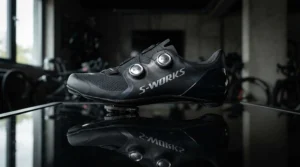
7. Specialized S-Works Ares 2 — the sprinter’s ultimate weapon
At the very top of this list sits the Specialized S-Works Ares 2, a shoe built with one very specific rider in mind: the sprinter who needs zero foot movement in the final, violent seconds of a bunch kick. Specialized’s triangular dual-Boa Li2 closure system spreads tension across the whole foot rather than concentrating it at the eyelets, and the brand claims the improved lockdown alone is worth around 7 watts thanks to better cleat positioning and reduced energy loss through the footbed.
Here’s what that watt claim actually means in practice: Specialized isn’t suggesting the sole itself got seven watts stiffer — it’s saying that a foot that isn’t sliding or rotating inside the shoe during max effort wastes less energy overall, which is a genuinely different (and more defensible) claim than most stiffness marketing you’ll read. Based on the spec comparison against the outgoing Ares, this generation prioritises lockdown security over further weight reduction, which tracks with Specialized’s stated aim of eliminating foot movement during full-gas efforts rather than shaving grams.
This is a specialist’s shoe rather than an all-rounder, and the price reflects that positioning — it’s the most expensive option here by a clear margin.
Pros:
- ✅ Best-in-class lockdown for sprinting and explosive efforts
- ✅ Triangular Boa Li2 closure spreads pressure evenly
- ✅ Genuinely race-proven at the top level of the sport
Cons:
- ❌ Premium price puts it out of reach for most club racers
- ❌ Overkill for anyone not specifically chasing sprint or crit performance
For riders whose racing lives and dies by the bunch sprint, the Specialized S-Works Ares 2 is the shoe to check current pricing on — just budget accordingly.
Full Spec Comparison: Stiffness, Weight and Value
| Shoe | Sole Material | Closure | Stiffness Rating | Price Range |
|---|---|---|---|---|
| Van Rysel RCR | 100% carbon | Twin rotary dials | 12/12 | under £200 |
| Boardman Carbon Cycle Shoes | Carbon | Ratchet dials | Moderate-high | under £90 |
| Fizik Vento Infinito Carbon 2 | Full carbon | Dual Boa | High | £180-£230 range |
| Sidi Shot 2 | Carbon C-Boost SRS | TECNO-3 Push | 9.6/10 | £300-£330 range |
| Shimano S-Phyre RC9 | Carbon | Screw-cap dial | 12/12 | £330-£350 range |
| Bont Vaypor S | Flat carbon plate | Micro-adjust dials | Very high | £300-£330 range |
| Specialized S-Works Ares 2 | Carbon | Triangular dual Boa Li2 | Very high | £450-£480 range |
The clearest takeaway from this table is that four of seven shoes here — the Van Rysel RCR, Shimano S-Phyre RC9, Bont Vaypor S and Specialized S-Works Ares 2 — are all operating at or near maximum stiffness on their respective brand scales, yet span roughly £300 in price. That gap is being sold almost entirely on weight, closure technology and fit precision rather than raw stiffness, which is genuinely worth knowing before you assume the priciest shoe is automatically the fastest one.

Practical Usage Guide: Breaking In and Maintaining Race Shoes
Buying the shoe is the easy part; getting the most out of it over a full racing season takes a bit more care than most listings mention.
Cleat position first. Before your first ride, set your cleats using the ball of your foot as a reference point — most manufacturers mark a guide line on the sole for exactly this purpose. Getting this wrong is the single most common cause of knee pain in new race shoe owners, and it’s free to fix.
Break in the closure, not the sole. Carbon soles don’t “break in” the way leather boots do — they’re rigid from day one. What does need settling is the upper and any heat-mouldable elements; if your shoe supports heat-moulding (as with the Bont Vaypor S), follow the manufacturer’s oven or heat-gun instructions to the letter, because over-heating can permanently damage the composite.
Maintenance schedule. Check dial mechanisms every few weeks for grit build-up, particularly after wet races — a stiff carbon sole is only as good as the closure keeping your foot locked to it. Replace heel and toe rubber pads as soon as they wear through to the carbon, since walking on exposed carbon accelerates sole damage and is genuinely dangerous on smooth flooring.
Common first-30-days mistake: over-tightening dials to compensate for a poor initial fit rather than sizing correctly from the start. This creates pressure hotspots that no amount of dial adjustment will fully solve — if you’re fighting the fit after three rides, it’s the wrong size or last shape, not a tension problem.
Buyer’s Decision Framework: Which Stiffness Level Do You Need?
Use this simple framework rather than defaulting to the most expensive option on the shelf:
- If you’re racing crits and bunch sprints, choose a max-stiffness flagship like the Specialized S-Works Ares 2 or Shimano S-Phyre RC9, because explosive efforts benefit most from zero sole flex and zero foot movement.
- If you’re doing club time trials and long solo efforts, choose a balanced option like the Fizik Vento Infinito Carbon 2, because comfort over sustained power output matters as much as peak stiffness.
- If you have wide or flat feet that never fit curved lasts, choose the Bont Vaypor S, because the flat, heat-mouldable plate solves a fit problem that stiffness numbers alone can’t.
- If you’re new to racing or on a tight budget, choose the Van Rysel RCR or Boardman Carbon Cycle Shoes, because you’ll get genuine carbon-sole stiffness without the flagship price tag while you find out how serious you are about the sport.
- If you want a shoe that will outlast several race seasons through serviceable parts, choose the Sidi Shot 2, because total cost of ownership over five years often beats a cheaper shoe replaced twice.
How to Choose Stiff Carbon Sole Road Shoes for Racing
Cutting through the marketing, here’s what actually matters when choosing a race shoe, in order of importance:
- Fit and last shape first. A slightly less stiff shoe that fits perfectly will out-perform the stiffest shoe on the market if the latter gives you hotspots by lap three.
- Closure system. Dual dials or a wraparound design distribute pressure more evenly than a single dial or Velcro strap, which matters more over a long race than most riders assume.
- Stiffness rating relative to your event. Sprinters and crit racers benefit most from maximum stiffness; long-distance time trialists can trade a little stiffness for comfort without losing much.
- Weight, but only after fit and closure. A 40g weight saving per shoe is genuinely marginal compared to a fit that lets you pedal efficiently for the full race distance.
- Ventilation for your climate. UK summer racing rarely hits the extremes some shoes are designed for, so don’t overpay for cooling you won’t need most of the season.
- Serviceability and spares availability. Check whether replacement heel pads, buckles or dials are sold separately before you buy — it changes the real cost over several seasons.
- Verified reviews over marketing copy. Look specifically for aggregated reviewer sentiment on fit and durability rather than a brand’s own stiffness index, which is unregulated and not directly comparable across brands.
The structural properties of carbon fibre reinforced polymer explain why this material dominates performance footwear soles in the first place — its extremely high stiffness-to-weight ratio simply isn’t matched by nylon or fibreglass composites at a comparable weight.
Racing Shoe Stiffness Ratings Explained
Every major brand publishes a racing shoe stiffness rating, but here’s the catch nobody puts on the box: these scales are proprietary and not directly comparable between manufacturers. Shimano’s 12-point scale, Bont’s own internal grading, Sidi’s 10-point rigidity scale and Van Rysel’s 12-point system are all measuring stiffness using different methodologies, so a “12” from one brand doesn’t necessarily mean the identical real-world rigidity as a “12” from another.
More surprisingly, the assumption that maximum stiffness automatically equals maximum speed has been directly challenged by biomechanics research. A University of Colorado Boulder study examining cycling shoe stiffness found that ultra-stiff soles didn’t reliably improve pedalling efficiency during moderate-intensity cycling compared with less rigid alternatives — directly undercutting a marketing claim the entire industry has leaned on for over a decade. Separately, real-world sprint testing by BikeRadar comparing a stiffness-8 shoe against a stiffness-12 flagship found no consistent, measurable power advantage from the stiffer sole in maximal sprint efforts either.
None of this means stiffness doesn’t matter at all — a genuinely soft, flexible sole clearly wastes energy, and the research still supports carbon over nylon in principle. What it means practically is that chasing the highest number on a brand’s proprietary scale, at the expense of fit and comfort, is often a false economy. A well-fitting shoe rated 9/10 will likely out-perform a poorly-fitting 12/10 flagship over a full race.
Time Trial Footwear vs Standard Road Racing Shoes
Time trial footwear shares the same core requirement as standard racing shoes — a stiff carbon platform for maximum power transfer — but the priorities shift once aerodynamics enter the equation. Dedicated TT shoes typically use a low-profile heel cup, minimal ventilation (since airflow-disrupting mesh costs watts at TT speeds), and sometimes a rear-entry design to keep the front of the shoe smoother against airflow.
For most club-level time triallists, though, a standard high-stiffness road racing shoe from this list — the Van Rysel RCR, Shimano S-Phyre RC9 or Fizik Vento Infinito Carbon 2 are all strong candidates — delivers the vast majority of the power-transfer benefit without the premium price and reduced ventilation of a dedicated TT-specific shoe. The aerodynamic gap between a standard race shoe and a purpose-built TT shoe is genuinely small in the context of total course time for anyone below national-level competition; the far bigger aero gains for most riders sit in helmet choice and body position, not footwear. Save the dedicated TT shoe purchase for once you’re chasing genuinely marginal gains at a competitive level.
The Best Carbon Sole Road Shoes Under £200
If your budget caps out below £200, you’re not settling for second-best performance — you’re simply trading away some fit refinement and closure polish, not stiffness. Both the Van Rysel RCR and Boardman Carbon Cycle Shoes deliver genuine full-carbon soles at this price point, which was genuinely rare even five years ago when sub-£200 shoes almost universally used nylon or fibreglass composites instead.
The Van Rysel RCR is the stronger pick of the two for anyone prioritising raw stiffness — its 12/12 rating matches shoes costing nearly double — while the Boardman Carbon Cycle Shoes edge it slightly on comfort and ventilation for riders who haven’t yet settled on a narrower performance fit. Reviewers consistently frame both as genuinely competitive against flagship rivals on the metrics that matter most for racing, with fit preference being the main deciding factor between them rather than outright performance.
For context on where these sit against premium alternatives, road.cc’s independent road shoe buyer’s guide has repeatedly recognised budget carbon-soled shoes as genuine value picks worth considering ahead of pricier options, rather than treating them as compromise purchases.
Getting the Best Value from Carbon Sole Road Shoes
Value isn’t simply “cheapest price” — it’s performance and durability divided by cost over the shoe’s realistic lifespan, and that calculation changes depending on how seriously and how often you race.
For a rider doing a handful of club events per season, the Van Rysel RCR or Boardman Carbon Cycle Shoes deliver excellent value because you’re not putting enough mileage through them to expose any long-term durability gap versus flagship rivals. For a rider racing weekly across a full season, the calculation shifts towards shoes with proven serviceability — this is where the Sidi Shot 2‘s replaceable components genuinely earn back some of the price premium over several seasons, since you’re not buying a whole new pair when a heel cup wears out.
The trap to avoid is buying a flagship shoe for occasional use purely for the stiffness number, then never putting in the racing volume that would justify the closure precision and fit refinement you paid for. Match the spend to your actual racing calendar, not to what the fastest rider in your club owns.
Common Mistakes When Buying Racing Shoes
A few recurring errors show up again and again in buyer feedback and forum discussions, and they’re worth flagging honestly:
- Sizing up “to be safe.” Carbon soles don’t stretch or give, so a shoe that’s slightly too big will let your foot shift under load, undoing much of the stiffness benefit you paid for.
- Ignoring cleat compatibility. Not every shoe suits every pedal system out of the box — check three-bolt compatibility and cleat adjustment range before buying, particularly if you’re switching pedal brands at the same time.
- Chasing the highest stiffness number regardless of fit. As covered above, the research doesn’t support this as a reliable strategy, yet it remains the most common reason riders end up disappointed with an expensive purchase.
- Skipping the return policy check. Cycling shoes are notoriously hard to judge from online sizing charts alone; buying from a retailer with a genuine fit-based returns policy avoids an expensive mistake.
- Forgetting cleats aren’t usually included. Several of the shoes on this list are sold without cleats, so factor that into your total budget before checking out.
What to Expect: Real-World Performance
On paper, stiffness ratings and gram counts are abstract. In practice, here’s what a genuinely stiff carbon sole feels like compared with a softer nylon composite: standing sprints feel noticeably more “connected,” with less of the vague, springy sensation you get from a flexing sole under maximum load. Climbing out of the saddle on a stiff shoe transmits torque more directly, which many riders describe as a feeling of the bike responding faster to input, even though the actual physical difference per pedal stroke is small.
Where riders are most likely to actually notice the difference is longer, sustained efforts — a 20-minute time trial effort or a long climb — rather than a single explosive sprint, simply because any small energy loss compounds over time. Comfort-wise, expect a short adjustment period moving from a flexible shoe to a rigid one; your feet are absorbing less shock through the sole, so calf and foot muscles that previously did some of that work will need a few rides to adapt.
Frequently Asked Questions
❓ What is the stiffest carbon sole road cycling shoe available in the UK?
❓ Are carbon sole road shoes worth it for racing?
❓ How much should I spend on stiff carbon sole race shoes?
❓ What stiffness rating is best for time trials and criteriums?
❓ Can I use stiff carbon sole shoes for everyday training rides too?
Conclusion
Stiff carbon sole road shoes for racing genuinely earn their reputation — a rigid platform reduces energy loss during hard efforts, and every shoe on this list delivers that core benefit in some form. But the honest, research-backed picture is more nuanced than most marketing admits: once you’re near the top of a brand’s stiffness scale, further gains come from fit, closure precision and weight rather than raw rigidity alone.
Whether that means the giant-killing value of the Van Rysel RCR, the accessible carbon entry point of the Boardman Carbon Cycle Shoes, the do-it-all versatility of the Fizik Vento Infinito Carbon 2, the long-haul durability of the Sidi Shot 2, the benchmark performance of the Shimano S-Phyre RC9, the wide-foot solution of the Bont Vaypor S, or the sprint-specific lockdown of the Specialized S-Works Ares 2 — the right choice depends on your event, your foot shape, and how often you’ll actually race in them. Get the fit right first, and the stiffness will look after itself.
Recommended for You
- Carbon Sole Road Cycling Shoes: 7 Best UK Picks (2026)
- Budget BOA Road Shoes: 7 Brilliant Picks for 2026
- BOA Dial Road Cycling Shoes: 7 Brilliant Picks for 2026
Disclaimer: This article contains affiliate links. As an Amazon Associate, I earn from qualifying purchases. If you purchase products through these links, we may earn a small commission at no additional cost to you.
✨ Found this helpful? Share it with your friends! 💬🤗
