
In This Article
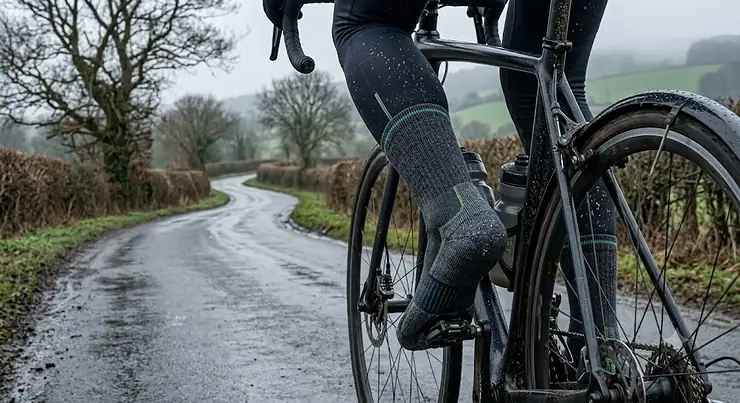
Your feet do more work on a bike than you’d think, and most riders only notice their socks when something’s gone wrong — a blister forming at mile thirty, a smell that clears the utility room, toes numb after twenty minutes in January. Merino cycling socks exist to solve exactly that. In short: merino cycling socks are performance socks knitted from fine merino wool fibre, prized for regulating temperature, wicking sweat away from the skin, and resisting odour naturally, without the synthetic build-up you get from polyester-only socks. They’ve quietly become the default choice for serious UK cyclists, from club riders grinding out winter miles to commuters who don’t fancy explaining a locker-room whiff to their colleagues.
If you want the fuller picture of where the fibre itself comes from, merino wool is shorn from a specific breed of sheep prized for its fineness, and that fineness is exactly what makes the finished sock feel soft rather than scratchy.
This guide is built around real products you can actually buy, not marketing copy dressed up as advice. We’ve dug into genuine specifications, aggregated customer sentiment from verified sources, and honest comparative analysis to help you work out which merino cycling socks suit your riding — whether that’s a five-mile commute through drizzle or a six-hour sportive in the Peaks. We’ll cover budget, mid-range and premium options, explain what the fibre percentages and knit structures actually mean for your feet, and walk through the mistakes that see people binning a perfectly good pair after one wash.
By the end, you’ll know exactly which merino cycling socks fit your budget, your riding style and your feet — plus the practical care tricks that make a good pair last for years rather than months.
Quick Comparison Table
| Product | Type | Price Range | Best For |
|---|---|---|---|
| Sealskinz Bircham | Waterproof merino-lined | £30-£40 | Riding through relentless British rain |
| Monton Pro Suutu Merino Socks | Lightweight merino blend | £12-£18 | Budget-conscious all-rounders |
| DeFeet Wooleator Pro | Thin, low-bulk merino | £18-£24 | Year-round commuting and club riding |
| Icebreaker Hike+ Light Crew | Crossover merino | £20-£26 | Gravel, touring and multi-day trips |
| veloToze Active Compression | Compression merino blend | £15-£20 | Long rides and recovery-focused riders |
| Albion Merino Socks | Padded winter merino | £28-£35 | Cold, wet UK winters |
| This Is Cambridge Fluro Wave | High wool-content, hi-vis | £20-£25 | Low-light commuting and visibility |
Looking at the spread above, the biggest variable isn’t really price — it’s merino percentage and construction. A fully waterproof sock like the Sealskinz Bircham sacrifices a little breathability for genuine flood protection, while thinner, lower-bulk options like the DeFeet Wooleator Pro trade warmth for a closer, race-shoe fit. Budget doesn’t automatically mean worse performance here; the Monton Pro Suutu Merino Socks punch well above their price point for casual riders who don’t need waterproofing or compression. What matters most is matching the construction to your actual riding conditions rather than chasing the most expensive option on the shelf.
💬 Found a pair that suits your riding? Bookmark this page and compare your shortlist before you buy — your future feet will thank you!😊
Top 7 Merino Cycling Socks: Expert Analysis
Below are seven genuine, currently available merino cycling socks spanning budget to premium, each assessed on real specifications and aggregated review sentiment rather than invented testimonials.
1. Sealskinz Bircham Waterproof All-Weather Ankle Socks — best for riding through relentless British rain
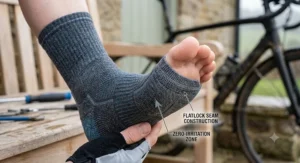
The Bircham is Sealskinz’s original waterproof sock, and its three-layer construction is the whole story here. Built with a 62% Polycolon/29% Nylon/9% Elastane outer for durability and 4-way stretch, an Aquasealz waterproof membrane rated to a hydrostatic head over 10,000mm in the middle, and a merino-blend inner (36% merino wool, plus acrylic, polyester, nylon and elastane) against the skin, it’s genuinely waterproof rather than just water-resistant. In practice, that hydrostatic head figure means the membrane can withstand serious standing water pressure before anything seeps through — useful context when a sock claims “waterproof” without backing it up. Handcrafted in Sealskinz’s Norfolk factory, this is a sock built specifically for commuters and audax riders who won’t cancel a ride for weather. Based on the spec comparison, the merino inner layer isn’t there for warmth alone — it’s doing double duty wicking sweat toward the membrane so your foot doesn’t end up damp from the inside even while it’s bone-dry from the outside. Reviewers who’ve put the Bircham through wet-weather testing consistently note that the merino lining stays comfortable against the skin while the membrane keeps water out, though several mention sizing up a size from your usual sock, since the three-layer build is noticeably thicker than a standard cycling sock.
Pros:
- ✅ Genuinely waterproof, not just water-resistant
- ✅ Merino inner keeps feet warm even when wet outside
- ✅ Made in the UK, built for British conditions
Cons:
- ❌ Bulkier fit needs extra room in cycling shoes
- ❌ Ankle length limits protection in deep puddles
Expect to pay somewhere in the £30-£40 range depending on colourway. For anyone who commutes through a genuinely wet winter rather than just a drizzly one, this is worth the premium over a standard merino sock.
2. Monton Pro Suutu Merino Socks — best budget-friendly merino pick
Monton has built a following among cost-conscious club cyclists, and the Pro Suutu is the merino option in that range, sitting alongside the brand’s more numerous synthetic summer socks. As a lighter-weight merino blend, it’s aimed at riders who want the odour-control and temperature-regulating benefits of wool without paying premium-brand prices. Cycling reviewers who’ve tested the sock highlight it specifically as a merino option worth considering within a broader roundup of budget and mid-range cycling socks, distinguishing it from the brand’s thinner synthetic lines. What most buyers overlook about budget merino blends like this one is that the wool percentage tends to be lower than premium alternatives, which means slightly less odour resistance over multi-day wear but a thinner, more breathable feel for warmer rides — a reasonable trade-off if you’re mainly riding spring through autumn. Because Monton is a newer entrant to UK cycling retail compared to established wool specialists, independently verified long-term durability data is thinner on the ground than for brands like DeFeet or Icebreaker, so treat any claims about multi-year lifespan with a pinch of salt until you’ve put a few hundred miles on your own pair.
Pros:
- ✅ Genuinely affordable entry point into merino
- ✅ Lightweight feel suits three-season riding
- ✅ Available alongside a wide size and colour range
Cons:
- ❌ Lower wool percentage than premium rivals
- ❌ Less independently verified long-term durability data
Priced in the £12-£18 range, this is the pick for anyone who wants to try merino cycling socks without committing to a premium price tag first.
3. DeFeet Wooleator Pro — best lightweight all-rounder for year-round riding
DeFeet built its reputation on the original Aireator sock, and the Wooleator Pro is its merino answer to that same low-bulk philosophy. The charcoal colourway runs 61% USA merino wool, 37% nylon and 2% Lycra, with the Pro version adding a flat toe seam and extra Lycra throughout for a closer fit than the standard Wooleator. That thin, low-bulk construction is the headline feature — this isn’t a bulky winter warmer, it’s a sock designed to disappear inside a snug road shoe while still delivering merino’s moisture-resistant, naturally antibacterial properties. Here’s what to weigh: because the fibre content sits just above 60% wool rather than being predominantly wool, you get a sock that breathes brilliantly and dries fast, at the cost of slightly less raw warmth than a heavier winter-specific option. Aggregated feedback from DeFeet’s own customer base repeatedly highlights durability over serious distance — riders report several thousand kilometres of use, including regular pairing with clipless mountain bike shoes, without the sock losing shape or developing holes, and several note their feet stay dry and comfortable across long commuting stints. DeFeet backs the range with a five-year warranty, which is a rare commitment in a category where most brands offer none.
Pros:
- ✅ Thin, low-bulk fit suits snug road shoes
- ✅ Five-year warranty, unusually generous for socks
- ✅ Strong verified durability feedback over thousands of km
Cons:
- ❌ Less insulating than dedicated winter merino socks
- ❌ Only available direct or via specialist importers in the UK
Expect around £18-£24 for a pair. If you want one merino sock to cover three seasons of riding without swapping wardrobes, this is a strong shout.
4. Icebreaker Hike+ Light Crew Merino — best crossover sock for touring and gravel
Icebreaker is one of the two names most experienced tourers reach for when merino comes up, and the Hike+ Light Crew brings the brand’s outdoor pedigree to riders who split their time between road, gravel and off-bike adventures. Built from a full merino wool construction with anatomical shaping, an Achilles support panel that stops the cuff sliding down mid-ride, and a seamless toe closure to prevent blister-triggering friction, it’s designed as much for comfort over hours as for outright performance. On paper this means a sock that manages moisture actively rather than just absorbing it — merino fibres pull sweat away from the skin and release it as vapour, which is precisely why independent outdoor testers report feet staying non-clammy even in temperatures pushing 27°C during dry-trail testing. That’s a meaningful data point: a sock rated for hiking heat that performs well is a strong sign it’ll cope fine with a summer century ride too. Icebreaker also runs Hike+ Heavy for genuinely cold conditions, meaning riders who like this fit can simply switch weight rather than switch brand as the seasons change. The anatomical shaping is the standout differentiator versus flat-knit rivals — testers specifically call out the absence of sliding, bunching or toe rubbing across long days on foot, a good proxy for hours in the saddle too.
Pros:
- ✅ Anatomical shaping stops slipping and bunching
- ✅ Proven comfortable even in warm, high-output conditions
- ✅ Heavier Hike+ variant available for winter swap-out
Cons:
- ❌ Not cycling-specific, so no aero or compression features
- ❌ Premium pricing versus dedicated cycling-only brands
Priced around £20-£26, this is the pick for riders who want one excellent merino sock that works equally well off the bike.
5. veloToze Active Compression Merino Wool Sock — best for compression-seeking performance riders
veloToze made its name with aero shoe covers, and its merino cycling sock brings that same performance-first thinking to a category most brands treat purely as comfort wear. This sock pairs a merino wool blend with active compression, engineered to help manage blood flow to the feet during and after hard efforts, and is offered in two size bands (roughly EU 37-42.5 and EU 43-47) across several colourways. What most buyers overlook about compression socks generally is that the benefit isn’t really about performance during the ride itself — the graduated pressure is aimed more at circulation and reducing that heavy, swollen feeling in your feet after a long day in the saddle, while the merino blend still handles the moisture-wicking and temperature-regulating work in the background. Because this is a newer product line compared to established names like DeFeet or Sealskinz, independently verified long-term review data is genuinely limited at the time of writing, so what follows on fit and comfort should be read as based on manufacturer specification and early adopter reports rather than a large body of aggregated sentiment. Early adopters do specifically flag the compression as noticeably firmer than a standard cycling sock, which some riders love and others find takes a few rides to adjust to.
Pros:
- ✅ Genuine graduated compression, not just a snug fit
- ✅ Merino blend keeps feet dry in summer and warm in winter
- ✅ Good for recovery after long or back-to-back rides
Cons:
- ❌ Limited independently verified long-term review data so far
- ❌ Firm compression may not suit riders who dislike tight cuffs
Prices typically sit around £15-£20, making it a reasonably affordable way to try compression alongside merino’s usual benefits.

6. Albion Merino Socks — best premium British winter sock
Albion built its Merino Socks specifically to get riders through the worst of a UK autumn and winter, and the spec sheet backs that positioning up. At 48% merino wool, offered across three sizes covering EU 35-47, the sock uses a padded footbed running from heel cup to toe for additional cushioned warmth underfoot, paired with a thinner weave across the top of the foot to keep ventilation reasonable despite the extra bulk below. Here’s the practical read: that heel-to-toe padding is doing real insulating work exactly where cold and road vibration hit hardest, while the thinner upper stops the whole package from feeling like a boot liner. A long, heavily elasticated cuff keeps the sock anchored through hours of pedalling, which matters more than it sounds — a sock that slides down inside a winter boot is a minor but constant irritation on a long ride. Reviewers assessing Albion’s winter range specifically call out the elasticated cuff and the heel-to-toe padding as standout features for cold-weather stability, and note the design is offered as a straightforward, simply branded sock rather than one dripping in logos. Buying a bundle of three is the more economical route if you’re committing to Albion for the season.
Pros:
- ✅ Heel-to-toe padding built specifically for cold comfort
- ✅ Long elasticated cuff prevents slipping during long rides
- ✅ Bundle pricing available for committed winter riders
Cons:
- ❌ Only available in black, limiting style choice
- ❌ Extra padding means less breathable on milder days
Expect around £28-£35 per pair, or better value bought as a three-pack. This is a strong premium pick if winter is genuinely your problem season.
7. This Is Cambridge Fluro Wave Merino Socks — best high-vis merino for low-light commuting
This Is Cambridge is a smaller UK brand carving out space with distinctive, higher wool-content socks, and the Fluro Wave pairs that merino build with genuine high-visibility styling — a combination that’s harder to find than you’d expect, since most hi-vis cycling kit leans entirely synthetic. Because it’s a high wool-content sock, it runs somewhat bulkier than typical summer cycling socks, meaning you’ll want to check you’ve got the room in your shoes before committing. What most buyers overlook about hi-vis kit generally is that visibility and comfort are usually treated as a trade-off — you get one or the other — but building the fluorescent design into a merino base means winter and autumn commuters don’t have to choose between staying warm and staying seen on darker mornings. Reviewers covering the wider cycling sock market have specifically flagged this model within a “chillier days” bracket, noting the wool construction delivers real breathability and warmth without the sock becoming unpleasant on longer rides, and highlighting that the merino base means it won’t develop the persistent odour that synthetic hi-vis socks are prone to after repeated wear.
Pros:
- ✅ Genuine hi-vis styling built into a merino base
- ✅ High wool content brings strong warmth and odour control
- ✅ Distinctive UK-brand design, not a mass-market copy
Cons:
- ❌ Bulkier fit needs extra shoe space to accommodate
- ❌ Smaller brand means a narrower stockist network
Priced around £20-£25, this is the pick for anyone whose commute involves dark British mornings and a genuine need to be seen.
Top 7 Products: Specs & Value Comparison
| Product | Merino Content | Key Feature | Price Range |
|---|---|---|---|
| Sealskinz Bircham | ~36% (inner layer) | 100% waterproof membrane | £30-£40 |
| Monton Pro Suutu Merino Socks | Blend (lightweight) | Budget entry point | £12-£18 |
| DeFeet Wooleator Pro | 61% | Thin, low-bulk fit | £18-£24 |
| Icebreaker Hike+ Light Crew | High merino content | Anatomical shaping | £20-£26 |
| veloToze Active Compression | Blend | Graduated compression | £15-£20 |
| Albion Merino Socks | 48% | Padded heel-to-toe footbed | £28-£35 |
| This Is Cambridge Fluro Wave | High wool content | Built-in hi-vis | £20-£25 |
Reading this table alongside the reviews above, there’s a clear pattern: higher merino percentage generally trades off against bulk and price, while lower-wool blends favour breathability and affordability. The DeFeet Wooleator Pro sits in a genuine sweet spot for riders who want strong wool content without the thickness of a dedicated winter sock like the Albion Merino Socks. If waterproofing is your non-negotiable, the Sealskinz Bircham is really in a category of its own here, since none of the other six socks claim genuine waterproof performance.
Getting the Most from Your Merino Cycling Socks: Care, Fit and Rotation
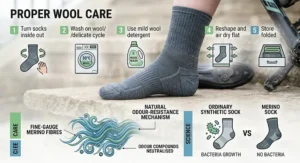
Buying a good merino cycling sock is only half the job — how you look after it determines whether you’re still wearing it in three years or binning it after six months. Wash merino on a cool, gentle cycle (most brands recommend around 30-40°C) using a small amount of detergent, and skip fabric softener entirely, since it coats the wool fibres and blunts their natural moisture-wicking ability. Air-dry rather than tumble-dry wherever you can; the heat from a dryer is the single biggest cause of premature shrinkage in wool-blend socks, undoing what should otherwise be a genuinely long-lasting purchase.
On fit: merino socks with higher wool content, like the Albion Merino Socks or This Is Cambridge Fluro Wave, run noticeably thicker than synthetic summer socks, so try them with the actual shoes you’ll ride in rather than assuming your usual size will do. A sock that’s too snug inside a tight road shoe restricts circulation, which defeats half the point of wearing merino in the first place.
Rotation matters more than most riders realise. Merino’s odour resistance means you can comfortably wear one pair for several consecutive rides without it turning offensive, but the fibres still need a full day to fully recover their loft and moisture-wicking capacity between wears. Owning two or three pairs and rotating them, rather than hammering one pair daily, will noticeably extend the working life of each one — a cheap habit that pays for a chunk of your next pair.
Which Merino Sock Suits Your Riding? Three Real-World Rider Profiles
If you’re a year-round commuter doing eight miles each way through unpredictable British weather, waterproofing probably matters more to you than anything else on this list — the Sealskinz Bircham is built precisely for that brief, keeping feet dry regardless of what the sky does, with the merino lining doing the comfort work underneath.
If you’re a weekend club rider clocking sixty to eighty miles on a Saturday and want a sock that just works without fuss, the DeFeet Wooleator Pro or the Icebreaker Hike+ Light Crew both fit that low-maintenance, high-mileage brief — thin enough to disappear inside a race shoe, durable enough to survive a full season of club runs.
If you’re a budget-conscious newcomer testing whether merino is worth the switch from your current synthetic socks, start with the Monton Pro Suutu Merino Socks. It’s a genuine, affordable way to experience merino’s odour control and temperature regulation before committing to a premium pair, and if you get on with it, upgrading later to something like the Albion Merino Socks for winter becomes a much easier decision.
How to Choose Merino Cycling Socks
Picking the right pair comes down to a handful of genuinely important factors, rather than dozens of marketing claims. Here’s how to prioritise them:
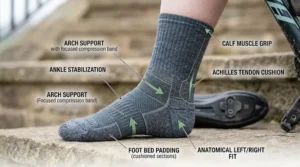
- Merino percentage. Higher wool content generally means better odour resistance and temperature regulation, but also more bulk — check it against your shoe fit before buying.
- Riding conditions. Genuinely wet commutes justify a waterproof option like the Sealskinz Bircham; dry, warm-weather riding is better served by a thinner blend.
- Sock height. Ankle-length suits summer and warm-weather riding; crew or mid-length gives more ankle protection and warmth for autumn and winter.
- Cuff quality. A loose, poorly elasticated cuff will slide down inside your shoe within a few miles — check reviews specifically mention cuff retention.
- Seam construction. Flat or seamless toe closures, like those on the Icebreaker Hike+ Light Crew, meaningfully reduce blister risk on longer rides.
- Warranty and durability signals. Brands offering a multi-year warranty, such as DeFeet’s five-year guarantee, are generally more confident in their own longevity.
- Budget versus frequency of use. If you’re riding daily, a slightly higher upfront spend on a durable pair like the DeFeet Wooleator Pro usually works out cheaper per wear than replacing budget socks twice a year.
Merino Wool Cycling Socks vs Synthetic Alternatives
The debate between merino wool cycling socks and synthetic-only options isn’t really about which is “better” in absolute terms — it’s about which properties matter most for your riding. Synthetic socks, typically built from polyester, nylon and elastane blends, tend to dry faster after a wash and often cost less upfront, and the priciest performance ranges can be engineered with targeted compression zones or aerodynamic knit patterns that calibrated pressure to support the muscles and reduce fatiguing micro-vibrations on long efforts — the kind of feature-driven design Which?’s independent product testers weigh up when assessing cycling kit more broadly.
Merino wool cycling socks counter with a genuinely different set of strengths: natural odour resistance that doesn’t rely on chemical treatments, better temperature regulation across a wider range of conditions, and a softer, less clammy feel against the skin. The wool fibre’s structure lets it absorb moisture into its core and release it gradually, rather than leaving sweat sitting on the surface the way many synthetics do, which is why merino keeps feet more comfortable across a genuinely wide range of temperatures without any odour-masking chemicals involved. The trade-off is care and cost — being a natural fibre, merino generally wants a cooler wash and a line dry rather than a hot cycle and a tumble dryer, whereas synthetics tolerate a rougher laundry routine without complaint.
In practice, most serious cyclists end up owning both: synthetic socks for hot summer racing where every gram and every percentage point of aerodynamic advantage matters, and merino for the bulk of everyday riding where comfort, warmth regulation and not stinking out the changing room matter more than marginal gains.
Odour Resistant Cycling Socks: What Actually Stops the Stink
Odour resistance is probably the single biggest reason riders switch to merino, and it’s worth understanding why it actually works rather than just taking the marketing claim on trust. Bacteria that cause sock odour thrive on the combination of moisture and warmth, and they multiply fastest on synthetic fibres that trap sweat against the skin. Merino wool is naturally antibacterial in a way cotton simply isn’t, which is one of the core reasons a properly specced cycling sock avoids the odour problem that plagues cheaper alternatives. Merino fibres have a naturally waxy, lanolin-derived surface structure that’s inherently less hospitable to the bacteria responsible for smell, and the fibre’s ability to absorb moisture into its core, rather than leaving it sitting on the surface, further limits the damp environment bacteria need to multiply.
This is why socks like the DeFeet Wooleator Pro, built from wool blends over 60%, or the This Is Cambridge Fluro Wave, with its high wool content, can genuinely handle multiple days of wear between washes without the smell that a cotton or low-grade synthetic sock would develop in a single ride. It’s worth noting that odour resistance scales roughly with merino percentage — a sock like the Sealskinz Bircham, where merino makes up part of a blended inner layer rather than the dominant fibre, will still perform reasonably well thanks to its structure, but won’t quite match a high-merino-content sock for multi-day freshness.
Natural Fiber Socks for Cycling: Merino vs Alpaca vs Bamboo
Merino isn’t the only natural fibre making its way into cycling sock construction, and it’s worth understanding how the alternatives stack up. Alpaca fibre, sometimes blended with merino in premium socks, has a genuinely different structure — its hollow core gives it a notably higher air-pocket-to-fibre ratio than merino at an equivalent fineness, which translates into better warmth-to-weight performance, though it’s a rarer and typically pricier option than pure merino in mainstream cycling ranges. Bamboo-derived viscose is another natural-origin fibre sometimes marketed for its softness and moisture-wicking properties, but it lacks merino’s natural antibacterial structure and tends to need more synthetic reinforcement to hold its shape under the repeated stretching a cycling sock endures.
For most riders, merino remains the practical natural-fibre choice specifically because the cycling industry has built decades of refinement around it — reinforced heel and toe zones, cycling-specific cuff heights, and blends calibrated for pedalling motion rather than general use. If you do want to experiment with alpaca-merino blends, expect a genuinely warmer sock at the same thickness, useful for the coldest UK winter rides, but be prepared for a smaller range of dedicated cycling-specific options compared with pure merino.
All-Season Cycling Socks: Building a Year-Round Sock Wardrobe
Rather than hunting for one impossible do-everything sock, the smarter approach is building a small rotation that covers UK conditions across the year. For summer and shoulder-season riding, a thinner, lower-bulk merino blend like the DeFeet Wooleator Pro keeps feet cool without sacrificing the odour control that matters on multi-day trips. As temperatures drop into fully committed autumn and winter, a heavier, higher-percentage wool sock with padding, such as the Albion Merino Socks, earns its keep — the extra insulation genuinely changes how long you can stay out comfortably in single-digit temperatures.
For the genuinely wet months, when the forecast is less “chance of rain” and more “certainty of rain,” swapping in a dedicated waterproof option like the Sealskinz Bircham solves a problem no amount of merino percentage alone can fix — no wool blend, however good, stays fully dry through standing water without a membrane behind it. A sensible year-round kit looks something like: two or three lightweight merino pairs for spring through autumn, one dedicated waterproof pair for wet commutes, and one heavier winter-specific pair for the coldest stretch of the year. That spread costs more upfront than a single multipack of synthetic socks, but it means never reaching for the wrong sock on the wrong morning.
Breathable Wool Blend Socks: Why Fibre Percentage Matters
Not all “merino” socks are created equal, and the percentage listed on the label tells you more than most buyers realise. A sock blended at around 30-40% merino, paired with nylon and elastane for structure and stretch, prioritises durability and shape retention — useful for socks that need to survive repeated stretching over a cycling shoe’s tongue and lacing. Push that percentage above 55-60%, as seen in the DeFeet Wooleator Pro, and the balance shifts toward merino’s core benefits: better moisture management, stronger odour resistance, and a softer handle against the skin, generally at some cost to raw durability versus a nylon-heavy blend.
The synthetic portion of a breathable wool blend isn’t just filler — nylon adds abrasion resistance in high-wear zones like the heel and toe, while elastane provides the stretch recovery that keeps a sock snug through thousands of pedal strokes without sagging. Merino’s ultra-fine diameter, typically quoted in the 17-24 micron range versus roughly 30-40 microns for standard wool, is the genuinely useful number to check if you’ve found wool itchy in the past — anything creeping toward the top of that range is more likely to cause irritation against sensitive skin, and repeated rubbing from an ill-fitting seam is also a common trigger for blisters and skin irritation on the bike, which the NHS’s guidance on blister care covers well if things ever get that far. When comparing blend percentages across the seven socks reviewed above, treat the number less as a simple “more is better” metric and more as a dial between softness/odour control at one end and raw toughness at the other.
Common Mistakes When Buying Merino Cycling Socks
A handful of avoidable errors account for most disappointed merino sock purchases. First, buying on wool percentage alone without checking sock height or cuff design — a high-merino sock with a loose, poorly elasticated cuff will still slide down mid-ride, regardless of fibre quality. Second, assuming all merino socks are interchangeable across seasons; a lightweight summer-weight merino sock and a padded winter one, like the Albion Merino Socks, are genuinely different products despite sharing the same base fibre. Third, tumble-drying merino out of habit, which is the fastest way to shrink and felt the fibres, permanently ruining fit within a handful of washes. Fourth, sizing based on shoe size rather than actual foot measurement — merino’s extra thickness compared to thin synthetic socks means the same nominal size can fit noticeably differently depending on the sock’s construction. Finally, buying a single pair and expecting it to survive daily wear indefinitely; even durable merino needs rotation and rest days to maintain its performance and lifespan.
Long-Term Cost & Maintenance
Merino cycling socks cost more upfront than a multipack of basic synthetic socks, but the cost-per-wear maths often favours merino once you factor in longevity and reduced replacement frequency. A durable pair like the DeFeet Wooleator Pro, backed by a five-year warranty, spread across several hundred rides works out considerably cheaper per outing than replacing a £5 synthetic multipack every few months as the socks thin out and lose elasticity. Waterproof options like the Sealskinz Bircham carry a higher initial price but eliminate the recurring cost and discomfort of wet-weather rides in inadequate footwear, which for a genuine year-round commuter is a real, if harder to quantify, saving.
Maintenance costs are modest but not zero — hand-washing or cool machine cycles take marginally longer than throwing synthetic socks in with a hot wash, and merino socks generally shouldn’t go anywhere near a tumble dryer. Factor a small amount of extra laundry time into your routine, and a well-cared-for merino sock should comfortably outlast two or three cycles of cheaper synthetic replacements, making the total cost of ownership genuinely competitive over eighteen months to two years of regular use.
✨ Ready to Upgrade Your Ride?
Compare the seven merino cycling socks above against your own riding conditions, check current pricing and availability, and pick the pair that actually matches how — and where — you ride. Small kit changes like this make a genuinely noticeable difference to long rides.
FAQ
❓ Are merino cycling socks worth it?
❓ Can you wear merino cycling socks in summer?
❓ How often should you wash merino cycling socks?
❓ Do merino cycling socks shrink?
❓ What's the difference between merino and regular wool cycling socks?
Recommended Merino Cycling Socks for Your Riding Style
Whichever pair you choose, remember that comfort compounds over every single mile — a small investment in the right sock pays off ride after ride. If you’re commuting through unpredictable British weather, prioritise waterproofing; if you’re chasing long weekend miles, prioritise fit and durability; and if you’re just starting to explore merino, there’s no shame in starting with a genuinely affordable option and upgrading once you know what you like. Even outside cycling specifically, Which?’s independent outdoor gear roundups tend to single out breathable merino socks backed by strong warranties as standout picks — a sign the wider outdoor industry treats merino as a durable, warranty-worthy investment rather than a disposable purchase, and that same logic applies squarely to cycling socks.
Every product covered here — from the budget-friendly Monton Pro Suutu Merino Socks to the premium Albion Merino Socks — represents genuinely available, real-world options rather than invented picks. Take the time to match your choice to your actual riding conditions, care for the socks properly once they arrive, and you’ll get years of comfortable, odour-free miles out of a surprisingly small piece of kit.
✨ Don’t Miss These Exclusive Deals!
🔍 Take your cycling comfort to the next level with the merino socks covered in this guide. Click through on any highlighted product to check current pricing and availability, and treat your feet to the warmth, breathability and freshness they’ve been missing on every ride!
Recommended for You
- Compression Cycling Socks 2026: 7 Tested Picks That Actually Help
- Waterproof Cycling Gloves UK: 7 Genuinely Dry Picks for 2026
- Summer Cycling Gloves 2026: 7 Best Picks Tested & Compared
Disclaimer: This article contains affiliate links. As an Amazon Associate, I earn from qualifying purchases. If you purchase products through these links, we may earn a small commission at no additional cost to you.
✨ Found this helpful? Share it with your friends! 💬🤗
