In This Article
Your feet touch your bike in exactly two places, and unlike your saddle, nobody talks about them at the pub after a ride. That’s a shame, because a poor pair of shoes can quietly sabotage an otherwise great bike. So what are road bike shoes, really? They’re stiff-soled, clip-in footwear designed to bolt your foot to the pedal via a cleat, transferring the power from your legs into forward motion with almost no energy lost to flex or slippage — unlike trainers, which squash and bend with every stroke.
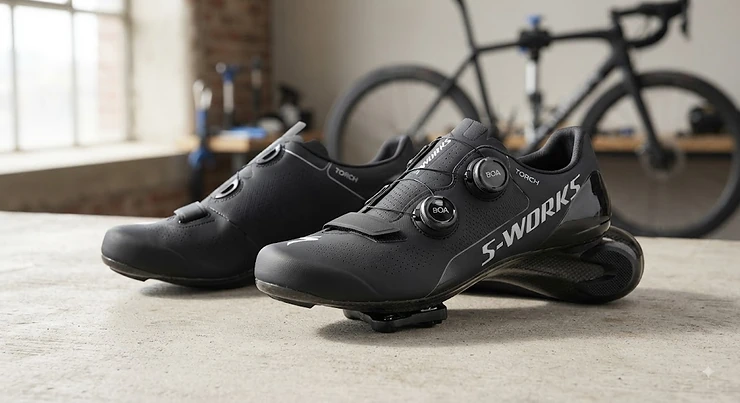
Picking from the top road bike shoes on the market in 2026 isn’t just about brand names or how flashy the colourway is. It’s about sole stiffness, closure systems, fit, and, honestly, how much of your money you’re willing to hand over for marginal gains you may never notice on a Sunday club ride. Cycling also comes with genuinely well-documented health benefits, which is one more reason to get the footwear right rather than let sore feet put you off riding altogether.
This guide covers seven real, currently available shoes spanning budget, mid-range and premium price points, alongside practical advice on setup, common mistakes, and how to buy with confidence — whether you’re commuting, racing club ten-mile time trials, or simply trying to survive your first sportive without your toes going numb at mile 40.
Quick Comparison Table
| Shoe | Price Range | Closure | Sole | Best For |
|---|---|---|---|---|
| Shimano RC300 | £75–£95 | Single BOA L6 | Glass-fibre reinforced nylon | First-time clip-in riders |
| dhb Dorica Carbon | £80–£100 | Lace-up | Full carbon | Cheapest carbon sole around |
| Specialized Torch 1.0 | £85–£110 | Single BOA L6 | Composite/carbon-reinforced | Comfort-first beginners |
| Giro Cadet | £90–£120 | BOA + hook-and-loop | Carbon-reinforced nylon | All-round beginner value |
| Fizik Tempo Overcurve R4 | £100–£140 | Single two-way BOA | Carbon-injected nylon | Mid-range daily workhorse |
| Van Rysel RCR | £170–£190 | Twin dial | 100% carbon | Race performance on a budget |
| Shimano S-Phyre RC903 | £330–£360 | Twin BOA (L6 + IP1) | Full unidirectional carbon | Racers who want the best |
The spread here tells its own story: you can get a genuinely usable clip-in shoe for well under £100, but the jump to a full carbon sole and dual dials at the top end costs roughly four times as much for a stiffness gain most club riders will never fully exploit. Notice too that price doesn’t map neatly onto quality — the dhb Dorica Carbon undercuts several rivals on price while still offering a full carbon sole, something usually reserved for shoes twice its cost. If you’re new to road cycling, the sensible starting point is the top three rows; the bottom two rows are for riders who already know exactly what they’re chasing.
💬 Found a shoe that jumps out already? Bookmark this page and compare it against our full breakdown below before you buy.🤗
Top 7 Road Bike Shoes: Expert Analysis
1. Shimano RC300 — best value first clip-in shoe
The Shimano RC300 (also badged SH-RC300 or RC3) is Shimano’s entry point into road-specific footwear, and it’s built with beginners squarely in mind. A single offset BOA L6 dial handles the wraparound perforated synthetic leather upper, while a glass-fibre reinforced nylon sole keeps the platform stable without the brittleness of a full carbon layup. In practice, this means a lighter dial tension and a larger entry target than pricier shoes — Shimano specifically designed the RC300 with a gentler clip-in feel so new riders aren’t fighting the pedal on every junction. The wide-fit version, sold alongside the standard last, is a genuine point of difference; Shimano’s own DYNALAST sizing system caters to roughly 90% of foot shapes without forcing wide-footed riders into a half-size up. Reviewers consistently note that the RC300 punches above its price for comfort and breathability, though a few mention the sole flexes noticeably more than carbon options once you start putting out serious wattage on climbs. For anyone buying their very first pair of clip-ins, that trade-off is a sensible one — you get Shimano’s fit knowledge and dealer network without flagship pricing.
Pros:
- ✅ Easy clip-in tension designed for beginners
- ✅ Wide-fit option available without upsizing
- ✅ Trusted brand with widespread UK dealer support
Cons:
- ❌ Nylon sole flexes more than carbon rivals
- ❌ Styling is fairly plain compared with rivals
At around £75–£95, the RC300 sits at genuinely accessible pricing for a shoe with proper road-cleat geometry, and it represents strong value if this is your first pair.
2. dhb Dorica Carbon — cheapest carbon sole around
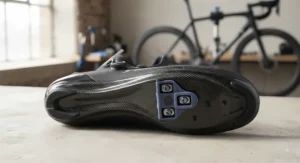
British own-brand dhb has built a loyal following by consistently undercutting the big names, and the dhb Dorica Carbon is arguably its best trick: a genuine full carbon fibre sole at a price point where most competitors are still using nylon or fibreglass composites. The lace-up closure keeps things simple — no dials to snap, nothing to recalibrate mid-ride — while the shoe’s roomy toe box accommodates wider feet better than many of its Italian-cut rivals. What most buyers overlook about a shoe this cheap is that the carbon sole isn’t a watered-down afterthought; it delivers genuinely stiff, efficient power transfer that punches well above the price tag, which is exactly why several independent test panels have rated it ahead of nylon-soled shoes costing considerably more. Reviewers consistently flag that it comes up slightly large, so sizing down is the common recommendation, and the sole can scuff faster than sturdier composite alternatives. dhb shoes are typically sold through Wiggle and Chain Reaction Cycles rather than general high-street retailers, which is worth knowing before you commit to a specific size without trying it on.
Pros:
- ✅ Full carbon sole rare at this price point
- ✅ Roomy toe box suits wider feet comfortably
- ✅ Lace-up simplicity with no dial to fail
Cons:
- ❌ Runs large — sizing down is usually needed
- ❌ Sole finish scuffs faster than pricier rivals
Priced around £80–£100, this is the shoe to recommend to anyone who wants carbon-sole stiffness without carbon-sole pricing, and on a pure cost-per-stiffness basis it’s difficult to beat.
3. Specialized Torch 1.0 — comfiest entry-level BOA fit
Specialized built its reputation on premium race shoes, and the Specialized Torch 1.0 is the brand’s attempt to trickle that expertise down to a genuinely affordable tier. A BOA L6 dial replaces the Velcro straps that used to define entry-level shoes, giving far more precise, on-the-fly micro-adjustment than a hook-and-loop strap ever could. The Body Geometry design — Specialized’s ergonomic footbed shaping, also found on its flagship S-Works shoes — aims to improve pedalling alignment and reduce hot spots over long rides, which is exactly the kind of detail that matters more the longer you’re in the saddle. Independent testing has put the Torch 1.0’s composite sole roughly on par with rivals costing £10–£20 more, and reviewers have specifically noted it out-stiffens shoes from Bontrager and Giro’s own budget tier. On the downside, the heel hold isn’t quite as locked-in as pricier options, and the stock insole is fairly basic — several testers found swapping it for an aftermarket footbed noticeably improved comfort on rides over two hours. This is a shoe for riders who want race-shoe fit language (Body Geometry, BOA) without race-shoe invoices.
Pros:
- ✅ BOA dial precision rarely seen this cheap
- ✅ Body Geometry design aids long-ride comfort
- ✅ Sole stiffness beats several pricier rivals
Cons:
- ❌ Heel retention looser than premium shoes
- ❌ Stock insole benefits from an upgrade
At roughly £85–£110, the Torch 1.0 remains one of the most complete entry-level packages around, particularly for riders who already know they’ll want a BOA dial rather than Velcro.
4. Giro Cadet — best all-rounder value with BOA
Independent lab testing tells a clear story about the Giro Cadet: its carbon-reinforced nylon sole deflected just 7.18mm under load in one widely cited test, a genuinely impressive figure for a shoe at this price and one that outperformed several rivals marketed as more “performance-oriented.” That stiffness comes from Giro’s one-piece Synchwire upper, a monofilament composite that’s thermobonded rather than stitched, paired with a single Boa L6 dial and a supporting hook-and-loop strap for extra security. What the spec sheet won’t tell you, but reviewers note, is that the stock “sport insole” is thin and quite firm, which transmits noticeably more road buzz than plusher options — fine for shorter rides, less ideal if you’re chasing all-day comfort straight out of the box. The Cadet also runs in full sizes only, and testers consistently recommend sizing down for a snugger, more supportive fit. Dual 2-bolt SPD and 3-bolt road cleat compatibility is a genuinely useful feature for anyone still deciding between road and gravel-style pedals, since it means the shoe isn’t locked into one ecosystem.
Pros:
- ✅ Sole stiffness outperforms its price bracket
- ✅ Dual SPD/road cleat compatibility for flexibility
- ✅ Boa dial offers precise 1mm adjustments
Cons:
- ❌ Stock insole transmits more road vibration
- ❌ Full sizes only — half-size buyers must choose
Sitting around £90–£120, the Cadet is repeatedly picked out by independent testers as the strongest all-round value option for riders moving beyond their very first shoe.
5. Fizik Tempo Overcurve R4 — best mid-range workhorse
The Fizik Tempo Overcurve R4 occupies the space between “cheap and cheerful” and “race-ready,” and it does so with a deliberately no-frills approach: a single two-way BOA dial instead of two, and a carbon-injected nylon sole rather than full carbon, both of which keep the cost down without gutting performance. Fizik’s Italian design pedigree shows in the shoe’s tough, lean upper, which prioritises durability and a snug wrap over ventilation-heavy mesh panelling — a sensible trade-off for riders who use one pair of shoes year-round rather than swapping between summer and winter options. Independent reviewers consistently describe it as a genuine workhorse: not the stiffest, not the lightest, but a dependable option for the average rider building fitness and mileage without racing every weekend. The one recurring criticism concerns cable-guide placement on the BOA routing, which some testers found created a pressure point on the big toe knuckle after several hours — worth trying on with your own socks before committing to a long ride. If you’re weighing this against the Torch 1.0 or Cadet, the Overcurve R4 generally offers a slightly stiffer, more race-oriented feel for a modest price step up.
Pros:
- ✅ Carbon-injected sole balances stiffness and cost
- ✅ Durable upper built for year-round use
- ✅ Dependable general-purpose performance shoe
Cons:
- ❌ Some riders report pressure at the big toe
- ❌ Less ventilated than mesh-heavy rivals
Typically priced in the £100–£140 range, the Overcurve R4 is a sensible step-up shoe for riders who’ve outgrown their first pair but aren’t ready to spend flagship money.
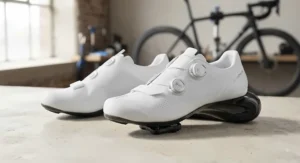
6. Van Rysel RCR — best value twin-BOA racer
Decathlon’s performance sub-brand Van Rysel built its reputation on undercutting established players, and the Van Rysel RCR is the clearest evidence yet that this isn’t just marketing. At roughly a third of the price of comparable flagship shoes, it delivers a 100% carbon sole, a twin-dial retention system using Habu’s licensed Boa-style hardware, and a wipe-clean technical mesh upper — the same broad feature set used by WorldTour pro Nans Peters at the Tour de France. On the road, independent testers have consistently struggled to find fault with the stiffness, noting the sole is “plenty rigid” for amateur use and genuinely competitive on weight at roughly 315g per shoe. What most buyers overlook is that this level of spec at this price point simply didn’t exist a few years ago — comparable twin-dial carbon shoes from bigger brands routinely cost £250–£350. The main caveat, echoed across multiple owner reviews, is fit: the RCR runs narrow and comes up long, so most riders need to size down from their usual EU size, and Decathlon’s in-store return policy for worn shoes is notably stricter than online retailers’, making an in-person try-on before buying strongly advisable.
Pros:
- ✅ Full carbon sole at a fraction of flagship price
- ✅ Twin-dial fit rivals shoes costing far more
- ✅ Genuinely competitive weight for the price
Cons:
- ❌ Narrow, long fit means sizing down is common
- ❌ Return policy is stricter for worn shoes
At around £170–£190, the RCR is the shoe that most disrupts the “you get what you pay for” assumption in this category, and it’s a genuinely strong pick for improving riders who want race-shoe performance without a race-shoe budget.
7. Shimano S-Phyre RC903 — ultimate race-day flagship
At the very top of Shimano’s range sits the Shimano S-Phyre RC903, a shoe built with essentially no compromises and priced accordingly. Its unidirectional carbon sole is rated 12 out of 12 on Shimano’s internal stiffness scale, and the shoe uses a distinctive 360-degree surround-wrapping upper — rather than closing from both sides towards a central tongue, one side wraps fully over the other, spreading tension more evenly across the foot. Two BOA dials (an L6 upper dial and an IP1 lower dial routed through what Shimano calls “Powerzone” channelling) allow genuinely independent adjustment of the forefoot and midfoot, something single-dial shoes simply can’t replicate. Reviewers across multiple independent outlets rate it as best-in-class for stiffness and heel retention, with an external heel cup lined in a grippy “cat’s tongue” fabric that virtually eliminates heel lift during hard efforts. The standard last runs slightly narrow at the toes, though a wide-fit version addresses this for a broader range of foot shapes. Ventilation is honestly described by testers as merely adequate rather than exceptional in very hot conditions — a small trade-off given how much material engineering has gone into stiffness and fit elsewhere.
Pros:
- ✅ Best-in-class stiffness and power transfer
- ✅ Independent twin-dial fit tuning across the foot
- ✅ Exceptional heel retention under hard efforts
Cons:
- ❌ Premium pricing puts it out of reach for most
- ❌ Standard fit runs narrow at the toes
Sitting around £330–£360, this is a shoe for competitive riders and racers who have already decided that marginal stiffness gains are worth the outlay — not a first purchase for anyone still finding their feet in the sport.
How to Buy Road Bike Shoes: Where and When to Spend
Knowing how to buy road bike shoes properly saves you money and, more importantly, saves you from riding in something that doesn’t fit. Sizing is the single biggest reason online cycling-shoe purchases get returned, so wherever possible, try shoes on in a shop before ordering online — even if you then buy the exact same model cheaper elsewhere afterwards. Bring the socks you’ll actually ride in, as sock thickness genuinely changes how a borderline size feels. If you’re buying online without a fitting, check the brand’s own size chart rather than relying on your usual shoe size; as this guide has shown, dhb and Van Rysel both run differently to Shimano and Giro. It’s also worth checking whether your employer offers a Cycle to Work salary sacrifice scheme, since shoes, cleats and pedals are typically eligible equipment alongside the bike itself, and buying through the scheme can meaningfully soften the cost of a mid-range or premium pair. Finally, always check current pricing directly with the retailer — prices for all seven shoes above fluctuate with stock, season and promotions, so treat every figure in this guide as a starting point for research rather than a locked-in number.
How to Choose Top Road Bike Shoes
What is the best way to choose road bike shoes? Start with fit and closure type, then work outward to sole stiffness, ventilation and weight — in that order of priority, since a stiff sole in the wrong size is worse than a slightly softer sole that fits properly. Here’s the fuller breakdown:
- Get your foot measured properly. Length and width both matter; a shoe that’s the right length but too narrow will numb your toes on longer rides.
- Decide on closure type. BOA dials offer the finest micro-adjustment and can be tweaked mid-ride; Velcro is cheaper and lighter but coarser to adjust; laces are lightest of all but can’t be loosened on the move.
- Match sole stiffness to your riding. Full carbon soles transfer more power but flex less over rough surfaces; nylon composite soles are more forgiving for commuting and longer, more relaxed rides.
- Check cleat compatibility before you buy. Most road shoes use a 3-bolt system for Shimano’s SPD-SL cleats or the LOOK-style equivalent; a handful, like the Giro Cadet, also support 2-bolt SPD pedals.
- Prioritise ventilation if you ride in summer heat, or a more enclosed upper if you’re mainly riding through a British autumn and winter.
- Weigh up wide-fit availability, since Shimano and the S-Phyre range both offer it, while several rivals only come in a single standard last.
- Set a realistic budget band rather than chasing the flagship model first — as this guide shows, the jump from £90 to £350 buys diminishing stiffness gains for most riders below competitive racing level.
Road Cycling Shoes for Beginners: What Actually Changes
Road cycling shoes for beginners don’t need to differ hugely in construction from performance shoes — most budget options above use the same fundamental sole and cleat geometry as their pricier siblings — but priorities shift considerably. New riders benefit far more from a forgiving clip-in tension and a wide-fit option than from an extra 5% of sole stiffness they won’t feel yet, which is exactly why the Shimano RC300 and Specialized Torch 1.0 were engineered the way they were. Beginners should also expect an adjustment period: clipping in and out smoothly, particularly at junctions and traffic lights, takes most riders a few weeks of deliberate practice, and it’s genuinely normal to have at least one slow-speed tip-over while your muscle memory catches up. Buying a shoe with a lighter dial tension, like the RC300, or a roomier toe box, like the dhb Dorica Carbon, removes one variable from that learning curve. It’s also worth resisting the urge to buy the stiffest, most expensive shoe available on a first purchase — sole stiffness genuinely matters most at high power outputs, and a new rider simply isn’t generating the wattage where a £350 sole outperforms a £90 one in any way you’d notice.
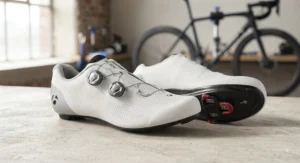
First Road Bike Setup: Getting Shoes, Cleats and Pedals Working Together
A first road bike setup only works properly when three components are chosen together rather than in isolation: shoes, cleats and pedals. Buying shoes without checking pedal compatibility is one of the most common early mistakes, since road shoes almost universally use a 3-bolt cleat mount, which is incompatible with SPD (2-bolt) pedals unless, like the Giro Cadet, the shoe specifically supports both. Once you’ve matched the systems, set your cleat’s release tension to its lowest setting for at least your first fortnight of riding — every clipless pedal has an adjustment screw for exactly this reason, and starting soft makes unclipping at junctions far less stressful. Position the cleat itself with the ball of your foot roughly over the pedal axle, a starting point most bike shops will set up for free or a small fee when you buy the shoes and pedals together. In the first thirty days, expect to make small cleat position tweaks as you settle in — knee discomfort after a ride is usually a sign the cleat angle needs adjusting rather than a sign the shoe itself is wrong. Finally, practice clipping in and out in a doorway or on grass before your first proper ride; five minutes of low-stakes practice prevents the classic beginner tip-over at the first red light.
Entry-Level Cycling Gear: What Else Belongs in Your Kit Bag
Shoes are only one piece of entry-level cycling gear, and riders often underspend elsewhere after splashing out on footwear. Padded bib shorts make a bigger difference to comfort on rides over an hour than almost any other single purchase, since saddle discomfort — not foot discomfort — is the number one reason new riders quit early. A decent pair of cycling socks, thin enough to avoid crowding a snug shoe fit, is a cheap upgrade that pays off immediately alongside any of the shoes reviewed above. If you’re commuting, a basic pair of overshoes extends the usable season of a warm-weather shoe like the dhb Dorica Carbon well into a British fog-and-drizzle autumn, delaying the need to buy a second, more expensive winter-specific pair. Multitools with a cleat-bolt-compatible hex key are worth carrying, since cleats do work loose over time and a wobbly cleat is often mistaken for a shoe problem. As mentioned above, most of this kit — shoes included — typically qualifies under workplace Cycle to Work schemes, which is worth factoring into a first-season budget rather than buying everything at full price in one go.
Real-World Scenarios: Matching Shoes to Riders
The commuting beginner. Riding 6–8 miles into work three times a week, on a budget, and not especially fussed about shaving grams. The Shimano RC300 or dhb Dorica Carbon both suit this profile well — reliable, comfortable for an hour in the saddle, and cheap enough that a scuff from locking your bike up outside the office doesn’t sting.
The improving club rider. Doing 40–60 miles most weekends, joining a local club, and starting to care about average speed. The Giro Cadet or Fizik Tempo Overcurve R4 make sense here — stiffer, more supportive soles for longer efforts without flagship pricing, and enough durability for regular weekly mileage.
The budget-conscious racer. Entering local time trials or fast chain gang rides, wants genuine race-shoe stiffness, but isn’t ready to spend £300-plus. The Van Rysel RCR is the obvious pick — a twin-dial carbon shoe that competes with far pricier rivals on pure performance.
Common Mistakes When Buying Road Bike Shoes
The single most common mistake is buying to your everyday shoe size rather than the brand’s specific cycling-shoe chart — as this guide has shown, the dhb Dorica Carbon and Van Rysel RCR both fit noticeably differently to Shimano’s range, and getting this wrong means either a painful return process or riding in ill-fitting shoes for a season. A close second is over-prioritising sole stiffness on a first purchase; unless you’re already generating serious wattage, the comfort and fit differences between shoes matter far more day-to-day than a marginal stiffness increase. Buyers also frequently ignore cleat compatibility until after they’ve bought pedals, only to discover a mismatch between 2-bolt and 3-bolt systems. Skipping a proper bike-shop fitting to save a few pounds online is another false economy, since an ill-fitting shoe can cause knee or hip discomfort that no amount of expensive components elsewhere will fix. Finally, many new riders buy a single warm-weather shoe and are then surprised when their feet are freezing by November — a pair of overshoes or a dedicated winter shoe is a cheaper fix than most people assume.
Road Bike Shoes vs Trainers: Why Clip-In Wins
| Factor | Road Bike Shoes | Trainers/Flat Pedals |
|---|---|---|
| Power transfer | Stiff sole, minimal energy loss | Sole flexes, power is lost |
| Foot security | Locked to pedal via cleat | Foot can slip on wet pedals |
| Long-ride comfort | Purpose-built, well-ventilated | Not designed for repetitive pedalling |
| Walkability | Limited, cleat-dependent | Full walkability |
| Best For | Committed regular riders | Casual, very short journeys |
The efficiency gap here isn’t marketing spin — a rigid sole simply loses less energy to flex with every pedal stroke than a cushioned trainer sole designed for impact absorption while running. That said, trainers on flat pedals remain a perfectly sensible choice for a five-minute ride to the shops, and nobody needs to feel pressured into clip-ins for occasional, low-mileage use. The trade-off becomes clearly worthwhile once you’re riding regularly enough that the small efficiency losses compound across dozens of rides a month.
Value Footwear: Long-Term Cost and Maintenance
Thinking about value footwear purely in terms of upfront price misses half the picture; cost-per-year of use tells a more honest story. A £90 shoe that needs replacing after eighteen months of hard commuting works out more expensive over three years than a £180 shoe built to last five, once you factor in the wear patterns typical of full carbon versus composite soles.
| Price Tier | Typical Lifespan | Approx. Cost-per-Year* | Best For |
|---|---|---|---|
| Budget (£75–£110) | 1.5–3 years | Lower entry cost, faster wear | Beginners testing commitment |
| Mid-range (£100–£190) | 3–5 years | Balanced value over time | Regular club and commuting riders |
| Premium (£330+) | 4–6 years, but often replaced sooner for newer tech | Highest upfront, lowest per-mile stiffness loss | Competitive racers |
*Estimates based on typical wear patterns reported by riders and independent testers; actual lifespan varies with mileage, storage and riding conditions.
Maintenance costs are modest but not zero: cleats wear out roughly every 500–1,000 miles regardless of which shoe they’re bolted to and typically cost a fraction of the shoe price to replace, so budget for that ongoing expense separately. Sole bolts and BOA dial cables occasionally need replacing on dial-closure shoes, which is usually a cheap, five-minute fix rather than a reason to buy new shoes outright.
Features That Actually Matter (And Those That Don’t)
Sole stiffness, secure heel retention, and a genuinely accurate fit are the three features that measurably affect your ride — everything else is largely preference. BOA dials feel premium and offer finer adjustment than Velcro, but the difference in actual on-bike performance between a well-fitted Velcro shoe and a well-fitted BOA shoe is smaller than marketing suggests; the dial mainly earns its keep through mid-ride micro-adjustment convenience. Claimed weight figures, meanwhile, get more attention than they deserve — the difference between a 250g and a 320g shoe amounts to roughly the weight of a phone case, spread across two shoes, and won’t be noticeable to the vast majority of riders. Colourways and styling genuinely don’t affect performance at all, however much a matching kit might improve your motivation to actually get out and ride. If you’re deciding where to spend extra money, put it into fit and sole quality first, closure system second, and aesthetics a distant third.
Problem → Solution: Fixing Common Road Shoe Issues
Numb toes on longer rides. Usually caused by a shoe that’s too narrow or laced/dialled too tight at the forefoot. Loosen the closure slightly at the toe box, or size up if the problem persists across multiple shoes.
Heel lift while pedalling hard. Often a sizing issue rather than a shoe fault — try a half-size down, or look at shoes like the S-Phyre range with a dedicated external heel cup for extra grip.
Hot spots or pressure points. Frequently linked to cleat position; moving the cleat slightly forward or backward, or checking a detailed cleat compatibility guide for your specific pedal system, often resolves it without buying new shoes.
Cold feet in winter. Overshoes are the cheapest fix; thicker socks help marginally but can also make a snug shoe fit worse, so change footwear volume carefully.
Creaking sole or loose cleat. Almost always a loose cleat bolt rather than a structural shoe problem — a multitool and a few minutes usually solves it.
Buyer’s Decision Framework
- If budget is your main concern, choose the Shimano RC300 or dhb Dorica Carbon, because both deliver genuine road-shoe performance under £100.
- If you want the best all-round beginner value, choose the Giro Cadet, because independent testing shows its sole stiffness outperforms its price bracket.
- If comfort over long rides is the priority, choose the Specialized Torch 1.0, because its Body Geometry design specifically targets pedalling alignment.
- If you’re stepping up from a first shoe, choose the Fizik Tempo Overcurve R4, because it bridges entry-level and race-oriented performance.
- If you want race-shoe stiffness without race-shoe pricing, choose the Van Rysel RCR, because it matches far pricier twin-dial carbon shoes on pure performance.
- If money is no object and you race competitively, choose the Shimano S-Phyre RC903, because it consistently rates as best-in-class for stiffness and retention.
FAQ
❓ What's the difference between road bike shoes and regular trainers?
❓ Are expensive road bike shoes worth it for beginners?
❓ What size should I buy in road cycling shoes?
❓ Can I use road bike shoes with any pedals?
❓ How long do road bike shoes typically last?
Conclusion
There’s no single best road bike shoe — only the best one for your budget, your riding, and the specific shape of your feet. For a first pair, the Shimano RC300 and Specialized Torch 1.0 remove as much friction from the learning curve as possible, while the dhb Dorica Carbon proves that carbon-sole performance doesn’t have to cost carbon-sole money. Riders building fitness and confidence will get real value from the Giro Cadet or Fizik Tempo Overcurve R4, and anyone chasing genuine race-day stiffness without a flagship budget should take a close look at the Van Rysel RCR. At the very top, the Shimano S-Phyre RC903 remains the shoe to beat for riders who’ve already decided that every watt matters.
Whichever you choose, prioritise fit over specification sheets, try before you buy wherever possible, and remember that the “best” shoe is simply the one that disappears under your feet and lets you focus on the ride. Always check current pricing and availability directly with retailers before purchasing, since stock and promotions shift regularly.
Recommended for You
- Best Neoprene Overshoes 2026: 7 Winter Picks That Actually Work
- Waterproof Cycling Overshoes: 7 Best Picks for Wet UK Rides
- Waterproof Cycling Socks: 7 Brilliant Picks for Dry Feet in 2026
Disclaimer: This article contains affiliate links. As an Amazon Associate, I earn from qualifying purchases. If you purchase products through these links, we may earn a small commission at no additional cost to you.
✨ Found this helpful? Share it with your friends! 💬🤗
