

In This Article
Your legs don’t lie. Somewhere around mile 40, that dull, heavy ache creeps into your calves, and no amount of gel or grimacing makes it go away. Compression cycling socks won’t turn you into a Grand Tour climber overnight, but they’ve quietly become one of the most talked-about pieces of small kit in British cycling, and for once, the hype has a bit of science behind it.
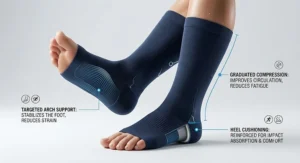
So what is compression cycling socks, exactly? They’re cycling-specific socks knitted with graduated elastic pressure — tightest at the ankle, gradually looser up the calf — designed to support venous return, reduce muscle vibration, and take some of the sting out of long rides and the day after. Some riders wear them purely for comfort on the bike; others reach for a pair specifically for recovery once they’ve racked the bike up.
What follows isn’t a rewritten spec sheet lifted from a listing page. It’s a proper look at seven real, currently available options, from budget multi-packs to genuinely medical-grade compression, built on real specifications and honestly framed analysis, plus the practical stuff — how to choose, common buying mistakes, and whether the “boosts blood flow” claims actually stack up. According to NHS inform, graduated compression garments work by applying pressure to the lower leg to help prevent blood and fluid pooling — the same underlying mechanism cycling brands have adapted for performance and recovery socks. Let’s get into it.
Quick Comparison Table
For riders who want the short version before the deep dive, here’s how the seven picks stack up at a glance.
| Product | Compression Level | Best For | Price Range |
|---|---|---|---|
| CEP Core Run 5.0 Tall Compression Socks | 20-30 mmHg | Long days in the saddle | £35-£45 range |
| Compressport Pro Racing Socks v4.0 Bike | Firm, targeted | Racing and aero gains | £22-£28 range |
| 2XU Recovery Compression Socks | Graduated, calf-focused | Post-ride recovery | £20-£30 range |
| DANISH ENDURANCE ProPerform Compression Socks | 26-32 mmHg | Sustainable mid-range | £18-£24 range |
| dhb Aeron Summer Lite Tall Socks | Mild | Hot-weather riding | £12-£16 range |
| Swiftwick Aspire Compression Socks | Firm, thin profile | Snug shoe fit | £24-£30 range |
| ROCKBROS Cycling Compression Socks (3-Pack) | 8-15 mmHg | Budget multi-buy | £10-£15 range |
Looking at the spread, there’s a clear pattern: compression strength and price tend to move together, but not always in the direction you’d expect. The DANISH ENDURANCE ProPerform Compression Socks actually deliver a firmer 26-32 mmHg squeeze than the pricier Compressport Pro Racing Socks v4.0 Bike, which trades outright compression strength for aerodynamic shaping instead. If your priority is genuine circulation support rather than race-day marginal gains, don’t assume the most expensive pair automatically wins.
💬 Found the table useful? Bookmark this page so you can compare again before you buy!
Top 7 Compression Cycling Socks: Expert Analysis
We’ve picked a spread of budget, mid-range and premium options, plus a couple of lesser-known but genuinely well-specced alternatives, so there’s something here whatever your riding does to your legs.
1. CEP Core Run 5.0 Tall Compression Socks — best medical-grade compression for long days
The standout here is the 20-30 mmHg compression rating, which sits at the firmer end of what you’ll find outside a hospital ward. That’s a proper graduated squeeze, not a marketing gimmick. CEP built its reputation on medical compression hosiery before moving into sport, and it shows: the calf panel is engineered to support venous return specifically, with additional shaping around the Achilles and shin to reduce strain on repetitive pedal strokes.
Based on the spec comparison with the rest of this list, CEP sits at the top for anyone doing back-to-back long rides or sportives where cumulative leg fatigue is the enemy, not just single-ride discomfort. It’s less about feeling fast and more about feeling less wrecked six hours in. Riders managing existing circulation concerns or recovering from injury often gravitate here specifically because the compression is calibrated rather than approximate.
Reviewers consistently report high satisfaction on Amazon UK, with several CEP compression sock listings sitting at 4.5 stars and above across hundreds of verified ratings. A common theme in that feedback is that the firm compression takes a session or two to get used to, but riders who stick with it rarely go back to unstructured socks.
Pros:
- ✅ True 20-30 mmHg medical-grade graduated compression
- ✅ Achilles and shin support reduces strain on long rides
- ✅ Breathable quick-dry fabric holds up on multi-hour efforts
Cons:
- ❌ Firm compression needs a short adjustment period
- ❌ Sits at the premium end versus cycling-specific socks
At around £35-£45 (check current price), the CEP Core Run 5.0 Tall Compression Socks cost more than most cycling-specific socks, but for riders chasing genuine compression rather than a snug fit, they’re worth the outlay.
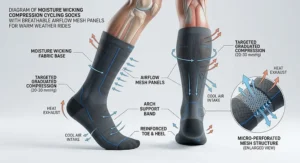
2. Compressport Pro Racing Socks v4.0 Bike — best aero-focused race sock
What most buyers overlook about this model is that it’s not primarily designed for medical-grade compression at all — it’s designed for speed. The standout Aero.dots technology runs from ankle to seam along the sides of the sock, shaping airflow to reduce the turbulent wake that forms behind your calf at race pace. Compressport claims this is one of the more cost-effective aerodynamic upgrades a cyclist can make, and while marginal gains are notoriously hard to feel on the road, the underlying wind-tunnel logic is sound and widely used across other aero apparel too.
Underneath the aero shaping sits genuine arch support built to activate venous return and keep the fabric locked in place during hard efforts, so it’s not purely cosmetic. The cycling-specific sock height is also cut to sit within UCI regulation limits — a detail that matters if you race, and a nice touch even if you don’t.
On real-world feedback, verified buyer reviews collected by specialist retailers like BIKE24 tend to praise the snug, non-slip fit during hard out-of-the-saddle efforts, with the two-year manufacturer warranty reassuring buyers who’ve had previous socks fall apart within a season.
Pros:
- ✅ Aero.dots technology targets drag reduction at speed
- ✅ Arch support keeps the sock locked in place while riding
- ✅ Cycling-specific cut respects UCI sock-height regulations
Cons:
- ❌ Priced above generic cycling socks for the aero tech
- ❌ Not built for all-day medical-grade compression relief
Expect to pay in the £22-£28 range (check current price at time of research) — a fair mid-premium ask for anyone racing or riding fast group sessions where every detail counts.
3. 2XU Recovery Compression Socks — best for post-ride muscle recovery
The standout feature is right there in the name: this is a recovery sock first, a cycling sock second, and the design reflects that. Graduated compression is concentrated through the calf specifically to promote venous return once you’re off the bike, paired with padded zones across the heel and ball of the foot to relieve pressure points from hours spent standing or pottering around after a ride.
Here’s what to weigh: unlike the on-bike options on this list, the 2XU sock isn’t meant to be worn inside a cycling shoe during the ride itself — it’s a change-into-afterwards piece of kit, which matters if you’re expecting a single pair to cover both use cases. What most buyers overlook is that recovery-specific compression like this is where a chunk of the genuine scientific evidence for compression garments actually sits, more so than during-exercise wear.
Aggregated review sentiment on the brand’s own site and third-party retailers frequently mentions relief for old ankle, calf and shin niggles, alongside repeated praise for reducing next-day heaviness after long or hilly rides. A recurring complaint in user reviews, however, is that sizing runs tighter than expected around the calf, so checking the size chart carefully is worth the two minutes it takes.
Pros:
- ✅ Graduated compression specifically targets post-ride venous return
- ✅ Padded heel and ball zones ease standing discomfort after riding
- ✅ Widely praised for reducing next-day leg heaviness
Cons:
- ❌ Some reports of snagging with regular wear
- ❌ Sizing runs tight in the calf for some buyers
At around £20-£30 (prices may vary), the 2XU Recovery Compression Socks are a smart add-on rather than a replacement for your on-bike socks.
4. DANISH ENDURANCE ProPerform Compression Socks — best sustainable mid-range pick
The standout advantage is compression strength for the money: 26-32 mmHg is a firm, athletic-grade squeeze that undercuts CEP on price while nearly matching it on paper. The socks are made from a majority-recycled polyamide blend, designed in Denmark and produced in Portugal, and shipped in recycled paper packaging rather than plastic — a detail sustainability-conscious riders will appreciate without having to hunt for a niche eco brand.
On paper this means DANISH ENDURANCE occupies an unusual middle ground: firmer compression than most mid-range competitors, at a price closer to the budget end of the market. Reviewers consistently note the brand’s cushioned sole and anti-friction zones around the toe and heel as effective at preventing blisters on longer rides, which matters more than compression alone when you’re several hours in.
The brand was developed in partnership with a Danish Olympic distance runner, and while that endorsement doesn’t guarantee performance for cyclists specifically, the underlying graduated-pressure construction is the same principle used across running, cycling and travel compression wear.
Pros:
- ✅ Firm 26-32 mmHg compression at a mid-range price point
- ✅ Majority-recycled materials and plastic-free packaging
- ✅ Anti-friction zones reduce blister risk on long rides
Cons:
- ❌ Firm compression may feel restrictive for wider calves
- ❌ General sports cut rather than a cycling-specific aero design
Priced in the £18-£24 range for a multi-pack (check current price), this is arguably the strongest value-for-compression pick on the whole list.
5. dhb Aeron Summer Lite Tall Socks — best lightweight summer sock
The standout feature is the 200-needle knit construction, which gives a noticeably finer, softer feel than most compression socks on this list. dhb is Wiggle’s in-house performance brand and a genuinely well-regarded name on UK roads, and this sock leans into mild compression rather than firm support, prioritising breathability for hot-weather and long-distance riding instead.
What the spec sheet won’t tell you, but the construction implies, is that this is a sock built for comfort over multiple back-to-back hours rather than maximum circulatory benefit. The Qskin polyamide-elastane yarn wicks moisture aggressively, and the anti-microbial finish is a genuinely useful touch for riders doing multi-day tours where fresh socks aren’t always an option. The air-mesh top panel and mid-foot support band keep the sock from slipping without the tight, medical-style grip of firmer options.
Coverage here matters for UK riders specifically: dhb stock is widely available through Evans Cycles and other UK retailers, and reviewers frequently mention the sock’s durability holding up well across a full riding season, which isn’t always guaranteed with lighter-weight construction.
Pros:
- ✅ Fine 200-needle knit feels noticeably softer against the skin
- ✅ Anti-microbial finish suited to multi-day riding
- ✅ Strong UK stockist availability and brand track record
Cons:
- ❌ Mild compression offers less muscle containment on hard efforts
- ❌ Best suited to warm-weather riding rather than year-round use
At around £12-£16 (check current price), the dhb Aeron Summer Lite Tall Socks are a sensible pick for anyone who finds firmer compression socks uncomfortably tight in summer heat.
6. Swiftwick Aspire Compression Socks — best thin firm-compression fit
The standout here is the combination most brands can’t quite pull off: firm compression in an ultra-thin profile. Swiftwick uses an Olefin fibre blend that’s naturally moisture-repelling rather than absorbent, meaning the sock stays lighter and drier through sweat-heavy efforts than cotton-nylon blends, while still delivering a genuinely contoured, firm compression fit through the arch and calf.
Based on the spec comparison, this thin construction matters more than it sounds inside a tight-fitting cycling shoe — bulkier socks can create pressure points or heel slip, and Swiftwick’s design is specifically built to avoid that, which is part of why it’s become a favourite among endurance and ultra-distance riders who spend entire days in the saddle.
Reviewers consistently highlight the brand’s Lifetime Performance Guarantee, replacing socks that wear out, as a meaningful point of difference from disposable budget alternatives. The trade-off, honestly reported, is that as a US-manufactured brand, UK stock and size availability through Amazon.co.uk can be more limited than domestic or European competitors.
Pros:
- ✅ Firm compression in a genuinely thin, shoe-friendly profile
- ✅ Olefin fibre resists moisture better than standard blends
- ✅ Backed by a Lifetime Performance Guarantee
Cons:
- ❌ UK stock and sizing options can be limited
- ❌ Ankle-height cuff gives less calf coverage than tall socks
Priced around £24-£30 for a three-pack (prices may vary), the per-pair cost is competitive once you factor in the multi-pack format.
7. ROCKBROS Cycling Compression Socks (3-Pack) — best budget multi-pack
The standout advantage is simple: three pairs of genuinely graduated-compression socks for less than the price of one premium pair elsewhere on this list. ROCKBROS specifies 8-15 mmHg gradient pressure targeted at the calf and sole, a light compression tier well suited to riders who are curious about compression benefits without committing to a firm medical-grade squeeze straight away.
Here’s what to weigh: the nylon-spandex blend with mesh panelling isn’t going to match CEP or DANISH ENDURANCE on containment, but for commuting, casual weekend rides, or as a low-risk way to trial compression before spending more, it does the fundamentals — wicking, gentle support, an anti-slip cuff to stop the sock migrating down your leg — competently and cheaply.
A common theme in aggregated Amazon feedback is strong value-for-money sentiment, with buyers frequently mentioning the multi-pack format as ideal for households with more than one cyclist, or for riders who simply go through socks faster than they’d like to admit. Durability reports vary more pack-to-pack than with the pricier brands on this list, which is a fairly typical trade-off at this price tier.
Pros:
- ✅ Three pairs for a genuinely budget-friendly total price
- ✅ Light 8-15 mmHg compression suits compression beginners
- ✅ Anti-slip cuff prevents the sock sliding down the leg
Cons:
- ❌ Lighter compression than firmer mid-range and premium picks
- ❌ Durability reports are more inconsistent pack to pack
At around £10-£15 for three pairs (check current price), the ROCKBROS Cycling Compression Socks (3-Pack) are the easiest, lowest-risk entry point into compression cycling socks on this whole list.
Practical Usage Guide: Getting the Most from Your Compression Cycling Socks
Buying the right pair is only half the job — how you use compression socks affects how much benefit you actually get from them. On first use, size correctly rather than guessing: most brands, including CEP and DANISH ENDURANCE, size compression socks against calf circumference rather than shoe size, so measure before you buy if the listing offers a size chart.
A common mistake in the first thirty days is wearing firm compression socks (20 mmHg and above) for the very first time on your longest ride of the week. Break firmer compression in gradually over shorter rides first, the same way you’d break in a new saddle, so your legs and feet adjust to the sustained pressure. Donning technique matters too: roll the sock down to the heel first, ease your foot in, then unroll it upward smoothly rather than yanking it straight up, which can distort the graduated pressure zones and cause uneven bunching.
For maintenance, machine wash on a cool cycle and air dry rather than tumble drying — heat degrades the elastane fibres that create the compression effect, and most manufacturer guidance, including dhb’s own care instructions, explicitly warns against tumble drying and ironing for exactly this reason. Rotate between two or three pairs rather than relying on one, since compression elastane loses effectiveness gradually with repeated stretching and washing cycles.
✨ Ready to build a proper sock rotation? Check current stock and prices on the picks above before your next long ride.
Real-World Scenarios: Which Compression Socks Suit Your Riding?
The weekend sportive rider covering 60-100 miles on Saturdays, usually on a budget that prioritises the bike itself over accessories, tends to do best with the DANISH ENDURANCE ProPerform Compression Socks. The firm 26-32 mmHg compression genuinely helps across long, single-effort distances, and the price sits comfortably alongside other mid-range kit purchases without feeling like an indulgence.
The daily commuter riding 8-15 miles each way in variable weather, usually more concerned with reliability than marginal gains, is well served by the ROCKBROS Cycling Compression Socks (3-Pack) or the dhb Aeron Summer Lite Tall Socks, depending on season. Light compression is enough to reduce end-of-week leg fatigue from accumulated daily mileage, and the lower price tolerates the wear and tear of near-daily use far better than a premium pair.
The multi-day tourer or audax rider, stacking consecutive long days in the saddle with limited recovery time between them, is exactly the profile CEP built its products for. The CEP Core Run 5.0 Tall Compression Socks worn during riding, paired with the 2XU Recovery Compression Socks for evenings off the bike, covers both the ride and the recovery window — arguably the single most evidence-supported use case on this entire list.

How to Choose Compression Cycling Socks
- Start with compression level, not brand. Light (8-15 mmHg) suits beginners and commuters; firm (20 mmHg+) suits long-distance and recovery-focused riders.
- Match the sock to its job. On-bike socks like Compressport prioritise fit and aero shaping; recovery socks like 2XU prioritise post-ride circulation instead.
- Check the fabric for your climate. Mesh-heavy, lightweight builds like dhb’s suit hot UK summers; denser knits like CEP’s suit cooler, longer rides.
- Measure your calf, not just your shoe size. Compression sizing is calf-circumference based, and an ill-fitting sock won’t deliver graduated pressure correctly.
- Factor in UCI sock-height rules if you race. Compressport’s cycling-specific cut is designed with this in mind; general sports socks may not be.
- Budget for a rotation, not a single pair. Two or three pairs let elastane recover between washes and extend the compression’s working lifespan.
- Read aggregated review sentiment, not star ratings alone. Look for recurring themes — sizing accuracy, durability, comfort inside cycling shoes — rather than a single average score.
Graduated Compression Cycling: What the Science Actually Says
Graduated compression cycling socks work on a simple mechanical principle: pressure is highest at the ankle and gradually decreases up the calf, encouraging blood to move upward toward the heart rather than pooling in the lower leg. This is the same principle used in medical compression stockings, adapted with performance fabrics and cycling-specific cuts.
Here’s what to weigh honestly: the evidence for graduated compression improving in-ride performance — actual speed, power output, or endurance — remains genuinely mixed, and no reputable cycling publication claims it as a guaranteed performance booster. Cycling Weekly’s own testing coverage frames compression cycling socks primarily as support for muscle vibration and circulation rather than a straightforward speed upgrade, which lines up with the more cautious tone of the underlying research.
Where the evidence is more consistently positive is post-exercise recovery rather than in-ride performance, which is exactly why brands like 2XU market a dedicated recovery-specific product rather than claiming their on-bike socks do everything. If you’re buying compression socks expecting a measurable power boost on the bike, temper those expectations; if you’re buying them to feel less wrecked the next morning, the evidence base is considerably more encouraging.
Muscle Recovery Socks: Do They Actually Speed Up Recovery?
This is the secondary keyword that gets asked most often, and the honest answer is: probably, to a moderate degree, for some people. A widely cited meta-analysis published via PubMed pooling data across multiple studies found that compression garments had a moderate positive effect on reducing delayed-onset muscle soreness severity, alongside modest improvements in measures of muscle strength and power recovery after damaging exercise.
Reviewers consistently note that recovery-specific socks like the 2XU model feel most effective when worn for several hours immediately after a hard ride, rather than briefly or intermittently. What most buyers overlook is that recovery compression doesn’t need to be worn during exercise to be useful — in fact, some of the strongest evidence specifically concerns post-exercise wear rather than on-bike use, which is exactly the gap products like 2XU’s recovery-specific range are designed to fill.
It’s worth being honest about the limits here too: individual response to compression varies significantly, effect sizes in the research are moderate rather than dramatic, and compression socks are a support tool alongside proper sleep, hydration and nutrition, not a replacement for any of them.
Blood Flow and Cycling Performance: Separating Fact from Marketing
Improved blood flow is the headline claim on almost every compression sock listing, and the underlying physiology is genuine: graduated pressure does measurably increase venous blood flow velocity in the lower leg, which is well established in medical literature around compression therapy for circulatory conditions. The question for cyclists specifically is whether that translates into anything you’d notice on the bike.
On paper this means more efficient removal of metabolic waste products like lactate from working muscles during and after exertion, theoretically supporting sustained effort over long rides. In practice, reviewers and cyclists tend to report the effect as one of reduced heaviness and fatigue rather than a dramatic power or speed increase — a subtle, cumulative benefit rather than a switch that flips.
Riders managing borderline circulation issues, varicose veins, or simply long hours in an aggressive riding position sometimes notice the biggest practical difference, since that’s closer to the population the underlying medical compression research was originally studying. For a healthy, uninjured rider doing a typical weekend ride, the blood-flow benefit is real but modest — worth having, not worth overselling.
DOMS Reduction Cycling: What to Expect After Long Rides
Delayed-onset muscle soreness — that stiff, achy sensation that peaks around 24 to 48 hours after a hard or unusually long ride — is where compression garments have some of their most consistently supportive research. A separate controlled study published in the Journal of Orthopaedic & Sports Physical Therapy found that a compression garment worn at 18-21 mmHg had a measurable effect on muscle perfusion and stiffness following a DOMS-inducing exercise protocol, though the researchers were careful to note that mechanisms are still not fully understood.
What most buyers overlook about DOMS reduction specifically is timing: wearing compression socks during the ride itself has less consistent evidence than wearing them for several hours immediately afterward. Riders chasing genuine DOMS relief are generally better served putting on a firm recovery-focused sock like the CEP or 2XU pick as soon as they’re off the bike, rather than assuming their on-bike Compressport or ROCKBROS socks are doing double duty automatically.
Realistically, expect a noticeable-but-moderate reduction in next-day soreness severity rather than a complete elimination of it — the research consistently describes the effect as helpful, not miraculous, and that framing should set your expectations honestly before you buy.
Compression Cycling Socks vs Standard Cycling Socks
The core difference is structural, not cosmetic. Standard cycling socks are knitted with a uniform or lightly ribbed elastic that holds the sock in place; compression socks are knitted with genuinely graduated pressure zones engineered to apply more force at the ankle than the calf, a construction technique that’s measurably different on a knitting machine, not just marketing language on a label.
| Factor | Compression Cycling Socks | Standard Cycling Socks |
|---|---|---|
| Circulation support | Graduated pressure, ankle to calf | Minimal to none |
| Muscle vibration control | Firmer options reduce it noticeably | Limited |
| Weight and thickness | Generally slightly heavier | Usually lighter, thinner |
| Price | £12-£45 range typically | £5-£20 range typically |
| Best For | Long rides, recovery, circulation concerns | Casual riding, hot weather, racing weight-weenies |
Interpreting that spread, standard socks still win on pure lightness and price for short, casual rides where circulation support simply isn’t the priority — nobody needs graduated compression for a twenty-minute spin to the shops. Compression socks earn their higher price and slightly heavier feel specifically on longer efforts, back-to-back training blocks, or dedicated recovery windows, where the physiological benefit actually has time to matter. For most regular riders, owning both and choosing based on the ride ahead, rather than picking one camp permanently, is the most sensible approach.
✨ Don’t Miss These Exclusive Deals!
🔍 Take your cycling comfort to the next level with these carefully selected socks. Click on any highlighted item to check current pricing and availability. These picks could help you ride further and recover faster.
Common Mistakes When Buying Compression Cycling Socks
The single biggest mistake is buying by shoe size instead of calf circumference — compression sizing charts are built around leg measurements, and an ill-fitting sock either fails to compress correctly or, worse, cuts off circulation uncomfortably rather than supporting it. A second common error is assuming higher mmHg is automatically better; very firm compression is genuinely uncomfortable for some riders and unnecessary for shorter rides, so matching the level to your actual riding, not just buying the strongest number available, matters more than ego.
Buyers also frequently overlook the difference between an on-bike sock and a recovery sock, expecting one pair to excel at both jobs. As covered above, the two use cases have different construction priorities, and a sock optimised for aero shaping inside a tight cycling shoe generally isn’t the same sock you’d want to relax in for three hours post-ride. Finally, plenty of first-time buyers skip checking material composition entirely, then find that a fully synthetic sock doesn’t suit hot-weather riding as well as a merino or mesh-heavy blend would.
Long-Term Cost & Maintenance: Getting Years Out of Your Socks
A single premium pair like CEP’s, at £35-£45, sounds steep against a £10 budget three-pack, but the total cost of ownership tells a more balanced story. Firm-compression elastane in premium socks is generally engineered with denser, higher-grade fibres designed for repeated stretching cycles, and manufacturer guarantees — Swiftwick’s Lifetime Performance Guarantee being the clearest example — can meaningfully offset the higher upfront price over a multi-year lifespan.
Budget multi-packs like ROCKBROS still make financial sense in a different way: buying three or more pairs spreads wear across a rotation, reducing how often any single pair is stretched, washed and dried, which is genuinely one of the biggest factors in how long compression elastane retains its effectiveness. Cold machine washing and air drying rather than tumble drying, across any price tier, is the single cheapest thing you can do to extend a pair’s working life — heat is consistently the fastest way to degrade the elastic fibres that create the compression effect in the first place.
Compression Socks for Different Types of Cyclist
Beginners dipping a toe into compression are generally best served starting light — the ROCKBROS 8-15 mmHg range or dhb’s mild-compression Aeron sock — rather than jumping straight to CEP’s firmer 20-30 mmHg tier, which can feel uncomfortably restrictive without a period of adjustment. Racers and competitive club riders lean toward Compressport specifically for the aero shaping and UCI-compliant cut, where marginal performance gains and regulatory compliance both matter.
Endurance and audax riders covering huge single-day distances tend to prioritise DANISH ENDURANCE or CEP for their firm, genuinely medical-grade compression profiles, since that’s where the strongest evidence for reduced fatigue and next-day soreness sits. Older riders or those managing existing circulation concerns should treat any of the firmer options as a comfort and support tool, not a medical treatment, and speak to a GP or pharmacist first if they have a diagnosed circulatory condition, since compression therapy at that level is sometimes clinically prescribed rather than freely chosen.
FAQ
❓ Do compression cycling socks actually work?
❓ What mmHg compression is best for cycling?
❓ Can I wear compression socks every ride?
❓ Are compression cycling socks worth the money?
❓ How do I wash compression cycling socks?
Conclusion
There’s no single “best” compression cycling sock, because the honest answer depends entirely on what problem you’re trying to solve. If it’s genuine circulation support across long, punishing days, the CEP Core Run 5.0 Tall Compression Socks deliver medical-grade compression that few competitors match. If you’re chasing race-day marginal gains, the Compressport Pro Racing Socks v4.0 Bike combine aero shaping with real arch support. For recovery specifically, the 2XU Recovery Compression Socks are purpose-built for the hours after you rack the bike up, while the DANISH ENDURANCE ProPerform Compression Socks offer firm compression at a genuinely fair price.
Budget-conscious riders shouldn’t feel short-changed either — the ROCKBROS Cycling Compression Socks (3-Pack) and dhb Aeron Summer Lite Tall Socks both do the fundamentals competently, while the Swiftwick Aspire Compression Socks carve out a useful niche for anyone who finds bulkier socks uncomfortable inside a tight cycling shoe. Whichever you choose, buy based on your actual riding pattern rather than the highest mmHg number on the page, size against your calf rather than your shoe, and give firm compression a session or two to bed in before judging it.
Recommended for You
- Waterproof Cycling Gloves UK: 7 Genuinely Dry Picks for 2026
- Summer Cycling Gloves 2026: 7 Best Picks Tested & Compared
- Merino Cycling Base Layer: 7 Brilliant Picks for 2026
Disclaimer: This article contains affiliate links. As an Amazon Associate, I earn from qualifying purchases. If you purchase products through these links, we may earn a small commission at no additional cost to you.
✨ Found this helpful? Share it with your friends! 💬🤗
