In This Article
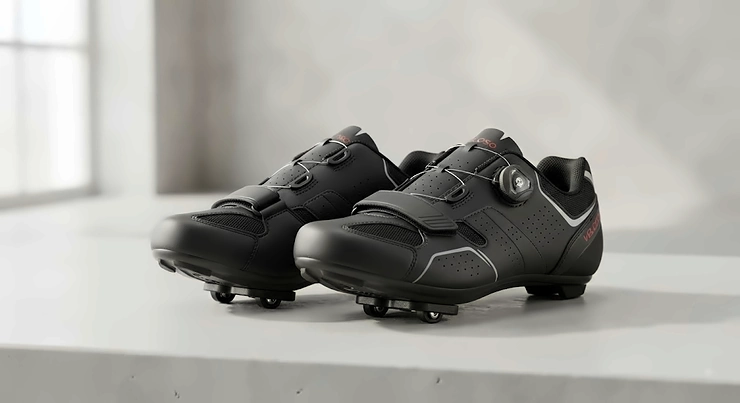
Let’s get one thing out of the way: budget clipless road shoes are simply road cycling shoes built to work with a clipless pedal system — the ones where a cleat on the sole locks into the pedal — priced to suit riders who don’t want to remortgage the house for a pair of size 9s. You don’t need to spend £250 to feel the benefit of pedalling in a shoe designed for the job rather than a pair of battered trainers. In fact, some of the most interesting engineering in cycling right now is happening at the cheap end, where brands are fighting hard for your custom.
If you’ve been riding flat pedals in trainers, that first clipless shoe purchase can feel like a bit of a leap of faith — new terminology, cleat bolts, walkability trade-offs, all of it. But the payoff is real: a stiffer sole stops your foot flexing around the pedal axle and wasting your effort, and a snug fit means your foot stays exactly where you put it, mile after mile. This guide walks through seven genuinely good options, what the spec sheets actually mean once you’re out on the road, and how to avoid the classic first-timer mistakes. According to the NHS, regular moderate-intensity exercise like cycling brings measurable health benefits — so there’s more riding on this decision than just watts.
We’ve dug through real product listings, independent bike media reviews and aggregated customer sentiment to put together honest, sourced commentary rather than a rehashed spec sheet. Prices below are shown as ranges rather than fixed figures, since retailers shift them constantly — always check the current price before buying.
Quick Comparison: Budget Clipless Road Shoes at a Glance
| Shoe | Closure | Sole | Price Range | Best For |
|---|---|---|---|---|
| Van Rysel Road 100 | 3-strap Velcro | Stiff nylon | Under £60 | Absolute first-timers on a shoestring |
| dhb Dorica | 7-eyelet laces | Nylon | £70-£85 range | Classic looks, dual cleat option |
| Shimano RC1 (SH-RC102) | 3-strap Velcro | Glass-fibre nylon | £75-£90 range | Trusted big-brand entry point |
| Bontrager Solstice | 3-strap Velcro | Nylon composite | £90-£110 range | Wide feet, SPD/SPD-SL flexibility |
| Boardman Carbon Cycle Shoes | Dual ratchet dial | Full carbon | Under £100 | Full carbon sole on a tight budget |
| Giro Cadet | Boa L6 dial | Carbon-reinforced nylon | £95-£115 range | Dial precision without the dial price tag |
| dhb Aeron Carbon | ATOP dial + Velcro | Full carbon | £115-£135 range | Ceiling-of-budget performance |
A quick scan of that table tells its own story: closures get more sophisticated as price climbs, but the jump from Velcro to a proper dial doesn’t actually cost that much once you’re shopping the sub-£150 bracket. The Boardman Carbon Cycle Shoes stand out as something of an anomaly here — a full carbon sole for well under £100 is rare, and it’s the kind of spec that would have cost double a few years back. Meanwhile, the Van Rysel Road 100 anchors the value end for anyone who just wants to try clipless pedals without committing serious cash before they know they’ll get on with the system.
💬 Found a shoe you like the look of already? Scroll down to the full breakdown — every pick below gets the honest, warts-and-all treatment.🤗
Top 7 Budget Clipless Road Shoes: Expert Analysis
1. Van Rysel Road 100 — cheapest genuine road-specific clipless shoe worth buying
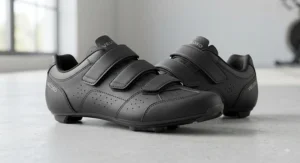
The headline here is the price, but it’s not a hollow bargain. This entry point from Decathlon’s in-house cycling brand uses a synthetic upper with micro-perforation for airflow, a classic three-strap Velcro closure, and a nylon sole stiff enough that it genuinely transfers power rather than just looking the part.
Reviewers who’ve tested it describe the sole as super stiff for the money — good news for pedalling efficiency, though it makes walking around a café or shop an exercise in penguin-waddling rather than anything graceful. That’s a fair trade-off for a first pair. Based on the spec comparison with rivals at this price, the Van Rysel Road 100 punches well above what you’d expect for the outlay, and it’s a sensible way to find out whether clipless riding suits you before spending more on your second pair.
Aggregated feedback consistently flags the stiff sole and Velcro adjustability as strengths, with off-bike comfort noted as the trade-off — a pattern common to nearly every shoe at this price point, not a Van Rysel-specific flaw.
Pros:
- ✅ Genuinely stiff sole for the ultra-budget price bracket
- ✅ Micro-perforated upper keeps feet cool on warm rides
- ✅ Straightforward Velcro fit, easy for clipless beginners
Cons:
- ❌ Stiff sole makes off-bike walking awkward
- ❌ Basic materials compared with pricier alternatives
In the under-£60 bracket, this is about as good as clipless value gets — check the current price at Decathlon or on Amazon before committing to a size.
2. dhb Dorica — classic lace-up looks with proper stiffness for the money
British brand dhb built its reputation on hitting the sweet spot between price and performance, and the Dorica is the clearest example in its road shoe range. The seven-eyelet “Oxford style” lace closure looks sharper than anything else at this price and, unlike Velcro, lets you fine-tune pressure across the whole foot rather than in three fixed bands.
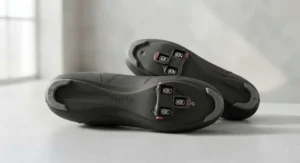
The synthetic upper is perforated the length of the foot, including around the ankle, and the nylon sole is drilled for three-bolt road cleats — with two-bolt SPD compatibility available if you add separately-sold pontoon adaptors. What most buyers overlook about lace-up shoes is that they distribute tension more evenly than straps, reducing hotspots on longer rides, which is exactly what reviewers have picked up on with the Dorica.
Aggregated reviewer sentiment is positive on value and looks but consistently flags sizing running large — testers recommend going down a size from your usual — and the shoes lack reflective detailing, so factor that in if you’re commuting in low light.
Pros:
- ✅ Refined lace-up fit beats basic Velcro for comfort
- ✅ Works with both 3-bolt road and 2-bolt SPD cleats
- ✅ Smart looks that punch above the price point
Cons:
- ❌ Sizing runs large — size down from your usual
- ❌ No reflective detailing for low-light visibility
At around £70-£85, the Dorica remains one of the most consistently recommended entry-level road shoes among UK cycling reviewers — check current price and stock before buying.
3. Shimano RC1 (SH-RC102) — trusted big-brand engineering trickled down from the flagship range
Shimano’s most affordable road shoe borrows its wraparound upper construction from the pro-level S-PHYRE line, then strips things back — three offset hook-and-loop straps instead of a dial, a glass-fibre reinforced nylon sole instead of carbon — to hit an entry-level price without feeling like a compromise.
In testing, reviewers found the RC1 delivered a strong mix of comfort and stability, particularly on long, hilly rides, thanks to a sole that avoids the foot-numbness some ultra-stiff carbon shoes cause. On paper this means the RC1 is a better pick for endurance riders than out-and-out racers chasing every gram of stiffness. Wide heel pads add real off-bike stability too, which matters more than most spec sheets let on if you’re stopping at cafés mid-ride.
Reviewers consistently note the three-strap Velcro system as genuinely useful for adjusting fit as feet swell over a long ride, though ventilation trails behind pricier, more perforated rivals.
Pros:
- ✅ S-PHYRE-derived wraparound fit at entry-level price
- ✅ Comfortable over long, hilly rides per tester feedback
- ✅ Wide heel pads aid stability walking off the bike
Cons:
- ❌ Less ventilated than premium perforated rivals
- ❌ Velcro straps wear faster than a dial closure long-term
Typically found in the £75-£90 range, this is the safe, big-brand choice if you’d rather not gamble on a less familiar name for your first proper road shoe.
4. Bontrager Solstice — dual cleat compatibility for riders who hate being boxed in
What makes the Solstice unusual in this company is its Shimano SPD compatibility on a road-shaped shoe — most of this list sticks rigidly to three-bolt cleats. If you’ve already got SPD pedals on a commuter or gravel bike and don’t fancy buying a second pedal system just for road riding, that’s a genuinely useful bit of flexibility.
The nylon composite sole is described by testers as moderately stiff — not race-shoe rigid, but more than adequate for club rides and commuting — while the medium/wide fit option is worth knowing about if narrow European-cut shoes have burned you before. Here’s what to weigh: at 227g per shoe in a typical size, it’s competitively light for a shoe built around practicality rather than outright performance.
Aggregated reviewer sentiment calls the Solstice an “uncomplicated, effective performer,” with light weight for the price cited as a recurring positive; the main criticism is that ventilation can fall short in genuinely hot conditions, and the two-bolt cleat adaptor isn’t included in the box.
Pros:
- ✅ SPD compatibility as well as road-standard cleats
- ✅ Medium/wide fit option for broader feet
- ✅ Competitively lightweight for a practicality-focused shoe
Cons:
- ❌ Ventilation can struggle in hot weather
- ❌ Two-bolt cleat adaptor sold separately
Sitting in the £90-£110 range, the Solstice earns its place here on flexibility alone — a smart pick if you’re not fully committed to road-only cleats yet.
5. Boardman Carbon Cycle Shoes — a full carbon sole at a genuinely sub-£100 price
This is the shoe that most upends expectations on this list. A full carbon fibre outsole — not carbon-reinforced nylon, actual carbon — normally starts appearing at £120 and up elsewhere, so finding one from a Halfords-stocked own-brand under £100 is worth flagging loudly.
The dual ratchet dial system allows independent adjustment across the forefoot, which reviewers have called an “absolute belter of a spec list” for the price, alongside a supple upper and decent ventilation. Based on the spec comparison, the trade-off for that carbon sole at this price is a small amount of flex under maximum effort — testers noted it isn’t the stiffest carbon shoe they’ve used, showing slight give when climbing hard out of the saddle. For the vast majority of riders who aren’t sprinting for a contract, that’s an entirely academic concern.
Boardman’s shoes are also cut with a wider fit than many performance brands, which several UK reviewers highlight as a deliberate nod to typical British foot shapes — good news if narrow continental lasts have never worked for you.
Pros:
- ✅ Genuine full-carbon sole rarely seen this cheap
- ✅ Dual ratchet dials allow independent forefoot tuning
- ✅ Wider fit suits typical UK foot shapes
Cons:
- ❌ Sole shows slight flex under maximum sprint effort
- ❌ Three-bolt only — no SPD cleat option
At under £100, this is arguably the single best value proposition on this list if outright stiffness for the money is your priority.
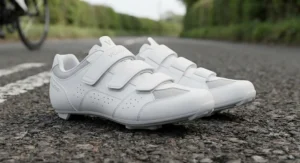
6. Giro Cadet — Boa dial precision without the usual dial price tag
Dial closures are where the real premium usually lives, so finding a genuine Boa L6 dial on an entry-level shoe is notable. The Cadet pairs it with Giro’s one-piece Synchwire upper — the same material used on some of the brand’s much pricier shoes — thermo-bonded for a clean, supportive fit, plus dual 2-bolt SPD and 3-bolt road cleat compatibility.
The carbon-reinforced nylon sole trades some stiffness for a more forgiving ride on rough or uneven roads, which reviewers note makes it noticeably more comfortable over choppy surfaces than fully rigid carbon rivals, even if outright power transfer takes a small hit. Here’s what to weigh: the extremely firm sport insole has been flagged by multiple testers as transmitting more road buzz than most, so budgeting for an aftermarket insole isn’t a bad shout if you’re doing serious mileage.
Sizing is another recurring theme in aggregated feedback — testers report the Cadet coming up slightly short, with several recommending you size up rather than trust your usual measurement.
Pros:
- ✅ Boa L6 micro-adjustable dial at a rare price point
- ✅ Dual 2-bolt SPD and 3-bolt road cleat compatibility
- ✅ Synchwire upper shared with pricier Giro models
Cons:
- ❌ Firm stock insole transmits noticeable road buzz
- ❌ Sizing runs slightly short — consider going up
In the £95-£115 range, the Cadet is the pick for anyone who’s decided a dial is non-negotiable but doesn’t want to spend three figures chasing one.
7. dhb Aeron Carbon — the ceiling of the budget bracket, and worth every penny of it
Sitting above dhb’s own Dorica in the range, the Aeron Carbon pairs a full carbon sole — the same unit dhb uses across its performance line — with an ATOP micro-adjustable dial and a supplementary Velcro strap for extra security. It’s the shoe on this list that starts to feel genuinely premium, without actually crossing into premium pricing.
What most buyers overlook about stepping up from a Dorica to an Aeron is that you’re not just buying a dial — you’re buying a noticeably stiffer platform for the same fundamental fit dhb has already proven works well across its range. Reviewers testing dhb’s carbon-soled shoes at similar price points have consistently rated them as sitting “up there with the very best cycling shoes” in their bracket, praising low weight and all-day comfort alongside the stiffness upgrade.
Based on the spec comparison with the rest of this list, the Aeron Carbon represents the point of diminishing returns for a genuinely budget-focused buyer — you can spend more, but you’ll be paying for marginal gains rather than transformative ones.
Pros:
- ✅ Full carbon sole matched with precise ATOP dial
- ✅ Noticeably stiffer platform than the entry-level Dorica
- ✅ Comfortable enough for genuine all-day use
Cons:
- ❌ Sits at the very top of the “budget” price bracket
- ❌ Dial adds a little more weight than pure Velcro rivals
Typically priced in the £115-£135 range, this is where we’d stop looking if a genuine £150 ceiling is the goal — beyond this, you’re into a different market entirely.
How to Choose Budget Clipless Road Shoes
Picking the right pair isn’t just about the lowest number on the price tag. Work through these in order and you’ll land on the right shoe faster than trawling twenty separate reviews:
- Confirm your pedal system first. Three-bolt cleats (SPD-SL/Look-style) suit dedicated road pedals; two-bolt SPD suits shoes you might also walk in or use on a gravel/commuter bike. Buying the wrong bolt pattern is the single most common beginner mistake.
- Decide how much you’ll walk in them. Stiffer carbon soles transfer more power but are genuinely awkward off the bike — if you’re stopping at cafés or shops mid-ride, factor that trade-off in honestly.
- Check the closure type against your budget. Velcro is cheapest and perfectly functional; dials cost more but allow tension adjustment mid-ride without stopping.
- Look at width, not just length. UK and European foot shapes vary, and several brands on this list specifically cater to wider feet — don’t assume your usual trainer size translates directly.
- Weigh ventilation against your riding climate. A heavily perforated upper is a blessing in summer and a curse in a British February — some riders keep two pairs for exactly this reason.
- Read aggregated sizing feedback before you buy. As seen above, several shoes here run large or small compared with standard sizing — checking real reviewer sentiment saves an expensive returns cycle.
- Set a genuine ceiling and stick to it. The jump from £90 to £150 buys real stiffness and closure improvements; the jump from £150 to £300 mostly buys marginal weight savings — know which gains actually matter to you.
Top Clipless Road Shoes Under £150: Price Range & Value Analysis
| Price Bracket | Shoes in Range | What You’re Paying For | Best For |
|---|---|---|---|
| Under £60 | Van Rysel Road 100 | Basic materials, proven stiffness | Testing the waters |
| £70-£100 | dhb Dorica, Shimano RC1, Boardman Carbon Cycle Shoes | Better uppers, first carbon soles appear | Most first-time buyers |
| £100-£150 | Bontrager Solstice, Giro Cadet, dhb Aeron Carbon | Dial closures, cleat flexibility, refined fit | Riders who know they’re sticking with clipless |
Looking at the table, the real value inflection point sits around the £85-£100 mark, where full carbon soles like the Boardman Carbon Cycle Shoes start appearing without a dial-closure premium attached. Spending up to the £150 ceiling buys you closure precision and marginal comfort gains rather than dramatically more stiffness — worth knowing if outright budget is your priority. For anyone still undecided, the middle bracket offers the best balance of proven materials and manageable cost without chasing diminishing returns.
First Clipless Shoe Purchase: A Practical Usage Guide
Buying the shoes is the easy part. Getting comfortable with them is where most beginners come unstuck, so here’s the practical side nobody puts on the product page.
Fit your cleats before your first proper ride, not the morning of a big group ride. Position the cleat so the ball of your foot sits roughly over the pedal axle, and start with a neutral rotational angle — you can fine-tune from there once you’ve felt how your knees track. Practise clipping in and out against a wall or on grass for ten minutes before you go anywhere near traffic; the muscle memory of twisting your heel outward to release genuinely does take a session or two to embed.
Expect at least one slow-speed tip-over in your first fortnight — it happens to almost everyone and it’s rarely painful, just embarrassing at a red light. Set your pedal spring tension to its lowest setting initially if your pedals allow it, then increase it once unclipping becomes automatic. Check cleat bolts for looseness after the first 50 miles, since new cleats can bed in and shift slightly. Finally, keep the cleats themselves clean of grit — a stiff brush after muddy rides prevents the slow degradation that makes clipping in feel vague rather than positive.
Real-World Scenarios: Matching Shoes to Riders
The commuter testing the water: Riding three miles each way, still deciding if clipless is worth the hassle, budget genuinely tight. The Van Rysel Road 100 or dhb Dorica make sense here — low financial risk, and the walkability trade-off matters less over a short commute than a weekend century.
The weekend club rider clocking 40-60 miles: Wants genuine comfort over distance without spending £150-plus. The Shimano RC1 or Bontrager Solstice fit this profile well, trading a little outright stiffness for all-day comfort and, in the Solstice’s case, SPD flexibility if their gravel bike shares the same pedals.
The improver chasing marginal gains on a budget: Racing club ten-mile time trials or pushing for a Strava PB, wants the stiffest platform available without breaching £150. The Boardman Carbon Cycle Shoes or dhb Aeron Carbon deliver genuine carbon stiffness and, in the Aeron’s case, a precise dial, without the premium-brand markup.
Common Mistakes When Buying Clipless Road Shoes
The most expensive mistake is buying the wrong bolt pattern for your pedals — always check whether your pedals are three-bolt road-standard or two-bolt SPD before you fall in love with a shoe. A close second is ignoring width entirely; a shoe that’s the right length but too narrow will numb your toes on anything over 20 miles, and no amount of breaking-in fixes that.
Beginners also consistently underestimate how much sizing varies between brands — as the aggregated review data above shows, some shoes here run generously large and others noticeably small, so relying purely on your usual trainer size is asking for trouble. Reviewers consistently note that skipping a proper cleat-fitting session, and simply bolting cleats on wherever feels roughly central, is one of the most common causes of knee discomfort in new clipless riders. Finally, don’t buy the stiffest, most ventilated shoe purely because it tops a “best of” list — a shoe optimised for summer racing will be miserable on a wet November commute, and comfort for your actual riding pattern beats spec-sheet bragging rights every time.
Clipless vs Flat Pedal Shoes: What’s Actually Different
The core difference isn’t really about the shoe at all — it’s the mechanical connection between foot and pedal. Clipless systems lock a cleat into a spring-loaded pedal mechanism, meaning your foot applies power through the entire pedal stroke, not just the downward push a flat pedal relies on. Flat pedal shoes, by contrast, use grippy rubber soles and rely purely on friction and foot positioning.
What the spec sheet won’t tell you, but plenty of experienced riders will, is that the efficiency gain from clipless is real but modest for casual riders — studies on pedalling efficiency suggest the biggest gains come from a stiffer sole reducing energy loss through flex, which flat-pedal shoes with soft soles simply can’t match regardless of technique. Where clipless genuinely wins is stability at speed and on climbs, where an unexpected foot slip on a flat pedal is a real (if rare) hazard. Where flat pedals win is simplicity and confidence for new or nervous riders, plus zero risk of the unclip-fumble that catches out almost every clipless beginner at least once.
Where to Buy Clipless Road Cycling Shoes
Amazon, dedicated retailers like Halfords and Decathlon, and specialist online shops such as Wiggle all stock the shoes covered here, and pricing genuinely does fluctuate between them, so it’s always worth a quick comparison before you commit — never assume any single retailer is automatically cheapest. If you’re unsure of sizing, buying from a retailer with a straightforward returns policy is worth prioritising over saving a few pounds, since the aggregated sizing feedback above shows how much variation exists between brands.
It’s also worth checking whether your workplace runs a Cycle to Work benefit — as Cycling UK’s guide to the scheme explains, salary-sacrifice schemes can meaningfully reduce the cost of eligible cycling equipment, and some providers include footwear and accessories alongside the bike itself. It’s worth ten minutes checking your provider’s eligible items list before buying outright.
Entry-Level Cycling Upgrades Worth Making Alongside New Shoes
New shoes rarely arrive in isolation — a few complementary upgrades genuinely change how much you enjoy those first clipless miles. Cycling-specific socks in a thinner weave than everyday socks reduce bunching inside a snug-fitting shoe, which matters more than it sounds once you’re three hours into a ride. A cleat-fitting tool or a local bike shop’s fitting service, often free or low-cost when you buy shoes there, removes the guesswork from initial cleat position and saves you fiddling by trial and error for weeks.
Pedal choice matters just as much as the shoe — mismatched pedal and cleat brands can sometimes work but rarely feel as secure as a matched system, so budget for pedals alongside the shoes rather than treating them as an afterthought. Finally, a small tube of anti-seize grease for cleat bolts prevents them corroding solid over a winter of wet rides, which is a cheap five-minute job that saves a much more frustrating one later.
Long-Term Cost & Maintenance
Budget clipless shoes aren’t a one-off purchase — cleats wear down with every clip-in and clip-out, typically needing replacement every 3,000-5,000 miles depending on how often you walk in them, and a fresh set costs a small fraction of the shoe itself. Velcro straps degrade faster than dial closures over several years of heavy use, which is worth weighing into your total cost of ownership if you’re planning to keep a pair for the long haul rather than upgrading again within a year or two.
On paper, a £70 pair of shoes lasting three seasons with £30 of cleat replacements works out considerably cheaper per year than a £200 pair replaced after two seasons because it no longer fits your evolving riding style — value isn’t just about the sticker price, it’s price divided by useful lifespan. Carbon soles, while stiffer, are also more brittle if dropped or knocked hard against kerbs when walking, so factor a little extra care into your ownership costs if you’ve gone for one of the carbon options above.
Safety, Fit and Regulations Worth Knowing
Cleat position genuinely affects knee health over time — a cleat set too far forward or with excessive rotational offset from your natural stance can contribute to persistent knee pain, and it’s one of the most common, entirely preventable issues new clipless riders run into. If discomfort persists beyond a few adjustment attempts, a proper bike fit session is worth the modest cost, since it’s far cheaper than months of niggling pain or a physio bill.
There’s no UK-specific legal requirement around cycling shoe standards the way there is for, say, cycle helmets in some contexts, but sensible practice still applies: reflective detailing or ankle bands are worth adding if you commute in low light, since several shoes on this list — including the budget-friendly dhb Dorica — lack built-in reflectives entirely. Always practise clipping in and out somewhere safe, away from traffic and junctions, until it’s second nature.
Features That Actually Matter (And Those That Don’t)
Sole stiffness matters, but past a certain point the returns genuinely flatten out for anyone who isn’t racing competitively — the difference between a good carbon-reinforced nylon sole and full carbon is smaller in real-world riding than marketing copy suggests. Closure precision matters more than most beginners expect, since a dial lets you loosen or tighten on the fly as your feet swell over a long ride, something a fixed Velcro strap simply can’t do mid-pedal-stroke.
Weight, on the other hand, is largely marketing noise at this price bracket — the gram differences between the shoes covered here are trivial compared with the weight of, say, the water bottle in your cage. Colour-matching your bike is entirely a personal choice with zero performance impact, and “race-proven” branding on an entry-level shoe usually just means it shares an upper material with a pricier sibling, not that it shares the sibling’s actual performance ceiling.
Frequently Asked Questions
❓ What are clipless road shoes?
❓ Can I use SPD cleats on road shoes?
❓ Are budget clipless shoes stiff enough for road riding?
❓ How much should a first pair of clipless road shoes cost?
❓ Do clipless shoes run true to size?
Conclusion
There’s no single “best” budget clipless road shoe — only the best one for how and where you actually ride. If you’re dipping a toe in for the first time, the Van Rysel Road 100 removes almost all the financial risk. If you want a proven big-brand name behind you, the Shimano RC1 is the safe, sensible choice. And if you’ve already decided clipless riding is here to stay, the Boardman Carbon Cycle Shoes or dhb Aeron Carbon deliver genuine carbon-sole performance without breaking a £150 ceiling.
What ties every pick on this list together is that none of them ask you to compromise on the fundamentals — secure fit, real power transfer, and a bolt pattern that matches your pedals — just because the price tag is modest. Spend the time getting cleat position and sizing right, and any of these seven will genuinely transform how your riding feels, regardless of which end of the budget bracket you land on.
✨ Ready to Get Clipped In?
🚴♂️ Compare the full lineup above, check current pricing, and pick the pair that matches your riding pattern rather than the flashiest spec sheet. Your knees — and your Strava times — will thank you.
Recommended for You
- Clipless Road Cycling Shoes: 7 Best Picks for 2026 (Ride Faster)
- Top Road Bike Shoes 2026: 7 Best Picks for Every Budget
- Best Neoprene Overshoes 2026: 7 Winter Picks That Actually Work
Disclaimer: This article contains affiliate links. As an Amazon Associate, I earn from qualifying purchases. If you purchase products through these links, we may earn a small commission at no additional cost to you.
✨ Found this helpful? Share it with your friends! 💬🤗
