
In This Article
There’s an old cycling joke that the most aerodynamic part of any rider is their excuses. But here’s one thing you genuinely cannot cut corners on: your helmet. A proper road bike helmet buying guide isn’t just a shopping list — it’s a decision that sits between you and the tarmac every single time you clip in. And British tarmac, bless it, is particularly unforgiving.
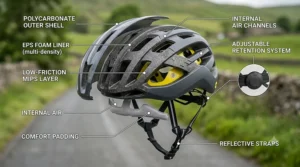
Whether you’re a weekend warrior hammering the Surrey Hills, a daily commuter weaving through Edinburgh’s Old Town, or a club rider preparing for a sportive through the Peak District, one truth applies universally: the helmet you wear matters enormously. Yet walk into any cycling forum (or more accurately, scroll through any Reddit thread at 11pm) and you’ll find riders spending hours debating frame geometry while buying whatever helmet was cheapest during Prime Day.
This road bike helmet buying guide is here to change that. We’ve combed through the latest models available on Amazon.co.uk, cross-referenced independent safety data from Virginia Tech’s helmet ratings lab — the most rigorous third-party testing in the industry — and applied some real-world British context. Because a helmet spec sheet won’t tell you how it performs when you’re soaked through on a February morning descending Box Hill.
What is a road bike helmet buying guide, exactly? Simply put, it’s a structured framework for evaluating helmets across five key dimensions: safety certification, fit system, ventilation, weight, and value in GBP. Get those five right, and everything else is largely personal preference. Get them wrong, and no amount of aero shaping will save you.
The seven helmets below cover a price range from around £55 all the way to the £230+ premium tier. There is something here for every rider and every budget — and we’ll tell you honestly which one is worth stretching for, and which is genuinely fine without the extra spend.
Quick Comparison: 7 Best Road Bike Helmets on Amazon.co.uk
| Helmet | Price Range | Safety System | Weight (approx.) | Best For |
|---|---|---|---|---|
| Bell Formula MIPS | ~£55–£75 | MIPS | ~272g | Budget buyers, new riders |
| Lazer Strada KinetiCore | ~£85–£100 | KinetiCore | ~294g | Value seekers, commuters |
| Giro Agilis MIPS | ~£99–£130 | MIPS-C2 | ~260g | Everyday road riders |
| POC Omne Air MIPS | ~£130–£170 | MIPS | ~250g | All-day comfort, commuters |
| Kask Protone Icon WG11 | ~£150–£220 | WG11 | ~223g | Performance-conscious riders |
| Giro Eclipse Spherical | ~£200–£260 | Spherical MIPS | ~260g | Aero-focused road racers |
| MET Trenta 3K Carbon MIPS | ~£200–£280 | MIPS Air | ~220g | Weight weenies, climbers |
The table above tells an interesting story. Notice how the gap between safety system sophistication and price isn’t always linear — the Lazer Strada’s KinetiCore, for instance, achieves a five-star Virginia Tech rating despite sitting at the budget end of the scale. Meanwhile, the premium tier earns its price tag through dramatic weight savings and more nuanced aerodynamic engineering, rather than simply offering “better” protection. For most UK riders doing regular sportives and weekend rides, the sweet spot sits firmly in the £99–£170 bracket.
💬 Just one click — help others make better buying decisions too! 😊
✨ Don’t Miss These Exclusive Deals!
🔍 Take your road cycling to the next level with these carefully selected helmets. Click any highlighted product name to check current pricing and availability on Amazon.co.uk. Each pick has been chosen for real-world British riding conditions.
Top 7 Road Bike Helmets: Expert Analysis
1. Bell Formula MIPS — Best Budget Road Helmet
The Bell Formula MIPS is proof that you no longer need to spend three figures to get genuine rotational impact protection on your head.
Bell integrates MIPS directly into the Float Fit retention system rather than adding it as a separate liner — a design decision that keeps weight down and ventilation respectable. The 19 air vents deliver adequate airflow for moderate-pace riding, though they won’t quite match the full-open channels of pricier helmets. At around 272g in a medium, it’s reasonable for the price. More importantly, the sweat-guide pad system channels moisture away from your brow — a detail that matters more than most people realise on a drizzly British morning when sweat and rain combine to sting your eyes mid-descent.
For the typical new UK road cyclist just moving up from a supermarket helmet, the Bell Formula MIPS is the right first step. It confirms the crucial thing: that MIPS is no longer a luxury add-on. The fit system is simple, with a comfortable adjustment dial and Y-strap divider that sits neatly below the ear. It lacks some refinements — the straps can shift slightly more than premium options — but at this price, you’d be hard-pressed to find better safety credentials on Amazon.co.uk.
UK buyers should note it’s available in multiple colourways, including high-visibility options well-suited to the darker winter months and early morning commutes along unlit country lanes.
✅ Affordable entry into MIPS protection
✅ Lightweight for the price bracket
✅ Sweat-wicking pad system works well
❌ Strap adjustment less refined than mid-range options
❌ Ventilation is adequate rather than impressive
Around £55–£75 on Amazon.co.uk. An honest, no-frills starting point that doesn’t compromise where it matters.
2. Lazer Strada KinetiCore — Best Value Under £100
Belgian brand Lazer has been making cycling helmets since 1919 — which means they were designing head protection decades before anyone thought to put gels in a water bottle. The Strada KinetiCore is the reward for that century of refinement: a helmet that earns a five-star Virginia Tech safety rating while sitting comfortably under £100.
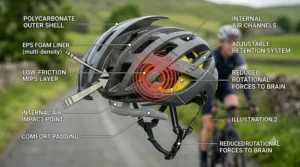
KinetiCore is Lazer’s proprietary alternative to MIPS. Rather than adding a low-friction liner, it profiles the EPS foam core itself to create crumple zones that collapse upon impact and absorb rotational energy. The practical upshot: the helmet is marginally lighter than MIPS equivalents (around 294g in medium), and the overall structure feels cleaner and less cluttered internally. The ScrollSys fit adjuster — operated via a rollable belt rather than the usual dial — is genuinely clever and easy to work one-handed when you’re on the move. A rare convenience when you’re trying to tighten your lid before a fast descent on a cold November morning in the Cotswolds.
Ventilation is solid for the price, with large front vents feeding air across the scalp reasonably efficiently. The hard outer shell wraps around the full rim of the helmet — a build quality detail that sets it apart from cheaper helmets with exposed EPS at the edges. UK customers report good availability on Amazon.co.uk with Prime-eligible delivery.
✅ Five-star Virginia Tech rating at sub-£100 price
✅ Premium ScrollSys fit system from Lazer’s high-end range
✅ Clean, fully wrapped shell construction
❌ Fit runs slightly narrow for wider head shapes
❌ Scrollsys adjuster takes brief acclimatisation
Around £85–£100. Arguably the best safety-to-pound ratio in this entire guide.
3. Giro Agilis MIPS — Best Everyday Road Helmet
The Giro Agilis MIPS occupies exactly the right space in the market: genuinely good rather than aggressively premium, and priced to make you feel sensible rather than indulgent.
With 32 air vents and Giro’s Roc Loc 5.5 fit system, the Agilis delivers ventilation that genuinely rivals helmets costing twice as much. The deep-fit design — Giro’s term for a more generous rear coverage that sits lower on the back of your head — offers more substantial protection in the region where oblique impacts are statistically most common. MIPS-C2, the updated second-generation MIPS liner, integrates into the retention system rather than sitting as a loose inner shell, reducing the slight rotational play that older MIPS designs sometimes produce. The spec sheet won’t tell you this, but that integration means the helmet fits snugger on the head — less of the faint “floating” sensation some riders find disconcerting with original MIPS helmets.
Virginia Tech’s independent testing gives the Agilis a five-star rating, placing it among the safest helmets at any price. For UK riders doing regular club runs, sportives, or simply wanting a reliable daily helmet for all-year commuting, this is the one. The high-visibility colourways are well-suited to British autumn and winter riding, when shorter days make visibility on narrow country lanes a genuine concern rather than a minor preference.
UK reviews on Amazon.co.uk frequently highlight the comfort on longer rides — relevant given that Britain’s cycling clubs tend to favour three-to-four-hour Sunday morning routes rather than the shorter, harder intervals common in continental riding culture.
✅ 32 vents — exceptional airflow for the price
✅ MIPS-C2 five-star Virginia Tech safety rating
✅ Deep-fit design for broader coverage
❌ Slightly heavier than premium equivalents
❌ Limited colour range in some sizes
Around £99–£130. The sensible choice for riders who want professional-grade safety without a professional’s budget.
4. POC Omne Air MIPS — Best for All-Day Comfort
POC is a Swedish brand that took the cycling world slightly by surprise — a ski protection company that decided to apply the same rigorous safety philosophy to road cycling helmets, and ended up producing some of the most intelligently designed lids in the industry.
The Omne Air MIPS sits in POC’s commuter and leisure range, and it’s the company’s answer to a genuine tension: can a helmet be both safe and genuinely comfortable to wear for hours? The answer is yes, emphatically, mostly due to the cradle and dial retention system that distributes pressure evenly around the entire head rather than concentrating it at a few contact points. At around 250g in a medium, it’s pleasingly light. The ventilation profile uses fewer, larger vents — a POC hallmark — that create less turbulent airflow than many competing designs. In practice this means at moderate speeds the helmet breathes freely, though it won’t quite match the raw airflow of open-vent designs like the Giro Agilis on scorching days.
MIPS liner here works conventionally, adding approximately 10g over the non-MIPS version and providing the established rotational impact protection. The design is understated and distinctly European in aesthetic — no aggressive aero tail fins or loud graphics — which suits British sensibilities rather well. Sunglass integration is thoughtfully executed, with ports that grip eyewear stems securely during climbs and sprints.
UK reviewers particularly value its versatility: equally appropriate for a long Sunday ride, a commute across Bristol’s hills, or a touring stint through rural Scotland. Prime-eligible on Amazon.co.uk.
✅ Outstanding all-day comfort via balanced pressure distribution
✅ Clean, versatile design suits all riding contexts
✅ MIPS protection at an accessible mid-range price
❌ Fewer vents than open-vent road designs
❌ Premium POC colourways cost more
Around £130–£170. The helmet you forget you’re wearing — which is exactly what you want.
5. Kask Protone Icon WG11 — Best Italian-Built Performance Helmet
Kask is Italian. This matters. The Italian cycling apparel industry operates on the slightly wonderful premise that there is no reason why performance equipment cannot also be beautiful, and the Protone Icon WG11 is the physical manifestation of that philosophy.
At around 223g in medium — one of the lightest road helmets on Amazon.co.uk at this price point — the Protone Icon achieves something remarkable: it feels like barely anything is on your head, yet 21 precisely engineered vents create what testers at road.cc have described as the airiest helmet in this price bracket. The WG11 designation refers to Kask’s own rotational impact protection system, which uses elastomeric pads rather than a full MIPS liner to mitigate rotational forces. It scores well in Virginia Tech testing, though doesn’t quite reach the five-star peak of MIPS-C2 designs.
What sets the Protone Icon apart for UK riders isn’t the headline specs — it’s the all-season versatility. Its ventilation performs impressively in the 10–18°C temperature range that defines most British riding weather, and the ten available colourways include several understated tones that don’t shout “I take this too seriously” to everyone in the coffee queue. The retention system is elegant but, worth noting, not the most adjustable for unusual head shapes — a constraint in an otherwise impeccable design.
Spotted regularly on professional WorldTour riders, though to be clear: they aren’t riding sportives in Derbyshire. The Protone Icon makes perfectly good sense for the amateur rider who wants pro-level quality and will actually notice the weight difference on a long day in the saddle.
✅ Exceptional lightweight at 223g
✅ 21 vents with outstanding real-world cooling
✅ Timeless Italian design in multiple UK-appropriate colourways
❌ WG11 system slightly below MIPS-C2 in independent testing
❌ Retention system less accommodating of very round or very narrow heads
Around £150–£220 on Amazon.co.uk. Wear it once on a summer morning. You’ll understand the price.
6. Giro Eclipse Spherical — Best Aero Road Helmet
The Giro Eclipse Spherical is what happens when a brand decides that “aero” and “comfortable to actually ride in” don’t need to be mutually exclusive. Previous generations of aero helmets were essentially plastic fish-heads that cooked your brain above 20°C and made you look like you were permanently about to race a time trial against the clock. The Eclipse Spherical is not that.
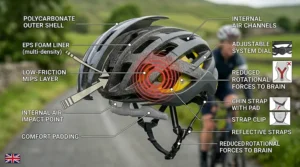
Spherical technology — Giro and Bell’s exclusive take on MIPS — uses a two-shell ball-and-socket construction rather than a liner. The outer shell slides over the inner upon impact, addressing rotational forces more smoothly than standard MIPS. Virginia Tech scores the Eclipse Spherical five stars. More importantly for everyday British riding: the ventilation is genuinely adequate for all-season use. Not the best airflow in this guide — that honour goes to the Agilis or Kask — but the Eclipse maintains comfortable temperatures up to around 20°C without issue. Given that British summers frequently top out around that figure, this is less of a compromise than it sounds.
Wind tunnel-validated aero shaping adds measurable drag savings at 40–45 km/h — the sort of benefit that registers meaningfully on longer sustained efforts into a headwind (and if you’ve ever ridden into a typical North Sea coast headwind, you’ll know those are frequent and deeply personal). For riders whose club rides occasionally tip into competitive territory, or who enter sportives with timed segments, the Eclipse Spherical earns every penny of its price.
UK buyers can find it on Amazon.co.uk in multiple sizes and colourways, with Prime-eligible delivery typically next day.
✅ Spherical MIPS — five-star Virginia Tech safety
✅ Genuine aero benefit in real riding conditions
✅ Better ventilation than most aero helmets in its class
❌ Premium price requires genuine commitment to aero riding
❌ Heavier than pure ventilation-focused options at 260g
Around £200–£260. The one to buy if you’re serious about speed and refuse to roast your head to get it.
7. MET Trenta 3K Carbon MIPS — Best Lightweight Premium Helmet
MET is an Italian brand that has spent the better part of three decades obsessing over grams, and the Trenta 3K Carbon MIPS is the obsession made material. At around 220g in a medium, it is one of the lightest road helmets you can buy on Amazon.co.uk without crossing into bespoke territory.
The 3K designation refers to the carbon fibre weave pattern integrated into the outer shell — a technique that allows MET to reduce EPS foam density (saving weight) while the carbon maintains structural integrity. MIPS Air, the version used here, integrates the liner into the ventilation channels themselves, minimising the weight penalty. The result is a helmet that weighs barely more than the non-MIPS Trenta — around 220g versus 217g — which is a remarkable engineering achievement. Virginia Tech testing awards it a five-star rating, and a recent overhaul of the internal impact geometry has reportedly improved safety scores by around 40% over the previous version.
The wave-shaped rear with twin exhaust vents is MET’s aerodynamic signature — it looks distinctive and manages airflow surprisingly effectively. For climbers specifically, this is the helmet. Every 10g removed from your head is a free gift on a long mountain day — and in a British context, that means routes like the Honister Pass in the Lake District, Bealach na Bà in the Scottish Highlands, or the relentless drag up to the Buttertubs Pass in the Yorkshire Dales.
UK buyers should confirm size availability on Amazon.co.uk before purchasing, as the 3K Carbon range can have limited stock in smaller or larger sizes.
✅ Ultralight 220g — among the lightest on Amazon.co.uk
✅ Carbon-reinforced shell with MIPS Air five-star rating
✅ Excellent aerodynamic profile for the weight class
❌ Carbon shell requires more careful handling than standard polycarbonate
❌ Premium price demands genuine weight-conscious riding intent
Around £200–£280. For riders who actually count grams — and we mean that as a compliment.
How to Choose a Road Bike Helmet in the UK: A Practical Framework
So you’ve browsed the seven options above and you’re still not sure. That’s normal. Here’s a numbered decision framework to cut through it.
1. Start with safety certification, not aesthetics. All helmets in this guide meet EN 1078, the European safety standard that remains applicable to the UK market post-Brexit. However, not all meet the more demanding Virginia Tech MIPS helmet ratings, which test for both direct and rotational impacts — the kind more common in real cycling accidents. Prioritise five-star Virginia Tech ratings where possible. Every helmet in this guide achieves it.
2. Fit is the single most important variable. A premium helmet that fits poorly is worse than a budget helmet that fits well. Road helmets generally come in small (50–54cm), medium (54–58cm), and large (58–62cm), though sizing varies by brand. Measure your head circumference with a flexible tape, placed 2cm above your ears. Then check the brand’s specific size chart. British heads, interestingly, tend to run slightly rounder than the oval profile many American-designed helmets assume — worth noting when selecting POC or Giro models.
3. Match ventilation to how you actually ride. British riders doing three-hour club rides on cool days will rarely overheat in even moderate-vent helmets. But if you climb regularly, or ride during the UK’s increasingly warm summers, prioritise vent count. The Giro Agilis (32 vents) and Kask Protone Icon (21 large vents) lead this guide on airflow.
4. Consider retention system quality carefully. A dial-adjust retention system should wrap completely around your skull, not anchor at the temples. One-hand adjustability matters more than you’d think when you’re 80km into a sportive and need to tighten up on a descent without stopping.
5. Set a realistic budget in GBP. Under £80: safety is fine, refinement is limited. £80–£130: the sweet spot for most UK club riders. £130–£220: noticeable quality leap, justified for regular or serious riders. Over £220: weight and aero gains become tangible but marginal. Be honest about how much you ride.
6. Confirm Amazon.co.uk availability before deciding. Some premium helmets ship from EU warehouses with extended delivery times post-Brexit. Prime-eligible listings on Amazon.co.uk ensure fast delivery with full UK Consumer Rights Act 2015 protections and a 14-day cooling-off period if the fit isn’t right.
Real-World Riding Scenarios: Which Helmet for Which UK Rider
The London Commuter (Zone 2, Rain-Prone)
You’re cycling from Hackney to the City. It rains roughly four out of five mornings. You need a helmet that fits cleanly under a buff on cold mornings, handles sweat during unexpectedly warm Tube-free Tuesdays, and doesn’t make you look like you’re en route to the Tour de France while picking up coffee in Shoreditch.
Best match: POC Omne Air MIPS. The understated design is city-appropriate, the all-day comfort is genuine, and the MIPS protection makes sense given the particular character of urban cycling accidents — slower speed, more oblique impacts from kerbs, parked car doors, or unexpected gravel patches. It’s also durable enough to handle the daily abuse of a commute without requiring the careful handling of a carbon-shelled premium model.
The Yorkshire Dales Weekend Rider
You do one big ride a week. It’s usually 60–100km, often hilly, frequently cold, occasionally spectacular. You don’t race but you’re competitive with yourself and your mates. Budget is sensible but not restrictive.
Best match: Giro Agilis MIPS. Thirty-two vents will keep you cool on long climbs, the deep-fit coverage suits the kind of falls that happen on gravel-strewn descents in autumn, and the MIPS-C2 system gives you genuine peace of mind without spending on features you won’t use. The Kask Protone Icon is also excellent here if the budget stretches.
The Sportive Rider Eyeing Timed Segments
You’ve entered the Etape Caledonia or the Dragon Ride. You want every marginal advantage. You’ll climb, descend fast, and spend considerable time in the drops on long valley roads into headwinds.
Best match: Giro Eclipse Spherical. The aero shaping saves measurable watts at sustained speed, the Spherical MIPS protection handles high-speed impacts, and the ventilation is sufficient for Scottish or Welsh summer temperatures. The MET Trenta 3K Carbon is the alternative if the climbing stages are where you most need help.
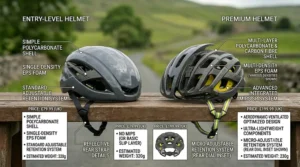
What to Look for in a Road Bike Helmet: Features That Actually Matter (And Those That Don’t)
What genuinely matters:
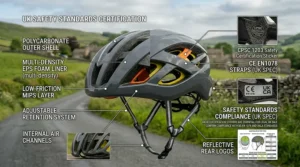
Rotational impact protection. MIPS, Spherical MIPS, KinetiCore, WG11 — the terminology varies but the principle is the same. Research published in the British Journal of Sports Medicine consistently shows that rotational forces, rather than direct impacts, are the primary cause of traumatic brain injuries in cycling accidents. Any helmet without some form of rotational protection system is a compromise.
Fit system quality. A retention dial that wraps fully around the rear of your skull provides measurably more stable fit than one that anchors at the temples only. Test by shaking your head firmly from side to side whilst wearing a fastened helmet — there should be virtually no movement.
CE/UKCA certification. Post-Brexit, the UK recognises both CE marking (for helmets manufactured for the EU market) and UKCA marking (the new UK conformity assessment mark). According to the UK Government’s official guidance on product safety, all helmets sold in Great Britain must carry appropriate conformity marking. Every helmet in this guide meets the required standard.
Weight under 300g. Above this threshold, neck fatigue becomes a meaningful factor on rides exceeding three hours. Below it, most riders won’t notice the difference between, say, 245g and 270g in real riding conditions.
What mostly doesn’t matter:
“Aerodynamic” styling on helmets under £150. Genuine aero benefit requires wind-tunnel validation and engineered surface geometry. Marketing photography of a helmet with a pointed tail does not constitute aerodynamic advantage. Save the aero premium for helmets where it’s genuinely tested.
Visor attachments on road helmets. Road cyclists don’t generally want visors; sunglasses serve that purpose better. Visor mounts add weight and complexity without utility in a road-specific context.
Colour choices beyond basic preference. High-visibility colourways (yellow, orange, white) do improve your conspicuity to drivers in low-light conditions — worth considering if you commute in British winters. Beyond that, colour is personal preference.
Long-Term Cost and Maintenance: What UK Buyers Often Overlook
A road bike helmet isn’t a one-time purchase. Here’s what to factor into the total cost of ownership.
Replace after any significant impact. This isn’t marketing — EPS foam compresses permanently in a crash and may not be visible externally. UK consumer advice from Cycling UK recommends replacing helmets after any impact with a hard surface, even if the helmet appears undamaged. Budget for replacement accordingly.
Replace every 3–5 years even without a crash. UV exposure (yes, even British UV), sweat, and general wear degrade both the EPS foam and the outer shell over time. The Snell Memorial Foundation recommends five years as a maximum lifespan; most manufacturers concur.
Spare padding and fit pads are available and replaceable on most helmets in this guide — particularly Giro and Bell models, which sell comfort padding sets on Amazon.co.uk for under £15. Worth replacing annually if you’re a heavy sweater or year-round commuter.
Storage matters. Helmets stored in car boots (the classic British compromise) are exposed to temperature extremes and UV through glass that accelerate material degradation. A simple hook in your hallway extends helmet life meaningfully. Given the storage constraints of the average UK terraced house, a compact hook system — available cheaply on Amazon.co.uk — solves this neatly.
Post-Brexit warranty notes. If purchasing a European-made helmet (MET, POC, Kask, Lazer), check that the UK retailer — in this case Amazon.co.uk — provides UK-based warranty support. Purchasing through Amazon.co.uk ensures full protection under the Consumer Rights Act 2015 and the 14-day online cooling-off period under Consumer Contracts Regulations. Returns are straightforward and don’t require dealing with overseas warranty departments.
✨ Don’t Miss These Exclusive Deals!
🔍 Ready to upgrade your ride? Click any highlighted helmet name in this guide to check current pricing, available sizes, and estimated delivery on Amazon.co.uk. Prime members enjoy free next-day delivery on eligible items.
Common Mistakes When Buying a Road Bike Helmet in the UK
1. Buying the right brand in the wrong size. Road helmet sizing is brand-specific. A Medium in Giro sits differently from a Medium in POC or Kask. Always measure your head circumference and consult the specific brand’s sizing chart, not a generic guide. This is the most common cause of helmet returns.
2. Ignoring UK-specific colourway limitations. Several premium helmets in this guide are offered in the UK market with a reduced colourway selection compared to the US. Don’t assume the colour you see on a US review site is available through Amazon.co.uk. Check stock before deciding.
3. Prioritising weight over fit. The MET Trenta 3K Carbon at 220g is objectively lighter than the Giro Agilis at 260g. If the Trenta doesn’t fit your head shape, the 40g difference is meaningless. Fit first, weight second. Always.
4. Assuming all MIPS is identical. MIPS-C2, Spherical MIPS, and standard MIPS liner all operate on similar principles but differ meaningfully in execution. Spherical MIPS (in the Giro Eclipse) is generally considered the most refined implementation. Standard MIPS liner (in the Agilis) is perfectly effective and lighter on your wallet. The difference is real but not dramatic for most riders.
5. Overlooking retention system quality at the budget end. Under £70, retention dials often anchor at the temples rather than wrapping fully around the skull. This is a genuine stability limitation, not merely a comfort one. It’s worth spending an extra £20–£30 to access a full rear-wrap retention system if you’re near the budget end.
6. Skipping the return window test. Amazon.co.uk’s 14-day cooling-off period exists precisely for moments like helmet fitting. Order the helmet, wear it on a stationary trainer for 30 minutes, check for pressure points. If it doesn’t work, return it. Use the window — that’s what it’s for.
FAQ
❓ What certifications should a road bike helmet have in the UK?
❓ How often should I replace my road bike helmet?
❓ What is the difference between MIPS and KinetiCore in a road helmet?
❓ Are road bike helmets on Amazon.co.uk covered by UK consumer protection?
❓ How do I measure my head for a road bike helmet in the UK?
Conclusion
A road bike helmet buying guide that treats every helmet as equally valid is doing you a disservice. The reality is simpler: your choice comes down to where you ride, how often, how hard, and what you’re comfortable spending in GBP.
For most UK road cyclists — club riders, weekend warriors, regular commuters — the Giro Agilis MIPS and Lazer Strada KinetiCore represent genuinely excellent value at their respective price points, with the safety credentials to back up the marketing. If your riding is serious and your budget allows, the Kask Protone Icon and Giro Eclipse Spherical are the step-change in quality and refinement that premium prices should deliver.
British riding conditions add their own considerations. Visibility in the short winter days, comfort in 10–15°C riding temperatures, and the durability to handle year-round use in a climate that is definitively not kind to equipment — these are the practical filters through which any helmet should pass before landing in your checkout basket.
One final thought: the right helmet is the one you’ll actually wear, every ride, without complaint. The best helmet in this guide, left on a hook because it pinches slightly, is worse than the simplest one that fits perfectly. Get the fit right first. Everything else follows from there.
✨ Don’t Miss These Exclusive Deals!
🔍 Ready to choose? Click any highlighted helmet in this guide to check current pricing and availability on Amazon.co.uk. All seven options offer Prime-eligible delivery, and Amazon’s 14-day returns policy means you can try before committing.
Recommended for You
- Best MIPS Road Cycling Helmet UK 2026: 7 Top Picks Rated
- Best Lightweight Road Cycling Helmets UK 2026: 7 Expert-Tested Picks
- Best Road Cycling Helmet UK 2026: 7 Expert-Tested Picks
Disclaimer: This article contains affiliate links. As an Amazon Associate, I earn from qualifying purchases. If you purchase products through these links, we may earn a small commission at no additional cost to you.
✨ Found this helpful? Share it with your mates! 💬🤗
