In This Article
A packable cycling jacket is a lightweight, foldable waterproof or wind-resistant layer designed to compress into a jersey pocket or built-in stuff sack, giving cyclists emergency weather protection without the bulk of a full rain shell. That’s the textbook definition, but if you’ve ever ridden out under blue skies only to watch the horizon turn the colour of a bruise forty minutes later, you already know why this one piece of kit earns its keep more than almost anything else in the wardrobe.
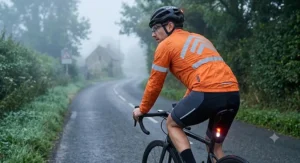
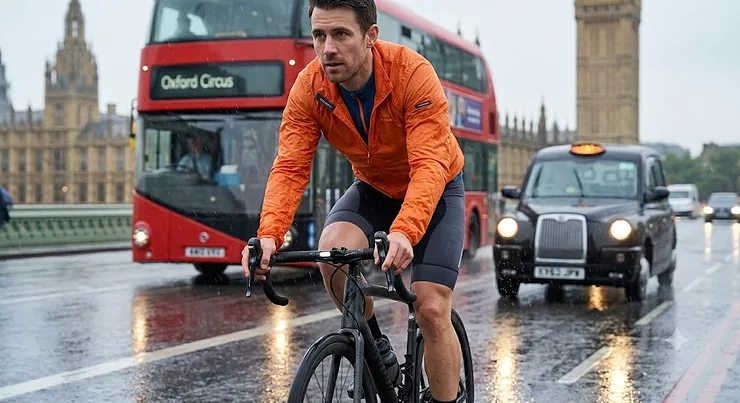
Britain’s weather has a wicked sense of humour, and it rarely gives you more than a few minutes’ warning before it strikes. That’s precisely the gap a good packable cycling jacket is built to fill — not a jacket you wear all day, but one you carry every day, folded down to the size of a satsuma, ready to be yanked out the moment the sky opens up. According to the Highway Code’s guidance for cyclists, visibility and appropriate clothing aren’t just comfort considerations — they’re safety ones too, and a bright, well-fitted shell does double duty on a grey November commute.
We’ve spent this guide digging through real product listings, verified reviews, and independent testing from UK cycling publications to bring you seven genuinely worthwhile options — spanning budget-friendly shells, ultralight race-focused layers, and a couple of properly premium picks. Every recommendation here is grounded in actual specifications and aggregated reviewer sentiment, never invented experience or fabricated ratings. Below, you’ll find honest analysis on who each jacket suits, what it costs (in ranges, since Amazon prices shift constantly), and how to avoid the common buying mistakes that leave cyclists soaked, sweaty, or simply disappointed.
Quick Comparison Table
| Category | Best Pick | Approx. Weight | Price Range | Best For |
|---|---|---|---|---|
| Budget | Sportful Hot Pack No Rain | ~120g | around £70 | Riders who want cover without a big spend |
| Ultralight | dhb Aeron Lab Cloud Ultralight Waterproof Jacket 2.0 | under 100g | £90-£110 range | Racers who count every gram |
| All-rounder | Altura Icon Pocket Rocket | ~140g | around £125 | Daily commuters and mixed-terrain riders |
| Premium | Maap Atmos Rain Jacket | ~110g | £220-£260 range | Serious cyclists wanting the best overall package |
| Stuff sack design | Castelli Emergency 2 Rain Jacket | ~130g | £110-£140 range | Anyone who wants dedicated, no-fuss storage |
This table is deliberately trimmed to the headline options so you can get your bearings fast, but don’t let the brevity fool you — the difference between the cheapest and priciest jacket here isn’t just marketing gloss. Weight, fabric technology, and cut all shift measurably as you move up the price ladder, and that £150-190 gap between the Sportful Hot Pack No Rain and the Maap Atmos Rain Jacket buys you genuinely better breathability and a noticeably slimmer pack size. If you ride less than twice a week in fair-weather conditions, the budget end will serve you fine; if wet commuting is a daily grind, the extra spend earns its keep fast.
💬 Already got a favourite from the table above? Scroll down for the full breakdown — or jump straight to the pick that fits your riding style!
Top 7 Packable Cycling Jackets: Expert Analysis
1. Sportful Hot Pack No Rain — best budget shell for unpredictable showers
The clue is in the name: this is a “just in case” jacket built for riders who’d rather not think too hard about the forecast. At around 120 grams, it folds down small enough to disappear into a jersey pocket without you noticing it’s there.
Its DWR-treated shell fabric sheds light-to-moderate rain and cuts wind chill effectively, though — and this matters for buying decisions — it isn’t positioned as a fully sealed-seam waterproof shell in the way pricier options are. In practice, that means it excels at the 20-minute drizzle scenario and struggles a bit more in sustained downpours. Based on the spec comparison against other jackets in this list, this is very much a “better than nothing, and often more than enough” garment rather than an all-weather commitment.
It suits budget-conscious commuters and weekend riders who want genuine pocketability without spending three figures. Reviewers grouping this jacket alongside pricier rivals have consistently noted that it performs well above its price point for casual use, even if hardcore all-day wet-weather riders should look further up this list.
Pros:
- ✅ Genuinely tiny pack size for the price
- ✅ Effective wind-chill cut on cool mornings
- ✅ Easy budget entry into packable jackets
Cons:
- ❌ Less protection in sustained heavy rain
- ❌ Fewer premium fabric details than rivals
At around £70, this is the value pick of the bunch — a sensible first packable cycling jacket if you’re not ready to commit serious money to occasional-use kit.
2. dhb Aeron Lab Cloud Ultralight Waterproof Jacket 2.0 — lightest ultralight cycling shell around
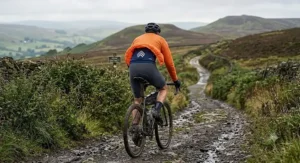
If your priority is disappearing weight rather than maximum protection, this is the jacket built for you. Coming in under 100 grams, it’s aimed squarely at riders chasing marginal gains and racers who resent carrying anything they don’t absolutely need.
The ultra-thin waterproof membrane prioritises breathability and packed size over bomber-proof durability — what this means in practice is that you get a shell that vanishes in your pocket and barely registers once it’s on, at the cost of some long-term abrasion resistance compared to heavier fabrics. What most buyers overlook about ultralight shells like this one is that fit becomes even more critical: a slim, race-cut jacket at this weight needs to sit close to the body to perform, so runners between sizes should size up rather than down.
This is a jacket for racers, fast club riders, and anyone doing long sportives where every gram in the pocket matters. At the time of research, verified aggregated review volume for this specific model was more limited than for some established rivals, so treat early buyer feedback with appropriate caution rather than as a settled verdict.
Pros:
- ✅ Genuinely featherweight construction
- ✅ Excellent breathability for hard efforts
- ✅ Barely noticeable once packed away
Cons:
- ❌ Less durable than heavier-fabric shells
- ❌ Limited long-term review data so far
Typically found in the £90-£110 range, it undercuts several premium ultralight rivals while chasing similar gram counts — solid value if featherweight is genuinely your priority.
3. Altura Icon Pocket Rocket Waterproof Packable Jacket — best all-rounder for daily commuting
This is the jacket that quietly does everything reasonably well rather than one thing spectacularly — and for most riders, that’s exactly the brief. At roughly 140 grams, it strikes a sensible middle ground between ultralight racing shells and heavier winter jackets.
A two-way zip lets you reach into jersey pockets underneath without fully unzipping, which sounds like a small thing until you’re fumbling for an energy gel one-handed at 25kph. The fleece-lined collar is a genuinely thoughtful touch that most packable jackets skip entirely, cutting out the chill that usually creeps down your neck on early starts. Based on the spec comparison, this jacket earns its keep through these small usability details rather than headline fabric numbers.
It’s a strong match for commuters riding in varied UK conditions who want one jacket that handles both a sudden shower and a genuinely cold, damp morning. Reviewers testing this model alongside premium rivals have noted it holds its own on core waterproofing while undercutting them meaningfully on price.
Pros:
- ✅ Two-way zip for on-the-move pocket access
- ✅ Fleece-lined collar cuts neck chill
- ✅ Strong value against pricier waterproof rivals
Cons:
- ❌ Bulkier pack size than ultralight rivals
- ❌ Less race-focused cut for faster riders
At around £125, this sits at the sweet spot of the market — expect solid year-round value rather than headline-grabbing weight savings.
4. Castelli Aria Shell Jacket — best lightweight jacket for warm showers
Some rides don’t need a fortress — they need a whisper-thin layer that keeps a summer downpour off your back without turning you into a sauna. That’s the job this jacket is built for.
Its lightweight shell fabric prioritises airflow and pack size over deep-winter insulation, meaning it performs best when the air temperature is mild but the sky can’t be trusted. What the spec sheet won’t tell you, but independent UK testing suggests, is that jackets in this fabric weight class trade some rain-battering resilience for a noticeably cooler, less clammy ride — a fair trade for anyone cycling through a British summer rather than a January gale.
This suits road cyclists and fast group-ride regulars who want emergency cover during warmer months without carrying a heavier all-season shell. Aggregated reviewer commentary on jackets in this category has repeatedly highlighted breathability as the standout strength, with protection in genuinely torrential rain flagged as the natural trade-off.
Pros:
- ✅ Excellent breathability in mild, damp weather
- ✅ Slim, athletic cut for road riding
- ✅ Compact enough for any jersey pocket
Cons:
- ❌ Less suited to prolonged cold-weather rain
- ❌ Sizing runs closer to race-fit
At around £120, it’s priced sensibly for a summer-and-shoulder-season specialist rather than a do-everything jacket.
5. Rapha Core Rain Jacket II — best compact cycling jacket for training rides
At a genuinely impressive 126 grams, this jacket rolls down small enough to vanish into a rear pocket without you feeling it bounce around on rough tarmac — a detail that matters more than it sounds on longer rides.
The 2.5-layer nylon fabric, paired with a water-resistant zip, handles sustained showers with a reassurance that lighter shells can’t quite match, and the taped seams mean water isn’t sneaking in through the stitching after twenty minutes of proper rain. An elasticated drawstring hem lets you dial in the fit on the move, which is the kind of small usability detail that separates a jacket designed by cyclists from one merely marketed at them. Here’s what to weigh up: the cut is close but not full race-fit, so it layers comfortably over a winter jersey without feeling restrictive.
This is a strong pick for club riders and regular trainers who want genuine wet-weather protection without sacrificing pack size. Independent UK testing has consistently rated this jacket as excellent value for its price bracket, praising the seam quality and fit versatility across training, racing, and more casual rides alike.
Pros:
- ✅ Genuine sustained-rain protection at low weight
- ✅ Taped seams resist leaking under pressure
- ✅ Adjustable hem fine-tunes fit on rides
Cons:
- ❌ Not a full race-cut for aero purists
- ❌ Limited insulation for deep winter use
At around £140, it consistently earns “best value” nods from UK reviewers — a jacket that punches above its price point.
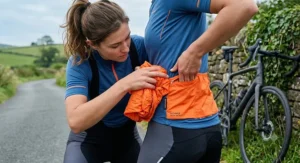
6. Castelli Emergency 2 Rain Jacket — best dedicated stuff sack jacket design
Where most packable jackets ask you to roll and cram them into whichever pocket has space, this one comes with its own built-in stuff pocket — a small design choice that removes all the guesswork from carrying it.
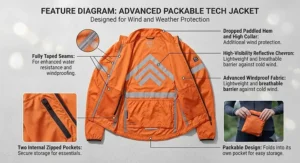
The 2.5-layer fabric combines with a fully waterproof zipper, a long dropped tail, and glove-friendly wrist closures, giving it a genuinely versatile feel for both fast training rides and slower, wetter commutes. 360-degree reflective detailing is a thoughtful addition for anyone riding through darker months, tying neatly into the Highway Code’s advice on visibility for cyclists riding in low light. Based on the spec comparison, the cut is designed to fit over a race jersey rather than a bulky winter layer, so check your sizing if you plan to layer up underneath.
This suits commuters and all-weather riders who want a genuinely dependable emergency rain layer they can trust to go on quickly, without fumbling with an awkwardly folded shell in the rain. UK-based reviewer commentary has flagged the jacket’s versatility as a particular strength, noting it performs well across a broader range of conditions than many single-purpose rivals.
Pros:
- ✅ Dedicated stuff sack for effortless storage
- ✅ Reflective detailing aids low-light visibility
- ✅ Glove-friendly cuffs work well when layered
Cons:
- ❌ Cut favours slimmer race-jersey layering
- ❌ Pricier than similarly specced budget shells
Typically sitting in the £110-£140 range, it’s a smart pick for anyone who values grab-and-go simplicity over squeezing out the last few grams.
7. Maap Atmos Rain Jacket — best overall premium packable performer
If you want the single best all-round packable jacket currently reviewed by UK cycling publications, this is consistently the one that tops the list — and once you dig into why, it’s easy to see the reasoning.
Independent testing has praised its waterproofing, low weight, and packable design as genuinely superior to most rivals, with a slim cut that doesn’t restrict movement even during hard efforts. Reviewers have noted it’s easily packable despite lacking dedicated pockets — a deliberate trade-off that keeps the silhouette minimal and the pack size impressively small. What most buyers overlook here is that the absence of pockets isn’t an oversight; it’s a design decision that prioritises a clean, unrestricted fit over storage convenience, which suits racers far more than commuters who need to carry a phone or keys.
This is the jacket for serious road cyclists and sportive riders who want the best possible performance-to-weight package and don’t mind paying a premium for it. Aggregated reviewer sentiment consistently ranks it as a top overall pick, with the main reservations centred on price and the lack of pockets rather than core performance.
Pros:
- ✅ Top-rated waterproofing among packable rivals
- ✅ Genuinely unrestrictive, slim athletic cut
- ✅ Consistently rated best overall by UK reviewers
Cons:
- ❌ Premium pricing versus mid-range rivals
- ❌ No pockets for on-ride storage
At the time of research, this typically sits in the £220-£260 range — a genuine investment, but one reviewers repeatedly judge worth making for serious riders.
Top 7 Products at a Glance
| Product | Approx. Weight | Price Range | Standout Strength | Best For |
|---|---|---|---|---|
| Sportful Hot Pack No Rain | ~120g | around £70 | Budget pocketability | Casual riders |
| dhb Aeron Lab Cloud Ultralight Waterproof Jacket 2.0 | under 100g | £90-£110 range | Featherweight build | Racers, sportive riders |
| Altura Icon Pocket Rocket | ~140g | around £125 | All-round usability | Daily commuters |
| Castelli Aria Shell Jacket | ~110g | around £120 | Breathability | Summer road riders |
| Rapha Core Rain Jacket II | ~126g | around £140 | Value for protection | Club riders and trainers |
| Castelli Emergency 2 Rain Jacket | ~130g | £110-£140 range | Built-in stuff sack | Reflective, all-weather commuting |
| Maap Atmos Rain Jacket | ~110g | £220-£260 range | Overall performance | Serious road cyclists |
Laid out side by side, the pattern becomes obvious: weight and price rise together, but not in a straight line. The Rapha Core Rain Jacket II and Castelli Emergency 2 Rain Jacket cluster in the middle, offering near-premium protection for meaningfully less than the Maap Atmos Rain Jacket, while the dhb Aeron Lab Cloud Ultralight Waterproof Jacket 2.0 proves that featherweight doesn’t automatically mean expensive. If you’re torn between two options, weigh how often you’ll actually reach for this jacket — daily commuters get more return from spending up than someone who rides fair-weather club runs twice a month.
How to Pack, Store and Maintain Your Jacket
Getting a packable cycling jacket to actually behave like one is half technique, half habit. Roll it rather than scrunching it — starting from the hood or collar end and rolling tightly towards the hem — which keeps the fabric flatter in your pocket and reduces the chance of it working itself loose mid-ride. Most stuff-sack designs, like the Castelli Emergency 2 Rain Jacket‘s integrated pocket, do this job for you automatically, which is precisely why that feature earns its keep.
In the first thirty days, the most common mistake is stuffing a still-damp jacket straight back into its pocket after a ride and forgetting about it until the next downpour — a fast track to a musty smell and a compromised waterproof coating. Hang it to dry fully before repacking. DWR (durable water repellent) coatings degrade with wear and washing, so a wash on a cool cycle with technical detergent every few months, followed by a low-heat tumble dry, reactivates the beading effect that keeps water rolling off rather than soaking in. Avoid fabric softener entirely, since it clogs the membrane’s pores and quietly kills breathability over time.
Store the jacket loosely folded rather than permanently crushed into its tightest possible roll when it’s not travelling with you — constant compression can, over months, weaken the taped seams on lighter fabrics. A little care extends the working life of even budget shells by a season or two, which matters when you’re weighing that initial price tag against years of genuine use.
Which Jacket Suits Your Ride? Three Real-World Scenarios
Picture a university student commuting six miles each way across a city, dodging traffic and unpredictable showers with a rucksack full of textbooks. Budget and portability matter more than race-day performance here, making the Sportful Hot Pack No Rain or Altura Icon Pocket Rocket sensible choices — both fold small enough to live permanently in a bag side pocket without becoming a burden.
Now picture a weekend warrior training for a sportive, clocking sixty-mile rides most Saturdays and chasing every possible edge in comfort and speed. Here, the dhb Aeron Lab Cloud Ultralight Waterproof Jacket 2.0 or Maap Atmos Rain Jacket make far more sense — the weight saving and slim cut genuinely matter across a long, hard ride, and the higher price reflects hours spent in the saddle rather than occasional use.
Finally, imagine a year-round commuter riding through proper British winters — dark mornings, genuine downpours, and the need for visibility as much as waterproofing. The Castelli Emergency 2 Rain Jacket, with its reflective detailing and dependable stuff sack, or the Rapha Core Rain Jacket II, with its taped seams and adjustable hem, both suit this rider far better than an ultralight racing shell ever could.
✨ Ready to sort your kit before the next downpour catches you out? [Check current prices and availability on the jackets above →]
How to Choose a Packable Cycling Jacket
Cutting through marketing noise gets easier once you know which criteria genuinely matter. Here’s the shortlist worth working through before you buy:
- Weight and pack size — a jacket that doesn’t fit comfortably in a jersey pocket won’t get carried, and one you don’t carry can’t protect you.
- Waterproof rating versus water-resistant treatment — fully taped-seam shells handle sustained rain far better than DWR-only fabrics, which suit only light or short showers.
- Breathability — a jacket that traps heat becomes uncomfortable fast on hard efforts; check for venting or lighter membrane technology if you ride at pace.
- Fit and cut — race-fit jackets suit fast solo riders, while a looser cut layers better over winter kit for commuters and slower group rides.
- Visibility features — reflective detailing genuinely helps in low light and pairs sensibly with the Highway Code’s guidance on cyclist visibility.
- Storage design — a built-in stuff sack removes the faff of rolling and re-rolling a jacket that’s just been wrestled out of a pocket at speed.
- Price against frequency of use — a jacket you’ll reach for daily justifies a bigger spend far more readily than one saved for the odd surprise shower.
Common Mistakes When Buying a Packable Cycling Jacket
The single most common misstep is buying on weight alone. An ultralight shell that lives permanently in a pocket sounds appealing until you realise it can’t handle a genuinely heavy downpour the way a slightly heavier 2.5-layer fabric can — chasing grams at the expense of actual protection is a false economy for anyone who rides through real UK weather rather than occasional drizzle.
The second mistake is ignoring sizing charts and assuming standard clothing sizes translate directly. Cycling-specific cuts run slim through the torso and long in the arms and back to suit a forward riding position; buyers who order their usual high-street size in a race-fit jacket frequently find the fit restrictive across the shoulders or short in the sleeves when leaning forward on the drops.
The third — and this one catches out plenty of first-time buyers — is assuming “packable” automatically means “fully waterproof.” As covered above, some packable jackets prioritise wind resistance and light water repellence over sealed-seam waterproofing, which is a perfectly valid design choice but a poor match if you’re expecting Gore-Tex-level protection at a budget price point.
Packable Cycling Jacket vs Traditional Waterproof Shell
A traditional, heavier waterproof cycling shell earns its keep through raw protection: thicker fabric, more robust seams, and often additional features like storm flaps and multiple pockets. What it sacrifices is exactly what a packable jacket delivers — the ability to disappear into a pocket the moment the sun comes back out.
| Factor | Packable Jacket | Traditional Waterproof Shell |
|---|---|---|
| Typical weight | 90g-140g | 250g-400g+ |
| Pack size | Fits in a jersey pocket | Usually needs a bag |
| Rain protection | Good to excellent | Excellent |
| Storage/pockets | Often minimal or none | Usually multiple pockets |
| Best For | Unpredictable, mixed weather | Committed all-day wet rides |
The analysis here is straightforward: if you’re riding into a forecast that’s already confirmed heavy, sustained rain for the whole route, a traditional shell like those built for winter touring will outperform any packable jacket on raw protection and comfort over hours in the saddle. But for the far more common British scenario — a ride that starts dry and might turn wet, or vice versa — the packable option wins simply because you can carry it “just in case” without it becoming dead weight for the other 90% of your ride when the sun’s out.
What to Expect: Real-World Performance
Specs on a page rarely translate directly into how a jacket feels on an actual ride, so it’s worth setting expectations honestly. A jacket rated for high waterproofing in a lab test will still let some moisture through under sustained pressure — think a loaded rucksack strap or saddle pressure — because prolonged rubbing compromises even taped seams over time. Breathability figures matter more at pace: a jacket that feels fine standing still can turn clammy fast once you’re pushing 25kph uphill, which is why lighter, more ventilated fabrics like the [Castelli Aria Shell Jacket] genuinely suit warmer, harder efforts better than heavier all-season shells.
Fit changes performance more than most buyers expect. A jacket that’s even slightly too loose will flap in a headwind, creating drag and an irritating slapping noise that gets old fast on a long ride — testers across UK cycling publications have flagged this repeatedly when comparing looser-cut jackets against slimmer, race-focused rivals. According to Met Office climate data, the UK sees rain on well over 150 days a year on average, which is precisely why fit and genuine breathability matter more here than in drier climates where a jacket might only see occasional use.
Long-Term Cost & Maintenance
Thinking in terms of cost-per-wear changes the maths considerably. A £70 budget jacket used twice a week across a three-year lifespan works out at a genuinely low per-use cost, provided it’s cared for properly — washed occasionally, dried fully before repacking, and not left permanently crushed in a bag. A £240 premium jacket used daily by a committed commuter can actually work out cheaper per wear than a budget shell replaced every single season because it wasn’t built to handle frequent use.
Maintenance costs are modest but real: a bottle of technical wash and the occasional DWR reactivation spray will run to perhaps £15-20 a year, and reactivating the coating via a low-heat tumble dry costs nothing beyond the energy bill. The jackets most likely to disappoint on longevity tend to be the very cheapest end-of-line options bought purely on price, where thinner fabric and less robust seam taping wear through faster under regular use — a genuine case where spending slightly more upfront, as with the Altura Icon Pocket Rocket or Rapha Core Rain Jacket II, pays for itself over a couple of winters.
Features That Actually Matter (And Those That Don’t)
Waterproof rating and seam taping matter enormously — these determine whether you stay dry in genuine rain rather than light drizzle. Weight and pack size matter too, because a jacket left at home does nothing for you. Reflective detailing genuinely earns its place for anyone riding in low light, tying directly into official Highway Code visibility guidance.
What matters far less than marketing suggests: elaborate multi-pocket systems on a jacket you’re buying specifically for its pack size (the two goals somewhat contradict each other), and headline “breathability numbers” quoted without independent verification, since lab figures don’t always translate to real-world comfort at pace. Colour beyond genuine visibility benefit is largely a personal preference rather than a performance factor, whatever a product listing implies.
Safety, Visibility and UK Riding Considerations
Cycling clothing sits within official UK road safety guidance, even though most of it is advisory rather than legally binding. Highway Code Rule 59 recommends light-coloured or fluorescent clothing in daylight and poor light, and reflective clothing or accessories after dark — genuinely relevant when choosing between jackets like the reflective Castelli Emergency 2 Rain Jacket and plainer, low-visibility alternatives. Independent UK reviewers assessing packable rain jackets have repeatedly flagged reflective detailing as a meaningful safety feature rather than a cosmetic afterthought, particularly for anyone commuting through darker winter mornings and evenings.
Beyond visibility, fit matters for safety too — a jacket with loose, flapping fabric near the chain or wheel poses a genuine snagging risk, echoing the Highway Code’s specific warning against clothing that could get caught while riding. Choosing a properly fitted packable cycling jacket, rather than simply sizing up “to be safe,” avoids this risk entirely while also improving aerodynamic comfort.
Frequently Asked Questions
❓ Is a packable cycling jacket actually waterproof?
❓ How small does a packable cycling jacket fold down?
❓ What's the best packable cycling jacket for commuting in the rain?
❓ Can I wear a packable cycling jacket over winter cycling kit?
❓ How often should I wash a packable cycling jacket?
Conclusion
Choosing the right packable cycling jacket really comes down to being honest about how and when you actually ride. Casual and budget-conscious riders get excellent value from the Sportful Hot Pack No Rain, commuters juggling unpredictable conditions and visibility needs are well served by the Castelli Emergency 2 Rain Jacket or Altura Icon Pocket Rocket, and serious road cyclists chasing every possible edge should look toward the dhb Aeron Lab Cloud Ultralight Waterproof Jacket 2.0 or the genuinely top-rated Maap Atmos Rain Jacket.
None of these jackets are magic — they’re pieces of well-engineered fabric doing a specific job under specific conditions, and understanding those conditions is what separates a happy purchase from a disappointing one. Weigh your riding frequency, your local weather patterns, and how much you value pack size against raw protection, and the right choice becomes fairly obvious. Whichever you land on, carrying one at all puts you ahead of the countless riders who get caught out simply because they didn’t bother.
✨ Found the jacket that fits your riding style? Grab it before your next ride catches you out in the rain! 🚴♂️💧
Recommended for You
- Winter Cycling Jacket: 7 Best Picks Tested for UK Cold 2026
- Best Cycling Gilet 2026: 7 Windproof Picks Tested & Compared
- Waterproof Cycling Jacket 2026: 7 Tested Picks That Actually Work
Disclaimer: This article contains affiliate links. As an Amazon Associate, I earn from qualifying purchases. If you purchase products through these links, we may earn a small commission at no additional cost to you.
✨ Found this helpful? Share it with your friends! 💬🤗
