
In This Article
Anyone who has tried to cram a fat ponytail under a helmet built for a bald mannequin knows the particular indignity of it: the yank on your scalp, the helmet that suddenly sits three inches too high, the headache that arrives before you’ve even clipped in. A road cycling helmet for women with ponytail compatibility isn’t a gimmick or a marketing footnote — it’s the difference between a helmet you forget you’re wearing and one you fight with every single ride. In practical terms, a ponytail-compatible road helmet uses a raised or gapped retention cradle, often paired with a top-mounted or height-adjustable dial, so your hair threads through cleanly instead of getting mangled underneath the shell.

This matters more than it sounds. Poor helmet fit isn’t just uncomfortable, it’s a genuine safety issue: a helmet perched too high because of a bulky ponytail can shift in a crash instead of staying planted, which undermines the very protection you bought it for. The Highway Code’s guidance for cyclists recommends wearing a helmet that conforms to current regulations, is the correct size and securely fastened — and “correct size and securely fastened” is precisely what a ponytail-hostile helmet struggles to deliver for long-haired riders.
The good news is that helmet brands have quietly become rather good at solving this. Giro, Specialized, Lazer, POC, Kask and Trek’s Bontrager range all now build genuine ponytail accommodation into at least some of their road lids, whether that’s a dedicated “hair port,” a top-mounted dial that frees up the whole rear cradle, or simply a wide enough gap between the retention system and the shell. Below, we’ve researched seven real, currently available options spanning budget, mid-range and premium, each one assessed honestly on how it actually handles hair, not just how the marketing copy claims it does.
Quick Comparison Table
| Helmet | Best For | Approx. Price | Ponytail System |
|---|---|---|---|
| Giro Aries Spherical MIPS | Best overall for serious riders | £270-£290 range | Roc Loc 5+ Air, huge rear gap |
| Lazer Sphere | Best for high or thick ponytails | £110-£140 range | Top-mounted ARS thumbwheel |
| Kask Mojito³ WG11 | Best style-meets-function pick | £100-£140 range | Octo Fit vertical-adjust dial |
| Specialized Echelon II MIPS | Best budget with a proper hair port | Under £85 | Dedicated Hair Port system |
| Lazer Tonic KinetiCore | Best value for money overall | Around £60 | TurnSys, ponytail through exhaust vent |
| Bontrager Circuit WaveCel | Best for commute-to-club-run versatility | £90-£135 range | BOA fit, adjustable cradle height |
| POC Omne Air MIPS | Best for gravel-and-road crossover | £110-£140 range | 360° fit system, narrower rear gap |
Looking at the spread above, there’s a clear pattern: the helmets that treat ponytail compatibility as a genuine engineering problem, rather than an afterthought, tend to move the adjustment mechanism away from the back-centre of the head entirely. Budget doesn’t dictate ponytail-friendliness either — the sub-£65 Lazer Tonic KinetiCore handles hair about as well as helmets costing double, while the POC, despite its mid-range price, has a narrower gap that thick-haired riders may find fiddly. Use this table as your shortlist, then read the fuller breakdown below before committing to one.
💬 Just one click — help others make better buying decisions too!😊
Top 7 Road Cycling Helmets For Women With Ponytail: Expert Analysis
1. Giro Aries Spherical MIPS — best-in-class ponytail clearance and safety rating
The Aries earns its standout tag honestly: its Roc Loc 5+ Air retention system leaves a genuinely generous gap above the dial, wide enough that even a chunky ponytail threads through without pinching. Under the hood, Giro’s Spherical Technology uses a ball-and-socket design that lets the outer shell rotate slightly against the inner liner during an angled impact, which is a more elaborate take on the rotational-protection idea than a standard MIPS liner. On the road, that translates to a helmet that’s noticeably light — Giro lists the Aries at around 270g in a size medium — while still packing 24 wind-tunnel vents that keep your scalp cool on a hot club run. Based on the spec comparison with rivals in this guide, the Aries also holds a genuinely rare distinction: independent Virginia Tech testing rated it among the very safest road helmets it has assessed, which is a meaningful data point rather than marketing fluff.
Who should care? Riders doing serious weekly mileage who want the best protection-to-weight ratio money can buy, and who are willing to pay a premium for it. Reviewers consistently note the fit runs slightly snug and low-volume, so trying a size up if you’re between measurements is sensible. Aggregated review sentiment across cycling press is strongly positive on comfort and ventilation, with the recurring caveat being the price tag — several testers flagged that at nearly £300 it’s a genuine investment rather than an impulse buy, and one review noted the strap buckles lack an end cap, meaning they can occasionally slip off if you’re not careful clipping them.
Pros:
- ✅ Widest ponytail gap of any helmet in this guide
- ✅ Independently rated among the safest road helmets tested
- ✅ Exceptionally light for all-day comfort
Cons:
- ❌ Premium price puts it out of reach for casual riders
- ❌ Runs snug — sizing up is often necessary
At around £270-£290, the Aries sits firmly in premium territory, but for riders logging serious distance, the combination of top-tier safety data and genuine ponytail accommodation makes a compelling case for the spend.
2. Lazer Sphere — top-mounted dial frees up the entire rear cradle
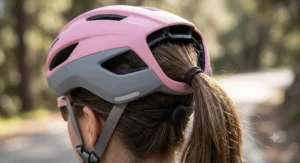
Lazer’s trick with the Sphere is refreshingly simple: instead of putting the adjustment dial at the back of your head where your ponytail lives, it sits on top, controlled by the Advanced Rollsys thumbwheel. What most buyers overlook about this design is that it doesn’t just make room for hair — it also distributes pressure more evenly around the skull, since there’s no single dial digging in at one point. The Sphere uses dropped-loop side cradles rather than a central rear dial, which is precisely the layout long-haired riders in cycling forums repeatedly recommend when asked for ponytail-friendly picks.
Weighing in at a competitive 275-280g depending on size, the Sphere isn’t the lightest helmet here, but the trade-off buys genuine one-handed micro-adjustment on the move, useful when you need to loosen things slightly for a climb. Reviewers consistently rate the ARS system as one of the smoothest fit mechanisms on the market, praising how the tension tightens symmetrically without creating hot spots. The optional Aeroshell accessory, which snaps over the vents, is a clever bit of transformation-grade thinking too — swap it in for a wet commute, swap it out for a summer sportive, and you’ve effectively bought two helmets in one shell.
Pros:
- ✅ Top-mounted dial keeps the whole rear cradle open
- ✅ Even pressure distribution avoids hot spots
- ✅ Optional Aeroshell adds rain and aero versatility
Cons:
- ❌ Aeroshell accessory sold separately at extra cost
- ❌ Slightly heavier than some direct competitors
Priced in the £110-£140 range, the Sphere is the helmet we’d point most high-ponytail riders towards first, especially if you switch between commuting and weekend club runs.
3. Kask Mojito³ WG11 — the stylish choice that still solves the ponytail problem properly
Kask built its reputation on looking good on a podium, and the Mojito³ hasn’t lost that instinct — but underneath the sleek Italian styling sits an Octo Fit retention system whose rear dial can be adjusted vertically as well as for tension, specifically to accommodate different head shapes and, yes, ponytails. Reviewers testing the helmet through autumn and winter conditions found it stayed comfortable with no hot spots developing even over extended, multi-week testing periods, and the synthetic-leather chin strap gives it a noticeably premium feel that budget helmets simply can’t match.
Here’s what to weigh up before buying: Kask’s WG11 protocol is the brand’s own safety standard, engineered to exceed EU rotational and linear impact requirements by a claimed margin, rather than relying on a licensed MIPS liner. That’s a legitimate engineering approach, but it means you’re trusting Kask’s in-house testing claims rather than the widely recognised third-party MIPS brand — worth knowing if brand-name safety tech matters to your buying decision. The helmet ventilates well, described by testers as airy even before full summer heat arrives, and the vertical dial adjustment genuinely does help when you’re switching between a low bun for commuting and a higher ponytail for a fast group ride.
Pros:
- ✅ Vertical dial adjustment tailored for ponytails
- ✅ Premium synthetic-leather strap comfort
- ✅ No reported hot spots across extended testing
Cons:
- ❌ Uses in-house WG11 tech rather than licensed MIPS
- ❌ Sits at a higher price point than similarly specced rivals
Typically found in the £100-£140 range, the Mojito³ suits riders who want their safety kit to double as a style statement without sacrificing the practical ponytail fix.
4. Specialized Echelon II MIPS — proof that Hair Port technology doesn’t need a premium price
Specialized deserves real credit here: its Hair Port system isn’t a vague marketing term, it’s a specific, height-adjustable channel built into the retention cage, with six height positions and a micro-adjustable Hair-Port system designed to be pony-tail compatible. On a helmet that regularly sells for well under £85, that’s a genuinely well-thought-out feature trickling down from Specialized’s pricier lids. The Headset SL II fit system pairs with a 4th Dimension Cooling System, and while it won’t out-vent a £280 aero helmet, it holds its own comfortably against other budget and mid-range options.
Based on the spec comparison, the standout advantage is flexibility: because the Hair Port has six discrete height settings rather than a single fixed gap, it accommodates everything from a low bun to a high, thick ponytail without you needing to buy a different helmet for each hairstyle. The Tri-Fix web splitter keeps straps away from your ears, a small detail reviewers repeatedly single out as more comfortable than the scratchy webbing found on some rival budget helmets. If there’s a genuine downside, it’s that this is an entry-to-mid helmet in Specialized’s own range, so don’t expect Aries-level ventilation or the ultra-low weight of the brand’s S-Works lids.
Pros:
- ✅ Six-position adjustable Hair Port, not just a fixed gap
- ✅ Genuinely budget-friendly for MIPS-equipped protection
- ✅ Tri-Fix straps avoid ear irritation
Cons:
- ❌ Ventilation trails behind pricier Specialized helmets
- ❌ Heavier than premium options in this guide
At £50-£85 depending on colourway and retailer stock, the Echelon II MIPS is arguably the smartest first “proper” road helmet for a new rider who’s fed up wrestling a ponytail under ill-fitting kit.
5. Lazer Tonic KinetiCore — the value pick that quietly nails ponytail comfort too
The Tonic KinetiCore is proof that Lazer’s engineering thinking on hair accommodation isn’t reserved for its premium Sphere and Genesis models. Testers with long hair reported the helmet worked with both a ponytail — threaded through the exhaust vent above the adjustment dial — and a bun, which is no small thing at this price point. Its 249g weight is genuinely impressive for a sub-£60 helmet, and that low weight isn’t achieved by skimping on safety tech: KinetiCore uses foam crumple blocks built directly into the EPS liner to manage both direct and rotational impacts, functioning as Lazer’s alternative to a bolt-on MIPS layer.
Reviewers consistently note the value proposition is hard to beat — at a similar price, rival helmets from Giro and Bell reportedly weigh more and offer less sophisticated rotational protection. The main compromise, and it’s a fair one to flag honestly, is that the vertical position of the rear cradle can only be adjusted while the helmet is off your head, so you can’t fine-tune ponytail height mid-ride the way you can with a top-mounted dial system. For most riders, that’s a one-time setup task rather than a daily annoyance.
Pros:
- ✅ Exceptional weight-to-price ratio for a MIPS-alternative helmet
- ✅ Confirmed to work with both ponytails and buns
- ✅ Eyewear docking slots hold sunglasses securely
Cons:
- ❌ Cradle height only adjustable with the helmet removed
- ❌ Fewer colour and size nuances than pricier siblings
At roughly £55-£65, the Tonic KinetiCore is our pick for anyone who wants genuine ponytail engineering without premium-helmet spending.
6. Bontrager Circuit WaveCel — the do-it-all commuter-to-club-run option
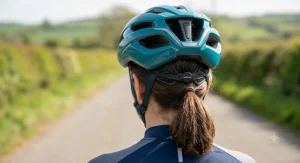
Trek’s in-house brand built the Circuit around WaveCel, a honeycomb-style collapsible structure that’s a genuine alternative to MIPS rather than a licensed version of it — it uses a large collapsible structure of gel-like walls rather than the two thin sliding layers MIPS relies on. Reviewers rated its ponytail-friendliness positively overall, though they noted adjusting the cradle height at the rear is a little fiddly compared with top-dial systems — an honest trade-off worth knowing before you buy. The BOA fit dial, borrowed from cycling shoe technology, allows quick one-handed tightening, and the magnetic Blendr mount system lets you snap on lights or a GoPro without extra straps cluttering the shell.
Here’s what to weigh up: the Circuit is heavier than most helmets in this guide, and testers found it ran warmer than expected given its vent count, largely because the dense WaveCel structure inside restricts airflow slightly more than an open MIPS liner. That said, the crash-replacement guarantee — a free replacement if the helmet takes an impact within the first year — is a genuinely useful bit of after-sale reassurance that not every brand in this list offers. For riders who commute five days a week and want one helmet that also survives Saturday’s fast group ride, the versatility argument is strong.
Pros:
- ✅ One-year crash replacement guarantee included
- ✅ Magnetic Blendr mount adds lights without extra straps
- ✅ BOA dial allows quick one-handed adjustment
Cons:
- ❌ Runs warmer and heavier than most rivals here
- ❌ Rear cradle height adjustment is fiddly mid-fit
Typically priced between £90 and £135, the Circuit WaveCel rewards riders who value all-round versatility over outright lightness or ventilation.
7. POC Omne Air MIPS — the gravel-and-road crossover with an honest caveat
POC’s Omne Air sits as the entry point to the brand’s road-helmet range, and it delivers genuinely strong ventilation credentials, with testers praising how efficiently sweat is wicked away from the eyes even on slower, sweatier climbs. The 360° fit system uses a rear dial for indexed adjustment, and — in the interest of honest analysis rather than blanket praise — reviewers found there is enough of a hole at the back of the helmet to get a ponytail through, though it might be too narrow for those with thick hair to use easily. That’s a meaningful distinction from the Giro, Lazer and Kask entries above, and worth weighing carefully if your ponytail runs on the thicker side.
What most buyers overlook is that the Omne Air’s MIPS Integra system is integrated almost invisibly into the helmet’s structure, avoiding the bulky yellow liner associated with older MIPS designs — a genuine comfort upgrade reviewers repeatedly praise. At a claimed 324-330g for a size medium, it’s on the heavier side for this price bracket, something POC attributes to the larger, more aerodynamic shell surface. The eyewear-specific ventilation ports are a nice practical touch, designed to work with POC’s own sunglasses range, though they’ll happily hold most standard cycling glasses too.
Pros:
- ✅ Excellent sweat-wicking ventilation on long climbs
- ✅ Low-profile MIPS Integra avoids bulky liner feel
- ✅ Dedicated eyewear docking ports
Cons:
- ❌ Rear ponytail gap can feel narrow for thick hair
- ❌ Heavier than most rivals at this price point
Priced around £110-£140, the Omne Air MIPS is a strong all-rounder, though riders with a genuinely thick ponytail should try one on before committing.
Practical Usage Guide: Getting The Perfect Ponytail Fit
Buying the right shell is only half the job — how you actually thread and tension your hair through it makes an enormous difference to comfort. Start by wearing your ponytail lower than you normally would; most helmet manufacturers and long-time cyclists agree that a ponytail sitting at the base of the skull, rather than high on the crown, clears the retention cradle far more cleanly and avoids the helmet perching awkwardly. During your first few rides, expect some trial and error: what works for a loose, low bun on a commute may not survive a tucked-in ponytail during a hilly sportive.
For the first 30 days with a new helmet, resist the urge to crank the retention dial as tight as it will go — over-tightening around a ponytail is one of the most common early mistakes, and it can create a genuine pressure headache within the first hour. Instead, tighten gradually until the helmet feels snug without rocking, then fine-tune the vertical cradle height (on helmets like the Kask Mojito³ or Bontrager Circuit) so your hair sits comfortably rather than being pinched. Clean the internal padding every few weeks with a damp cloth and mild soap; sweat and hair product residue build up faster in ponytail-adjacent padding than most riders expect, and a grubby pad is a common source of unexplained itching or minor breakouts along the hairline.
A useful optimisation trick that Amazon listings rarely mention: braiding a very thick ponytail into a slim, low plait before riding can dramatically improve fit on narrower-gap helmets like the POC Omne Air, without you needing to buy a different model altogether.
Real-World Scenarios: Which Helmet Suits Your Ride
Picture three different riders, each with genuinely different needs, and the “best” helmet answer changes completely for each of them. Take Priya, a 34-year-old commuting six miles each way through city traffic on a hybrid-leaning road bike. Her priority isn’t outright lightness, it’s reliability and versatility — she needs a helmet that copes with a work-appropriate ponytail in the morning and doesn’t overheat on a humid summer commute. For her budget of around £100 and daily-use frequency, the Bontrager Circuit WaveCel’s magnetic light mount and crash-replacement guarantee make genuine practical sense.
Then there’s Freya, a weekend sportive rider clocking 60-80 miles most Saturdays, training three evenings a week on quieter rural roads. She’s less price-sensitive and more focused on marginal gains — ventilation, weight, and long-ride comfort matter enormously to her, and she’s comfortable spending £250-plus if the data backs it up. The Giro Aries Spherical, with its top-tier Virginia Tech safety rating and generous ponytail clearance, is squarely built for exactly her use case. Finally, consider Bethan, a university student cycling to lectures on a tight budget, whose thick, waist-length ponytail has made every previous “unisex” helmet she’s tried genuinely painful. For her, the Specialized Echelon II’s height-adjustable Hair Port, at under £85, solves the specific problem that’s been putting her off wearing a helmet at all — which, given the safety stakes, is precisely the outcome this whole guide is trying to encourage.
Problem → Solution: Common Ponytail Helmet Frustrations
Even with the right helmet, a handful of recurring problems crop up, and each has a genuinely practical fix. If your ponytail keeps pulling the helmet backwards on your head as you ride, the likely culprit is wearing the tail too high — dropping it two or three inches lower, closer to the nape of the neck, usually solves this instantly and costs nothing. If you’re getting a sharp pressure point exactly where the retention dial meets your hair tie, try swapping a standard elastic for a flatter, fabric-covered hair tie, since the hard plastic clasps on cheap elastics are a frequent, easily fixed source of that specific pain.
Persistent scalp itching around the hairline, particularly in warmer months, is often down to padding that’s overdue a wash rather than a fundamentally bad helmet fit — most manufacturers’ pads are removable and machine-washable, and reviewers across multiple brands note this simple maintenance step resolves the majority of comfort complaints filed within the first month of ownership. And if your ponytail simply won’t thread through a narrower-gap helmet like the Omne Air comfortably, don’t force it: a low, tightly wound bun, rather than a swinging tail, is a genuinely comfortable workaround that several reviewers with thick hair specifically recommend for that model.
✨ Don’t Miss These Exclusive Deals!
🔍 Take your road cycling helmet search to the next level with these carefully researched picks. Click on any highlighted model to check current pricing and availability on amazon.co.uk. The right helmet means comfortable, protected rides your ponytail will actually thank you for!

How To Choose A Road Cycling Helmet For Women With Ponytail
Choosing the right helmet comes down to working through a handful of criteria in order, rather than being seduced by the flashiest colourway on the shelf.
- Measure your head properly first. Wrap a soft tape measure around your head roughly two finger-widths above your eyebrows, with your hair styled the way you’ll actually ride, since this affects the true circumference more than most buyers expect.
- Identify your ponytail height and thickness. A helmet that suits a low, thin ponytail may frustrate a rider with a high, thick one — check reviews specifically for hair compatibility rather than general fit comments.
- Prioritise the retention system type. Top-mounted dials (Lazer Sphere) generally clear more space than rear-centre dials; height-adjustable cradles (Kask, Specialized) offer flexibility across different hairstyles.
- Decide your safety-tech preference. MIPS, WaveCel and KinetiCore all aim to reduce rotational impact forces, but they’re engineered differently — none is objectively “wrong,” but it’s worth understanding what you’re paying for.
- Set a realistic budget band. As this guide shows, genuinely good ponytail engineering exists from around £60 upwards; you don’t need to spend £280 to solve the hair problem specifically.
- Check ventilation for your typical ride length. Short commutes tolerate less airflow than three-hour sportives, where an under-vented helmet becomes genuinely uncomfortable.
- Try before you commit where possible. Reviewers across every brand in this guide stress that fit varies by head shape far more than by brand reputation, so an in-store trial, even briefly, beats guessing from a size chart alone. For a deeper technical dive into fit, ventilation and safety-tech testing across the wider market, Cycling Weekly’s road helmet buyer’s guide is a useful independent reference point.
What Is A Ponytail Port Helmet Design?
A ponytail port is a purpose-built gap, channel or height-adjustable opening in a helmet’s rear retention cradle, engineered specifically to let long hair pass through cleanly rather than bunch up underneath the shell. Rather than being a single universal feature, ponytail port helmet design varies meaningfully between brands: Specialized’s Hair Port uses a multi-position adjustable channel, while Lazer’s ARS system relocates the entire dial to the top of the head, sidestepping the rear-cradle problem altogether.
What most buyers overlook is that the quality of a ponytail port isn’t just about the size of the gap — it’s about whether the retention system still applies even, secure pressure once your hair is threaded through it. A wide gap paired with a wobbly cradle isn’t actually much of an improvement over no port at all, since the helmet can still shift during a ride. The best-executed examples in this guide, the Giro Aries and Lazer Sphere in particular, combine generous clearance with genuinely stable retention, which is really the whole point of the design.
Bike Helmet Ponytail Compatible: Features That Actually Matter (And Those That Don’t)
Marketing copy loves throwing around the phrase “ponytail compatible,” but not every feature contributing to that claim carries equal weight. What genuinely matters: the physical size and shape of the rear gap, whether the adjustment dial sits at the back-centre or elsewhere, and whether the cradle height itself can be adjusted independently of tension. These three factors, taken together, determine whether a helmet actually accommodates your specific hairstyle or just claims to on the box.
What matters far less than marketing suggests: the number of vents alone (more vents doesn’t automatically mean better ponytail clearance), and flashy colourways, which have precisely zero bearing on fit. Reviewers consistently note that some heavily marketed “women’s specific” helmets differ from unisex versions only in colour options and slightly smaller size ranges, with no meaningful change to the retention system itself — so don’t assume a helmet is more ponytail-friendly purely because it’s labelled and packaged for women. Read the specific retention-system description, not the branding, before you buy.
Women’s Helmet Ponytail Port Road Cycling vs Unisex Helmets
There’s a persistent myth that “women’s” road helmets are fundamentally engineered differently from unisex ones, and it’s worth untangling honestly. In most cases, the core shell, EPS foam and safety technology are identical across a brand’s men’s, women’s and unisex lines — the genuine differences tend to be smaller size ranges, different colourways, and sometimes marginally slimmer padding. What actually varies meaningfully for ponytail compatibility isn’t the “women’s” label at all, it’s the specific retention system fitted to that model, which any unisex helmet with a ponytail-friendly cradle will handle just as well.
| Comparison Point | “Women’s Specific” Helmets | Unisex Helmets With Ponytail Ports |
|---|---|---|
| Core safety tech | Usually identical to men’s/unisex equivalent | Identical |
| Ponytail accommodation | Depends entirely on retention system, not gender label | Same — depends on retention system |
| Size range available | Sometimes narrower | Often broader, more head-shape options |
| Colour/style options | Typically more feminine-leaning | Broader unisex palette |
| Best For | Riders who prioritise style-specific colourways | Riders prioritising the widest fit choice |
The analysis here is straightforward: don’t shop by gender label, shop by retention-system design. A unisex Lazer Sphere or Giro Aries will handle your ponytail exactly as well as, if not better than, a “women’s specific” helmet lacking a proper ponytail port, simply because the engineering that solves the hair problem isn’t gender-exclusive technology in the first place.
Best Cycling Helmet Ponytail Fit: Common Mistakes When Buying
The single most common mistake buyers make is choosing a helmet size based purely on the manufacturer’s chart without accounting for how their hairstyle changes the effective fit. A head that measures 56cm bare might genuinely need a size up once a thick, wound ponytail is threaded through the cradle, and skipping this consideration leads directly to the “why doesn’t this fit like the reviews said it would” frustration reviewers flag repeatedly.
A second frequent error is assuming all MIPS-branded helmets handle hair identically — as this guide has shown, the Giro Aries and POC Omne Air both use rotational-impact technology, yet their actual rear-gap generosity differs substantially. A third mistake, and a genuinely costly one, is buying based on colour or aesthetic alone and skipping the retention-system research entirely; several riders in aggregated review threads report returning a beautifully styled helmet within weeks purely because it made their ponytail unbearable on longer rides. Finally, don’t underestimate the padding-wash mistake covered earlier — buyers sometimes assume a helmet “doesn’t fit” when the real issue is simply overdue maintenance.
Road Helmet Women’s Fit Guide: Sizing And Retention Explained
Getting sizing right starts with an accurate head measurement, taken with your hair in its usual riding style, since — as covered above — this can shift which size is genuinely correct. Beyond raw circumference, head shape matters enormously: some brands’ internal moulds suit rounder heads, others suit more oval shapes, and a helmet that measures “correctly” on paper can still feel wrong once it’s actually on. If a helmet doesn’t sit right, reviewers across multiple brands consistently recommend trying a different manufacturer entirely rather than assuming a bigger or smaller size within the same brand will fix things, since every brand’s internal shell shape differs.
Once sized correctly, retention adjustment should tighten gradually, checking for rocking motion by shaking your head gently side to side and front to back — a properly fitted helmet shouldn’t shift independently of your skull. For ponytail wearers specifically, adjust the vertical cradle height (where available) before tightening the circumference dial, since doing it in the opposite order often results in a helmet that’s technically snug but sitting at an uncomfortable, too-high angle because the ponytail is fighting the cradle position.
Cycling Helmet For Long Hair: Safety, Regulations & Compliance
In the UK, helmet safety compliance runs through the EN 1078 standard, which every helmet legally sold here must meet to carry the CE mark (with UKCA gradually being introduced alongside it). Beyond that baseline, technologies like MIPS, developed by specialists at Sweden’s KTH Royal Institute of Technology and a brain surgeon at the Karolinska Institute in 1996, aim to reduce the rotational motion that can increase the risk of brain injury during angled impacts, and independent bodies such as Virginia Tech and the UK’s Road Safety Trust conduct additional testing beyond the legal minimum, which is genuinely useful information when comparing helmets that all technically “pass.”
Importantly, wearing a helmet isn’t a legal requirement for cyclists in the UK — it’s guidance, not law — but that guidance matters practically, since long hair specifically increases the risk of a helmet sitting incorrectly if the retention system isn’t built to accommodate it. Independent cycle helmet testing carried out for the Road Safety Trust has found that good safety performance doesn’t necessarily require a high price tag, which is reassuring for anyone assuming a genuinely safe, ponytail-friendly helmet has to cost hundreds of pounds. What matters for long-haired riders specifically is ensuring the helmet stays correctly and securely positioned throughout a ride, not just when it’s first put on — which is precisely why the ponytail-port quality assessed throughout this guide is a genuine safety consideration, not merely a comfort one.
Women Specific Helmet Retention: Long-Term Cost & Maintenance
Thinking beyond the initial purchase price paints a fuller value picture. A £60 Lazer Tonic will likely need replacing sooner than a £280 Giro Aries if you’re riding daily in all weather, since UV exposure and general wear degrade EPS foam over roughly three to five years regardless of price point — but the Tonic’s lower upfront cost still often works out more affordable across a five-year window unless you’re logging genuinely high annual mileage where the Aries’s superior ventilation and comfort reduce the temptation to skip rides. Replacement padding sets, typically £10-£20, extend a helmet’s comfortable lifespan considerably and are a far cheaper fix than buying a whole new lid when the original pads simply wear thin.
Crash-replacement schemes, like Bontrager’s, add genuine long-term value that’s easy to overlook at the point of sale — a free or heavily discounted replacement after an impact within the first year effectively lowers your real cost of ownership if you’re an accident-prone or high-mileage rider. Total cost of ownership, then, isn’t just the sticker price: factor in expected riding frequency, whether your chosen brand offers a crash-replacement guarantee, and how readily replacement pads are stocked before deciding which of these seven genuinely represents the smartest long-term spend for your specific riding pattern.

Frequently Asked Questions
❓ Do all road helmets fit a ponytail?
❓ What is the best helmet for a thick ponytail?
❓ Are women's specific helmets better for ponytails than unisex ones?
❓ How tight should a road cycling helmet be with a ponytail?
❓ Can I wear a bun instead of a ponytail with these helmets?
Conclusion
Finding a genuinely comfortable road cycling helmet for women with ponytail needs shouldn’t require the trial-and-error frustration so many riders describe in review threads. As this guide has shown, real ponytail engineering exists across every price band — from the budget-friendly, height-adjustable Hair Port on the Specialized Echelon II, right through to the Giro Aries Spherical’s class-leading clearance and safety credentials. The common thread across every genuinely good option is that the brand treated hair accommodation as a real design problem, not an afterthought bolted on for the marketing copy.
Whichever of these seven you land on, prioritise trying the retention system with your actual, real-world ponytail before committing, and remember that price alone doesn’t guarantee ponytail compatibility — some of the smartest engineering here sits well under £100. Ride safely, ride comfortably, and let your hair do its thing without a fight.
Recommended for You
- Women’s Road Cycling Helmet: 7 Best MIPS Picks for 2026
- Road Cycling Helmet for Commuting: 7 Best Picks for UK Riders 2026
- Best Budget Road Cycling Helmets with MIPS UK 2026: Top 7 Picks
Disclaimer: This article contains affiliate links. As an Amazon Associate, I earn from qualifying purchases. If you purchase products through these links, we may earn a small commission at no additional cost to you.
✨ Found this helpful? Share it with your friends! 💬🤗
