In This Article
Picture mile 40 of a lovely Sunday ride. The sun’s out, your legs feel good, the playlist is on a roll. Then a pins-and-needles fizz creeps in somewhere it really shouldn’t. Welcome to the club nobody wants to join. The good news is that choosing the right saddle for numbness cycling is one of the most effective fixes available. It doesn’t involve quitting the sport or riding out of the saddle like a startled meerkat.

Numbness isn’t a badge of honour. It’s a signal that soft tissue, nerves and blood vessels in the perineum are being squashed for longer than they’d like. A recent cross-sectional study mapped saddle pressure on 20 young off-road cyclists. It found that in male riders, pressure in the pubic region rose as pedalling intensity increased. In plain English, the harder you ride, the more your saddle matters.
This guide covers seven genuinely different options, from short-nosed budget channels to deeply engineered premium shapes. Along the way we’ll untangle pressure relief cut-outs, which aren’t magic and have more mixed evidence than the marketing suggests. We’ll also explain saddle pressure mapping, and look at what to choose if you need a saddle for lower back pain cycling or a saddle for long-distance road cycling. Perineal comfort stays front and centre throughout, because that’s the real goal.
A quick note on method. Everything here is built from manufacturer specifications, published reviews and aggregated retailer feedback, not personal testing. Treat it as a well-researched shortlist rather than a lab result.
What Is a Saddle for Numbness Cycling?
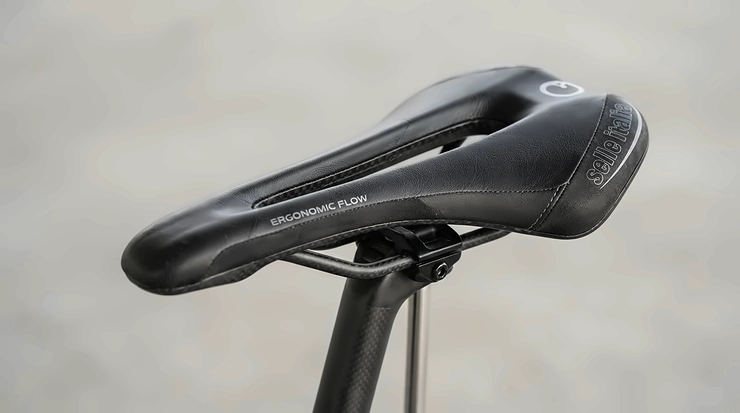
A saddle for numbness cycling is a bike saddle shaped to reduce pressure on the perineum, the soft area between your sit bones. It typically combines the correct width for your sit bones, a pressure relief channel or cut-out, a supportive shell and a shorter or dipped nose, so weight lands on bone rather than on nerves and blood vessels.
That definition hides a crucial point: no single feature does the job alone. A beautifully carved channel on a saddle that’s too narrow simply moves the problem to the edges of the channel. A pillowy, gel-stuffed saddle can make things worse because your sit bones sink through the foam and your soft tissue takes the load.
Think of it like a hammock versus a bench. A well-fitted saddle gives your sit bones a firm place to sit while the middle stays out of the firing line. Width, shape, tilt and riding position all work as a team, and the saddle is only one player. Many riders who “fix” numbness with a new saddle have, without realising it, also fixed their saddle angle or height during the swap. That’s no bad thing, but it explains why two riders can rave about opposite saddles.
Most numbness advice boils down to three questions. Does the saddle match your sit-bone width? Does it suit how far you rotate your pelvis forward? Does it offload the centre without creating hard edges? The seven picks below answer those questions in different ways.
Quick Comparison: 7 Saddles for Numbness at a Glance
| Saddle | Best For | Width Options | Relief Design | Indicative Price Range* |
|---|---|---|---|---|
| Selle Italia Novus Boost Evo Superflow | Budget-conscious road riders | Several sizes (145mm reviewed) | Full-length Superflow channel | £60–£110 |
| Ergon SR Allroad Core Comp | Road and gravel all-rounders | Multiple sizes (check chart) | Central recess, damped core | £80–£110 |
| Ergon SM Pro Men | Gravel, MTB and firm-seat fans | 144mm / 160mm | Deep rearward channel plus cut-out | £85–£115 |
| Specialized Power Arc Expert | Aggressive positions, short-nose fans | 143mm / 155mm | Wide, elongated channel | £110–£150 |
| Selle SMP Dynamic | Long, low rides; those who’ve tried everything | 138mm (fits roughly 116–150mm sit bones) | Huge open channel, dropped nose | £150–£220 |
| SQlab 612 Ergowave Active | Riders with numbness and back niggles | Roughly 120–150mm (varies) | Stepped profile plus flex | £130–£200 |
| Brooks Cambium C17 Carved All Weather | Touring, commuting, bikepacking | Around 162mm (C17) | Single cut-out | £100–£140 |
*Indicative ranges at the time of research; prices vary by size, rails and seller. Check current price on amazon.co.uk.
Looking at the table above, the Selle Italia Novus Boost Evo Superflow is the gentlest, cheapest way into a channel design. The SQlab 612 Ergowave Active and Selle SMP Dynamic sit at the premium end, where the shapes get more unconventional and the fitting matters more. If you ride upright or tour with luggage, the Brooks Cambium C17 Carved All Weather trades weight for all-day, all-weather comfort that the racier options can’t match.
💬 Just one click — help others make better buying decisions too!😊
Top 7 Picks if You Need a Saddle for Numbness Cycling: Expert Analysis
Each pick below is judged on what it does for perineal comfort, who it suits, and where it falls short. Availability on amazon.co.uk varies by size and seller, so confirm the width before you buy.
1. Selle Italia Novus Boost Evo Superflow — short nose, big channel, sensible money
The standout is a compact 245mm length paired with a broad, full-length Superflow channel. BikeRadar’s reviewer, with sit bones measured at 147mm, found the 145mm version spot-on, and the saddle weighed around 247g. In practice, the short nose lets you tip forward on the hoods without the tip prodding tissue. The wave profile, with a dip through the middle and a kick at the rear, cradles your sit bones and stops you sliding about.
Selle Italia says waved shapes suit static riders or those with posterior pelvic tilt. If you sit rather than perch, this is your shape. Remember Selle Italia’s numbering: the “3” in S3 or L3 denotes the largest Superflow opening, while “1” means no hole at all.
Reviewers praise the comfort and build for the money. The main gripe is that the rear slots measure only 40 x 5mm, which can complicate fitting some saddle bags.
Pros:
- ✅ Large channel at a friendly price
- ✅ Light for the money, around 247g
- ✅ Wave shape stabilises sit-bone position
Cons:
- ❌ Narrow rear slots limit saddle-bag options
- ❌ Short nose takes some setup adjustment
Expect a budget-to-mid-range price, indicatively £60–£110. For a first channel saddle, the value is hard to argue with.

2. Ergon SR Allroad Core Comp — firm, vibration-damping road and gravel all-rounder
The headline here is the “Core” construction: a damping layer under the shell designed to take the sting out of rough surfaces. A central recess takes care of perineal pressure, and the smooth flanks reduce thigh rub. The flat top spreads load across the sit-bone zone instead of letting you sink in.
Ergon’s higher-spec versions claim to reduce stress transmitted to the lower back. That’s a manufacturer claim, but vibration damping is plausible on chip-seal lanes and gravel. This is the sensible shortlist entry for riders switching between road and gravel who want one saddle.
Review evidence is thin for the Comp specifically. One retailer reviewer called it comfortable and supportive after fitting it to a gravel bike. A published review of the higher-spec Pro, which shares the same profile and channel, was warmly positive about its firm yet supportive feel. The retailer listing flags that it’s “reasonably heavy”, which is the price of the cheaper nylon shell and CroMo rails.
Pros:
- ✅ Central recess plus damped core
- ✅ Suits both road and gravel
- ✅ Smooth flanks reduce thigh chafing
Cons:
- ❌ Heavier than the Pro and Carbon versions
- ❌ Few verifiable user reviews for this version
A realistic range is around £80–£110. It’s a solid mid-range buy for mixed-surface riders.
3. Ergon SM Pro Men — deepest relief channel in the group
The standout is a pronounced relief channel that deepens towards the rear and finishes in a proper opening through the shell. OutdoorGearLab’s testers noticed no pressure points from the channel edges, which is the classic cut-out failure. They also called it a tester favourite for pressure relief. At 235g it’s light.
It’s available in two widths, 144mm (S/M, for 9–12cm sit bones) and 160mm (M/L, for 12–16cm). Note the 12cm overlap: if you’re at the boundary, getting measured matters more than usual. A women’s version exists, so check the correct model.
The catch is that reviewers tested it as a mountain bike saddle, so road-specific verdicts are thin. A retailer reviewer praised it but urged buyers to know their sit-bone width. One shop reviewer reported cover cracking, which is a single data point rather than a trend.
Pros:
- ✅ Deep channel with smooth, hard-edge-free finish
- ✅ Light at roughly 235g
- ✅ Two clear sizes with published sit-bone ranges
Cons:
- ❌ Designed for MTB, so road feedback is limited
- ❌ Overlapping size ranges can confuse buyers
Indicatively, expect £85–£115. It’s superb value if your riding is gravel, off-road or relaxed endurance.
4. Specialized Power Arc Expert — shortened nose, wide elongated channel
The big idea is a shorter-than-usual nose paired with an extra-wide, elongated channel. Specialized says it was developed through blood-flow testing and pressure mapping. Treat that as a brand claim, but the shape logic is sound: less nose to bruise you when you’re rolled forward.
It comes in 143mm and 155mm widths (some listings show larger), with a stiff composite shell, Level Two PU padding and hollow titanium rails. The Power Arc is less flared than the original Power, so it suits riders who liked the older Romin shape. If you pedal in a low, aggressive position, the short nose is the point.
Reviewer sentiment is encouraging but with caveats. Competitive Cyclist reviewers say it’s a refinement of the original Power. One retailer reviewer reported no more numbness after several rides. BikeRadar’s earlier Power review found even the Expert’s padding quite firm, so don’t expect plushness.
Pros:
- ✅ Wide, elongated channel
- ✅ Short nose suits aggressive positions
- ✅ Durable hollow titanium rails
Cons:
- ❌ Firm padding takes adjustment
- ❌ Short shape needs careful setback fine-tuning
Expect roughly £110–£150. It’s a premium-leaning purchase that rewards correct sizing.
5. Selle SMP Dynamic — radical drop-nose and a huge central channel
Love it or hate it, the Selle SMP Dynamic is memorable: a big open channel, a beak-like dropped nose and a kicked-up rear. At 138mm wide and about 274mm long, it fits sit bones between roughly 116mm and 150mm. Weight is quoted at around 270–290g depending on source.
The design flattens your rolled-forward position so you sit on the base rather than the nose. Reviewers describe a steep learning curve. BikeRadar’s tester was sceptical, found the first rides mixed, and said it only started making sense after several successive long rides. They also noted the kicked-up tail helps on climbs. Road.cc found minimal padding and a firm base great for performance riding. A UK fitting studio, Cyclefit, describes SMP pressure maps as among the best it sees, though bear in mind it also sells and fits them.
Pros:
- ✅ Very large channel for soft-tissue relief
- ✅ Raised tail aids climbing support
- ✅ Wide sit-bone range coverage
Cons:
- ❌ Divisive shape needs a patient adaptation period
- ❌ Minimal padding is unforgiving on rough roads
Indicatively around £150–£220. It’s an investment, best bought if you’ve exhausted conventional shapes.
6. SQlab 612 Ergowave Active — tunable flex for numbness and niggly backs
SQlab’s Ergowave profile rises at the rear, dips, then flattens at the front. The company developed it with Frankfurt’s University Hospital and Frankfurt University of Applied Sciences. The “Active” part adds interchangeable rubber elastomers that let the saddle rock slightly with your pedalling. The 612 is the road version, with a slimmer, shorter nose and firmer, thinner padding than the 611 mountain bike model.
Reviewers describe it positively. One said they stopped noticing sit-bone pressure and called it welcome for riders struggling with perennial numbness. Another reviewer (testing the sister 611 Active) found the tuneable flex helped alleviate lower back pain once they chose the right elastomer. SQlab recommends setting it slightly forward of your old saddle so you sit “in” the rear section.
Pros:
- ✅ Rear flex adjustable via three elastomer hardnesses
- ✅ Stepped shape developed with university research
- ✅ Good pressure spread across the sit bones
Cons:
- ❌ Premium pricing
- ❌ Narrowest widths may not suit very narrow sit bones
Expect around £130–£200 depending on rails. It’s expensive, but the best-built case for a saddle serving both perineal comfort and back relief.
7. Brooks Cambium C17 Carved All Weather — rubber hammock with a cut-out for long, mixed-weather rides
The standout is a vulcanised natural-rubber top that flexes like a leather Brooks without the break-in period. A single cut-out adds pressure relief and extra flex. It measures around 162mm wide on retailer listings. Weight is quoted between roughly 400g and 446g, so it’s no racer, but steel rails and a nylon cover make it nearly weatherproof.
It suits upright-to-moderately-angled riding: touring, commuting, gravel and bikepacking. REI’s page shows 15 of 18 reviewers recommending it, and a desertcart reviewer said the cut-out resolved their numbness. A critical reviewer wrote that it “fits your bum or not at all”, and a bike-components reviewer found it harder and less supple than the uncut C17. Brooks width variants differ, so check carefully.
Pros:
- ✅ No break-in and weatherproof rubber top
- ✅ Single cut-out relieves perineal pressure
- ✅ Great for touring and commuting loads
Cons:
- ❌ Heavy for road racing use
- ❌ Fit is hit-or-miss across riders
Indicatively around £100–£140. For tourers and commuters, it’s good value.
How to Choose a Saddle for Numbness Cycling
Choosing well is mostly process, not luck. Work through these steps in order.
- Measure your sit-bone width. Width is the single biggest lever. Too narrow and your weight slides inward onto soft tissue. Use a shop’s gel-pad measuring device or a DIY cardboard imprint, then add the manufacturer’s recommended allowance.
- Match your riding position. Rolled-forward, aggressive riders generally want shorter noses and flatter shapes. Upright riders need more width and rear support.
- Pick a relief design. A full-length channel, a cut-out or a short nose each handles pressure differently, so choose the one matching your position.
- Prefer firm, supportive foam over plush gel. Thick soft padding lets sit bones sink through, loading the middle. Moderate density wins on longer rides.
- Start with a neutral to slightly nose-down tilt. Many fit guides suggest roughly 1–3° nose-down as a starting point, then adjust in tiny steps.
- Give it two to four weeks. Your body needs adaptation time. Change one variable per ride so you can tell what helped.
- Check returns before you buy. Saddles are personal. Confirm the seller’s returns policy on the listing.
Following this process matters more than brand loyalty. A mid-priced saddle in the right width beats a premium one in the wrong size every time.
Pressure Relief Cut-Outs: Do They Actually Work?
Pressure relief cut-outs look like obvious winners: remove material where the nerves are and pressure vanishes. Reality is messier. A study of 48 competitive female cyclists found that riders on cut-out saddles had on average a 4 kPa higher mean perineal pressure and 11 kPa higher peak perineal pressure than those on traditional saddles. The authors concluded that cut-out and narrower saddles negatively affected pressures in women. Saddle width was significantly associated with several pressure measures.
One proposed explanation is edge loading: forces concentrate along the edges of the opening and transfer back to the perineal area, while the reduced surface area raises overall pressure. Sports Performance Bulletin’s summary of related research adds that a wider saddle often spread the load better than extra padding, and that riders’ comfort ratings didn’t always match measured pressures. On the other side, the recent off-road study notes earlier research in male cyclists found partial cut-outs or noseless saddles reduced perineal pressure.
| Feature | Pressure Relief Cut-Outs | Conventional Padded Saddle | Best For |
|---|---|---|---|
| Central pressure | Removes midline support | Supports centre, may compress it | Riders with persistent central numbness |
| Edge risk | Hard edges can load tissue if poorly shaped | No edge, but pressure is continuous | Cut-out buyers should seek smooth, deep channels like Ergon SM Pro Men |
| Width sensitivity | Very high | High | Everyone, so measure first |
| Typical example | Selle SMP Dynamic | Standard flat-top shapes | Match to your position |
The sensible reading is that pressure relief cut-outs help when they’re well-shaped and your width is correct. They fail when they’re treated as a substitute for fit. If a cut-out saddle leaves you worse off, it’s not you, it’s the geometry. Try a wider shape or a different relief style before giving up.
Saddle Pressure Mapping: What It Reveals
Saddle pressure mapping uses a thin sensor mat laid over your saddle while you pedal, showing a live heat map of where load concentrates. In the off-road study mentioned earlier, researchers used a Bluetooth mat with 68 resistive sensors. Fit studios use similar kit. UK studio Cyclefit says its system, developed by GebioMized, can reveal pressure hot spots, left–right instability and forward–backward movement that you’d otherwise only discover as saddle sores.
What does that mean for your wallet? A mapping session is worth considering if you’ve cycled through two or three saddles without success. It tells you whether pressure sits under the sit bones, where it should, or creeps towards the front. Two cautions, though. First, comfort ratings and pressure readings don’t always agree, so use mapping alongside how the saddle actually feels. Second, mapping a static trainer ride isn’t the same as hour three on a rough lane.
If you can’t book a session, you can still borrow the logic. Chalk or talc on the saddle shows where you rub. Notice whether numbness arrives when you rotate forward onto the hoods or the drops. That points towards nose pressure, which is the target of short-nosed designs like the Specialized Power Arc Expert and the Selle Italia Novus Boost Evo Superflow.
Saddle for Lower Back Pain Cycling: What to Consider
A saddle for lower back pain cycling can’t cure a back problem, but the wrong saddle can aggravate one. If your pelvis rolls backwards on a flat saddle, your lumbar spine rounds and the lower back works overtime. If your pelvis is tipped too far forward, you load the front of the saddle and numbness shows up.
Design features that may help include a supportive, curved rear for your pelvis to lean against, some vibration damping, and sometimes controlled flex. The SQlab 612 Ergowave Active offers tuneable flex, and a reviewer of its mountain bike sibling reported the right elastomer helped their lower back. Selle Italia describes waved shapes as suiting posterior pelvic tilt, which applies to the Selle Italia Novus Boost Evo Superflow. The Ergon SR Allroad Core Comp uses a damped core to take the buzz out of rough surfaces, and the Selle SMP Dynamic has a raised tail that gives your pelvis something to push against when climbing.
Flexibility matters too. A small study of 15 young cyclists, reported by Sports Performance Bulletin, found that better hamstring and lower-back flexibility correlated with lower pressure at the front of the saddle. The sample is small, but it hints that stretching might help as much as shopping. If back pain persists, see your GP or a physiotherapist rather than relying on equipment alone.
Saddle for Long-Distance Road Cycling: Why Hour Three Changes Everything
A saddle for long-distance road cycling is judged very differently from one for a 45-minute spin. Early comfort is easy; late comfort is the test. Soft padding feels lovely at mile five and treacherous at mile 80, when your sit bones have sunk through it and the middle is carrying weight.
For long road days, prioritise a supportive shell, moderate padding, correct width and a relief design that suits how you sit. Endurance versions of familiar shapes can be useful. Selle Italia, for example, offers an Endurance variant of the Novus with extra padding and light gel, though that’s a different model from the Selle Italia Novus Boost Evo Superflow reviewed here. The Specialized Power Arc Expert suits fast, low riding, while the Selle SMP Dynamic targets long days in an aggressive position. If you’re touring with luggage and mixed weather, the Brooks Cambium C17 Carved All Weather is the pragmatic choice.
Whatever you buy, get off the saddle regularly. Standing for a short spell every 10–15 minutes is commonly recommended to reduce cumulative pressure. It costs you almost no speed and buys real protection.
Setup Guide: Dial In Perineal Comfort in 30 Days
Perineal comfort is partly about the saddle and partly about how you set it up. Here’s a practical month-long approach.
Week 1: Baseline. Install the saddle level, using a spirit level or phone app, and keep saddle height and setback exactly as before. Ride short and moderate routes. Note where pressure appears and when.
Week 2: Tilt. If you feel nose pressure, tilt a degree or two nose-down. If you slide forward, level it again. Change only one thing at a time and make millimetre-level moves.
Week 3: Height and position. A saddle that’s too high makes your pelvis rock side to side, which can intensify pressure. If your hips sway, drop it slightly. SQlab, for example, suggests setting its saddles slightly forward of your old one.
Week 4: Longer ride test. Complete a ride at least as long as your usual long ride. If numbness disappears, you’ve nailed it. If it persists, consider a width change.
Maintenance matters as well. Check clamp bolts monthly, wipe the cover after wet rides, and inspect shell and rails for cracks. A saddle that creaks or sags can quietly ruin your angle.
Real-World Scenarios: Which Saddle for Which Rider?
The weekday commuter. You ride eight miles each way on a hybrid, five days a week, in all weathers, upright, on a modest budget. The Brooks Cambium C17 Carved All Weather is built for this: weatherproof, no break-in, with a cut-out for relief. If you also ride rough towpaths, the Ergon SR Allroad Core Comp is a strong alternative.
The weekend club rider. You cover 60–100 miles on Saturdays and Sundays, rolled-forward, on smooth tarmac. A short-nose design suits that posture. The Specialized Power Arc Expert is built for aggressive positions, while the Selle Italia Novus Boost Evo Superflow offers a similar short-nose philosophy for less.
The gravel bikepacker with a cranky back. Three days of mixed surfaces, heavy bags, and lower back complaints. The SQlab 612 Ergowave Active or the Ergon SM Pro Men make sense: the first for tuneable flex, the second for a deep channel and light weight.
The “I’ve tried everything” rider. If conventional saddles keep failing, the Selle SMP Dynamic is the left-field option. Book a fitting or use a try-before-you-buy scheme if possible.
Problem → Solution Guide
Problem: numbness after 30 minutes. Likely a width or nose-pressure issue. Re-measure your sit bones, then try a slight nose-down tilt or a short-nose design such as the Specialized Power Arc Expert.
Problem: sit-bone soreness after switching to a firmer saddle. This is normal for the first few rides as your body adapts. If it persists after a few weeks, you may be too narrow.
Problem: you slide forward constantly. Level the saddle, then check height. A wave profile, as on the Selle Italia Novus Boost Evo Superflow, can help you stay planted.
Problem: numbness only on the drops. You’re rotating forward more, loading the nose. A shorter nose or lower-reach position may fix it.
Problem: numbness lasting hours after a ride, or getting worse. Stop and see your GP. This isn’t a “buy another saddle” situation, and persistent or recurrent numbness deserves proper medical advice.
Common Mistakes When Buying a Saddle for Numbness Cycling
The most common error is buying on looks or padding. Thick, soft saddles feel wonderful in the shop and let you sink through on the road. Second, ignoring width: choosing by brand rather than by sit-bone measurement. Third, assuming a cut-out is automatically better. As the female-cyclist study shows, narrow or poorly shaped cut-outs can raise pressure.
Fourth, not allowing an adaptation period. Your body needs time to adjust, so judge a new saddle over several weeks, not one ride. Fifth, changing several variables at once. Swap the saddle, then adjust height, then tilt, otherwise you’ll never know what worked. Finally, treating persistent numbness as normal. It isn’t. Numbness that outlasts the ride deserves a conversation with a clinician, and no saddle should be asked to solve a medical problem.
Price Range & Value Analysis
| Tier | Examples | Indicative Range | Best For |
|---|---|---|---|
| Budget | Selle Italia Novus Boost Evo Superflow | £60–£110 | First-time channel buyers |
| Mid-range | Ergon SR Allroad Core Comp, Ergon SM Pro Men, Brooks Cambium C17 Carved All Weather | £80–£140 | Gravel, touring, mixed-surface riders |
| Premium | Specialized Power Arc Expert, Selle SMP Dynamic, SQlab 612 Ergowave Active | £110–£220 | Riders needing a specialist shape |
The table above shows a fairly narrow gap between budget and mid-range, so don’t assume more money equals more comfort. A saddle in the wrong width at £200 is worse than a well-matched £80 one. Premium options earn their price mainly through fit-tuning features and refined shells.
Think in cost per ride. A saddle costing around £120 used for 150 rides a year over three years works out to roughly 27p per ride. Seen that way, spending a bit more on something that keeps you riding pain-free is excellent value. Factor in return policies, too, because a saddle that doesn’t suit you has a hidden cost.

FAQ
❓ How long does a new saddle take to feel right?
❓ Do padded cycling shorts fix numbness on their own?
❓ Is a noseless or very short-nose saddle worth trying?
❓ Can I return a saddle if it doesn't suit me?
❓ When should I see a GP about cycling numbness?
Conclusion
Finding the right saddle for numbness cycling comes down to respecting a few unglamorous truths. Width beats padding. Position and tilt matter as much as the saddle. And pressure relief cut-outs help only when they’re well shaped and sized for you. The evidence, from studies on women cyclists to off-road pressure mapping, says there’s no universal winner, only a good match.
If you want a low-risk starting point, the Selle Italia Novus Boost Evo Superflow is the budget-friendly entry. Gravel and mixed-surface riders should look at the Ergon SR Allroad Core Comp or Ergon SM Pro Men. Aggressive road riders have the Specialized Power Arc Expert, and anyone who’s exhausted conventional shapes might try the Selle SMP Dynamic or the back-friendly SQlab 612 Ergowave Active. Tourers and commuters will find the Brooks Cambium C17 Carved All Weather a dependable all-weather option.
Measure your sit bones, change one variable at a time, and be patient. If numbness persists, take it seriously and speak to your GP. Your ride should end with a smile, not a tingle.
Recommended for You
- Road Bike Saddles: 7 Best Comfy Picks For UK Riders (2026)
- Look Keo Cleats For Racing: 7 Proven Picks Under £25 (2026)
- Best Look Keo Cleats: 7 Top Picks Ranked For 2026
Disclaimer: This article contains affiliate links. As an Amazon Associate, I earn from qualifying purchases. If you purchase products through these links, we may earn a small commission at no additional cost to you.
✨ Found this helpful? Share it with your friends! 💬🤗
